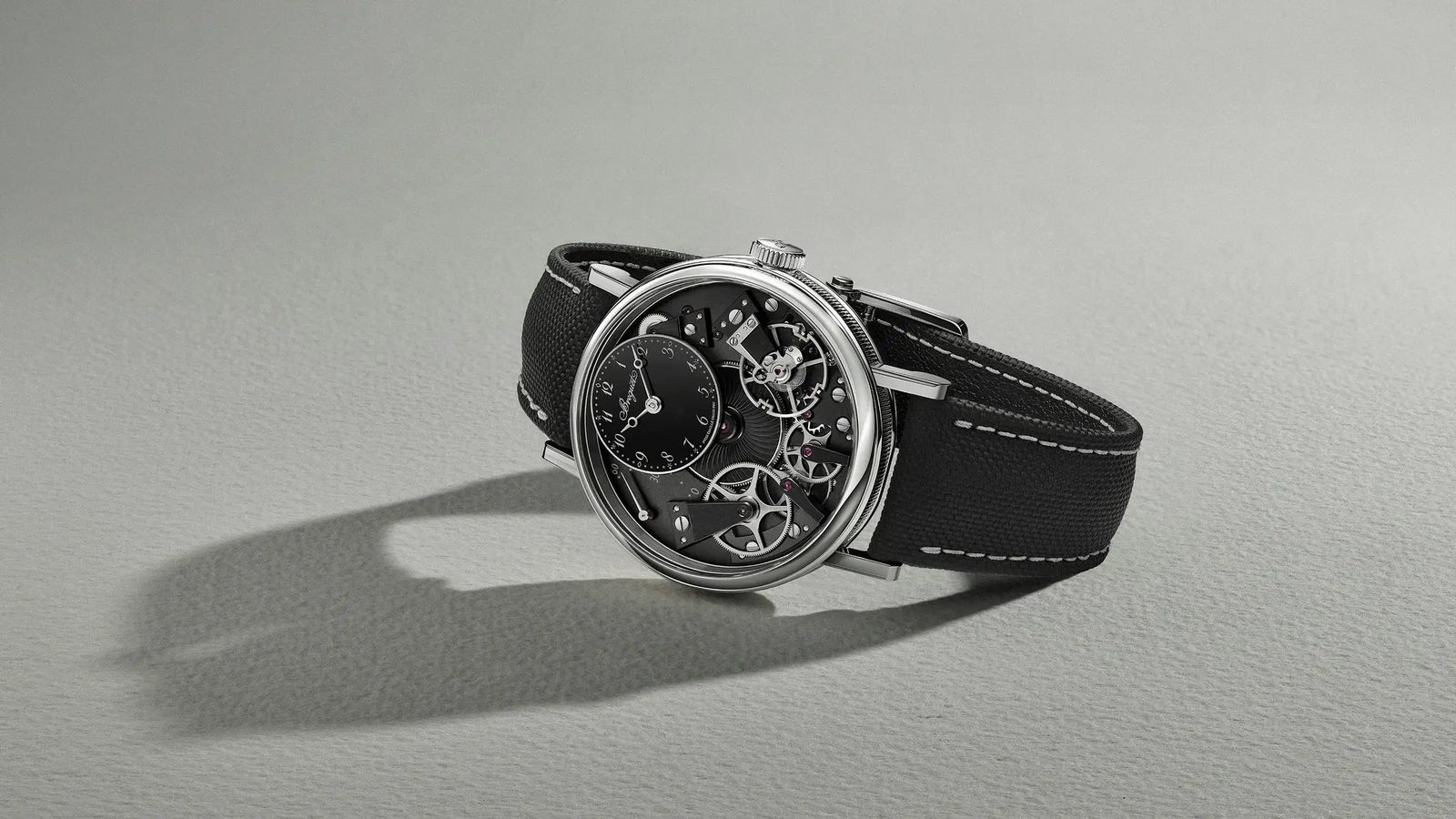

On August 18, 1853, a buyer recorded only as Capitaine Denny paid 700 francs in Paris for a gold Breguet hunter pocket watch. More than 170 years later, that piece, No. 2226, has surfaced and is now up for auction at Webb's in Auckland.
The archive record
How the watch got from the Quai de l'Horloge to New Zealand remains unresolved. The house founded by Abraham-Louis Breguet in Paris in 1775 has kept its sales registers since the 18th century, and the entry for No. 2226 documents the sale but little more.
The register describes a gold hunting-case watch with case No. 1507, an enamel dial carrying small seconds at 6 o'clock, a gold cuvette, a lever escapement and a compensated balance. Breguet's heritage team found no further record of the buyer.
The watch never came back to the manufacture for servicing, so its documented history begins and ends with the 1853 sale. In that year Breguet still worked from its original premises beside the Pont-Neuf, where the founder had opened his workshop in 1775.
The business stayed there until 1870, and by the time Capitaine Denny visited, the founder's grandson Louis-Clément Breguet was running it. At 700 francs, this was far from the maison's most expensive piece: in 1850 a gold quarter repeater sold for 2,800 francs.
The sum still meant something. A skilled Parisian tradesman earned roughly 3.3 to 4.2 francs a day, so at four francs the purchase equated to about 175 working days, nearly seven months of six-day weeks. That points to a buyer of means or standing.
The watch itself
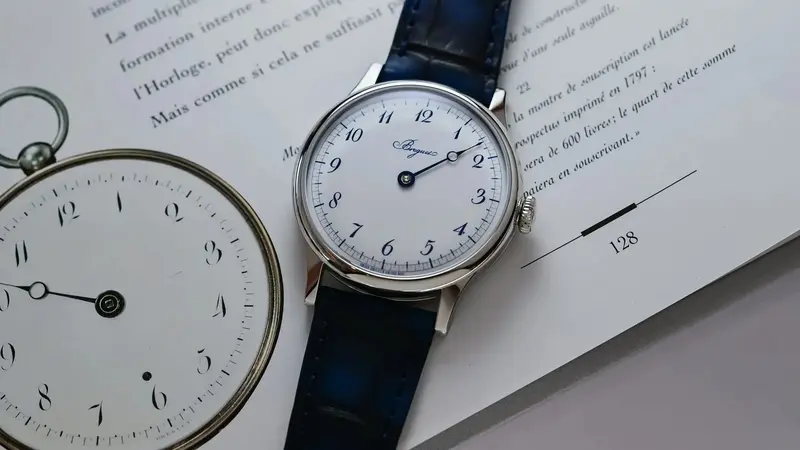
The watch itself is restrained. The 47mm 18K yellow gold case holds no complications. Beneath the hunter cover is a white enamel dial with Roman numerals, Breguet hands and small seconds, and the piece still comes with its original winding key.
The real clue is inside the cover, where a crest shows an arm holding ears of wheat above the motto æt mea messis erit, loosely translated as "and mine shall be the harvest." That crest led the search toward the military Denny family.
The Denny crest
Wellington's Te Papa holds a whale-tooth snuff mull dated 1845 whose silver lid bears the same crest and motto. Its inscription reads "R. Denny 58th Bay of Islands, New Zealand August 1845," linking it to Captain Richard Denny of the 58th Regiment's Light Company.
Denny served in the Northern War, later receiving a brevet majority. But he died in Quebec on June 4, 1850, three years before the watch sold, which rules him out while still proving the crest on No. 2226 belonged to the military Dennys.
The inscription places him in the Bay of Islands in August 1845, amid the Northern War, the first major conflict of the New Zealand Wars and often called the Flagstaff War. It grew from tensions after the 1840 Treaty of Waitangi.
To the Ngāpuhi leader Hōne Heke Pōkai, the flagstaff on Maiki Hill above Kororāreka symbolized authority his people were losing, and he cut it down four times. The last came on March 11, 1845, when Te Ruki Kawiti's men created a diversion.
That afternoon the powder magazine at Polack's stockade blew up, and troops withdrew to the ships, abandoning the town to looting. Reinforcements followed, including men of the 58th Regiment, who reached Auckland later that month.
The early fighting went badly for the Crown. At Ōhaeawai on July 1, 1845, Kawiti's defenders repelled an assault led by Colonel Henry Despard, and British forces took heavy losses at the fortified pā. The war ended after British forces entered Ruapekapeka in January 1846, and Kawiti and Heke agreed to peace terms with Wāka Nene.
A separate thread from a 1978 Turnbull Library Record surfaces a Captain Denny outside Paris in 1855 and 1856, employing William Mathew Hodgkins, later a notable New Zealand painter and the father of Frances Hodgkins, on a substantial literary work.
A testimonial dated October 17, 1859, confirms Hodgkins was "assisting the late Capt. Denny at Versailles," meaning that man was alive in 1855 and 1856 but dead by 1859. No evidence shows Hodgkins ever touched the watch itself.
The strongest candidate remains Anthony Cuthbert Collingwood Denny, born 1818, who died September 22, 1857, aged 39. His mother was a granddaughter of Admiral Lord Cuthbert Collingwood, Nelson's second-in-command at Trafalgar, and his family had edited the admiral's letters.
Anthony joined the Royal Navy in 1831, served aboard the Blenheim during the First Opium War, and became a lieutenant in October 1841 after Canton, Amoy and Chinghae. But naval records list him as lieutenant, not captain, and nothing places him in Paris.
For now the identity stays open, and the answer may be in the indexed Versailles censuses for 1855 and 1856. For a New Zealand collector, the documented trail is remarkable enough: a founder's house, a colonial war and a woman who became one of New Zealand's great artists.
That lineage matches the pieces we already cover, from Patek Philippe's ref. 973J-001, the pocket watch we rank first, to this uncomplicated hunter from 1853. The auction marks the first public sale of No. 2226 in any modern record.
Support the content you love — it’s free 🎉
Add Luxe Digital as a preferred source on Google. Our stories will be more likely to appear in Google’s Top Stories. It’s free and supports our team. Thank you!
Add as preferred sourceYou can remove us any time in Google’s source preferences.
Thank you — you’re all set 🎉
Luxe Digital is now one of your preferred sources, so our stories are more likely to appear in Google’s Top Stories.
This briefing is published daily using an AI-powered system crafted by Luxe Digital’s team and finely tuned to meet our editorial standards. While we continuously test and review the output, mistakes can sometimes happen. Tell us if you spot one.