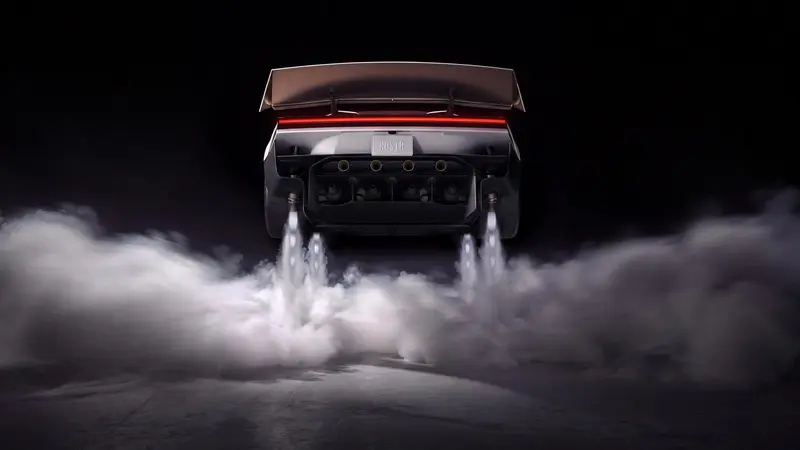

Tesla unveiled its long-delayed second-generation Roadster on Thursday night at SpaceX's Rocket Development and Testing Facility in McGregor, Texas. The coupe drove up a multi-story ramp, used a suction system to hang briefly upside down, then launched off the edge and performed a flip before landing.
To prove it was no fluke, the Roadster then ran a barrel roll, which Musk called a kickflip, over a lineup of five Teslas that included the 13.5-foot-tall Semi. SpaceX-supplied cold-gas thrusters also carried the car from zero to 60 mph in 0.81 seconds.
The whole flying display unfolded during a 30-minute livestreamed showcase. It was the kind of performance Tesla chief executive Elon Musk first promised in 2017, when he introduced the model and took deposits of $50,000 to $250,000 from reservation holders eager to secure one.
Nine years later, the car that arrived looks almost nothing like the 2017 concept. The earlier prototype carried a sharp front end and a compact, curvy body with a targa roof, an Acura NSX-like profile that has now been thrown out entirely.
What replaced it borrows the angular language of the Cybertruck, with a long silhouette, butterfly doors and a fixed roof. The front bodywork recedes to expose the headlights, and a large rear section rises as an active spoiler. Tesla says the shape draws on military aircraft such as the SR-71 Blackbird and F-35.
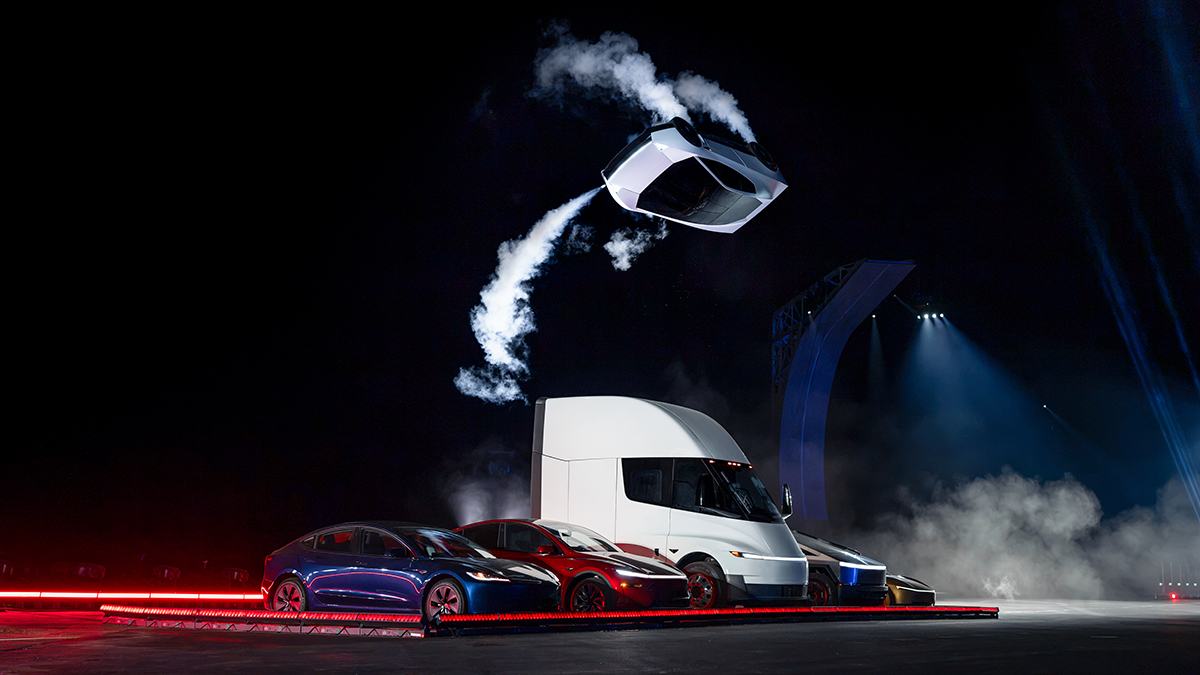
In its white paint the new design also echoes the Lotus Esprit S1 that Roger Moore's James Bond drove in The Spy Who Loved Me. Deposit holders who paid an arm and a leg nearly a decade ago will be getting a car that looks nothing like the one they reserved.
The show car's powertrain is just as dramatic. Tesla claims the battery pack and rear-mounted dual electric motors produce north of 1,340 horsepower. That is a believable figure, though it sounds like too much for two driven wheels to manage off the line.
What is real enough for production
Beneath the spectacle, the prototype looks close to production-ready. Proper cutlines for body panels, latches and hinges for the doors, and an interior with the expected controls and room for airbags in the steering-wheel hub are all present, along with a dash-mounted screen built around a functional interface rather than a show prop.
Musk says the Roadster will actually go into production, in 2028 give or take a few years. Tesla has a long history of missing its own deadlines, but this time the bones of the car appear real enough to reach the road before the decade ends.
The wilder technology is another story. Lars Moravy, Tesla's vice president of vehicle engineering, told Top Gear that the nitrogen tank fuelling the thruster system empties in about six seconds and takes hours to refill. That alone argues against the thrusters appearing on a car meant for daily driving.
Legality is the larger question. Musk addressed it directly at the reveal, saying he was not sure it was necessarily legal in all jurisdictions to operate a flying car on public roads. Street-legal variants would likely disable the thrusters and suction system, or reserve them for track-only models.
What this means for Tesla
Tesla is the name behind this act, and the show of thrusters and rocketry is as much about the brand as the car. We have tracked Tesla across our coverage of luxe carmakers, where it places third among American car brands behind Ford and Chevrolet, all three built on very different foundations.
Ford runs on the F-Series, Chevrolet on the Silverado, and Tesla on a single crossover, the Model Y, which remains the best-selling electric vehicle in the United States. A flying flagship is well outside that calculus, but it restores some of the showmanship Tesla built its early reputation on.
The Roadster is the kind of car that drives brand heat, the same way a mid-engined supercar does for Porsche. Our earlier coverage of the Roadster's predecessor recorded it as a concept held together by compressed-air promises; this one pairs those promises with a demonstration people actually saw.
Price is the remaining unknown. Musk first quoted the Roadster at $200,000 in 2017, a figure that looks increasingly unlikely for a car that can do what Thursday's example did. Whatever it lands at, a sub-second sports car with aerospace thrusters will not be a value proposition.
For the deposit holders who paid up to $250,000 nine years ago, the reveal is a mixed resut. They are getting a car Tesla now insists will enter production by 2028, but it is a car they could not have imagined when they handed over the money, in styling, capability and almost certainly in price.
Support the content you love — it’s free 🎉
Add Luxe Digital as a preferred source on Google. Our stories will be more likely to appear in Google’s Top Stories. It’s free and supports our team. Thank you!
Add as preferred sourceYou can remove us any time in Google’s source preferences.
Thank you — you’re all set 🎉
Luxe Digital is now one of your preferred sources, so our stories are more likely to appear in Google’s Top Stories.
This briefing is published daily using an AI-powered system crafted by Luxe Digital’s team and finely tuned to meet our editorial standards. While we continuously test and review the output, mistakes can sometimes happen. Tell us if you spot one.
Image: Tesla Roadster