
Urwerk has released the UR-300 Time Quantum, a watch whose display dismantles and rebuilds itself once every hour. Co-founders Felix Baumgartner and Martin Frei ditched the rotating carousel that has defined the brand since 1997 and replaced it with a modular T-shaped frame that snaps into a new configuration on the hour.
Two versions launch together, each capped at 25 pieces and priced at CHF 168,000. The Titan model keeps a bare Grade 5 titanium case, while the AlTiN edition adds a black PE-CVD surface treatment. Both come on NATO-style straps, with sapphire crystals carrying an anti-reflective coating.
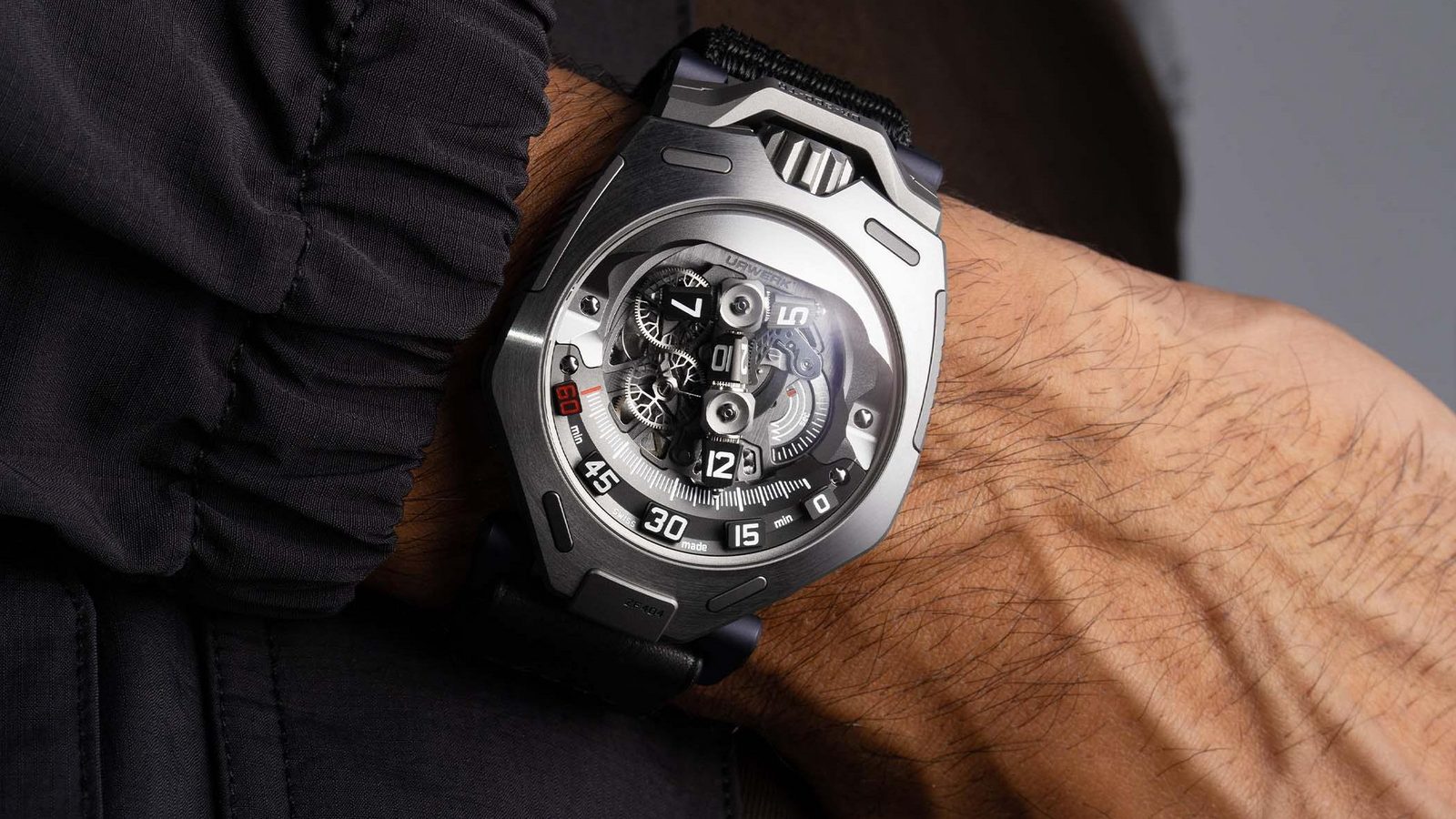
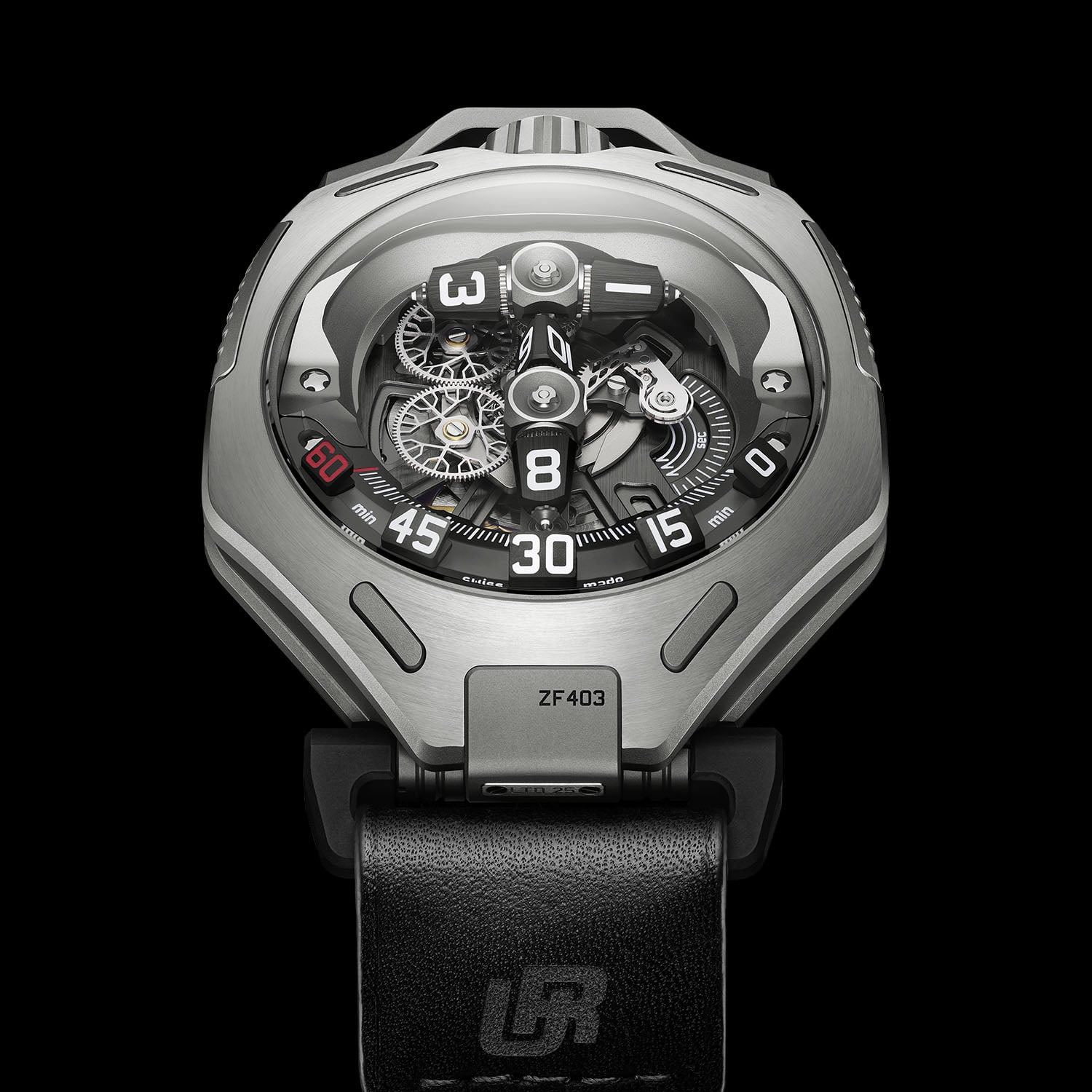
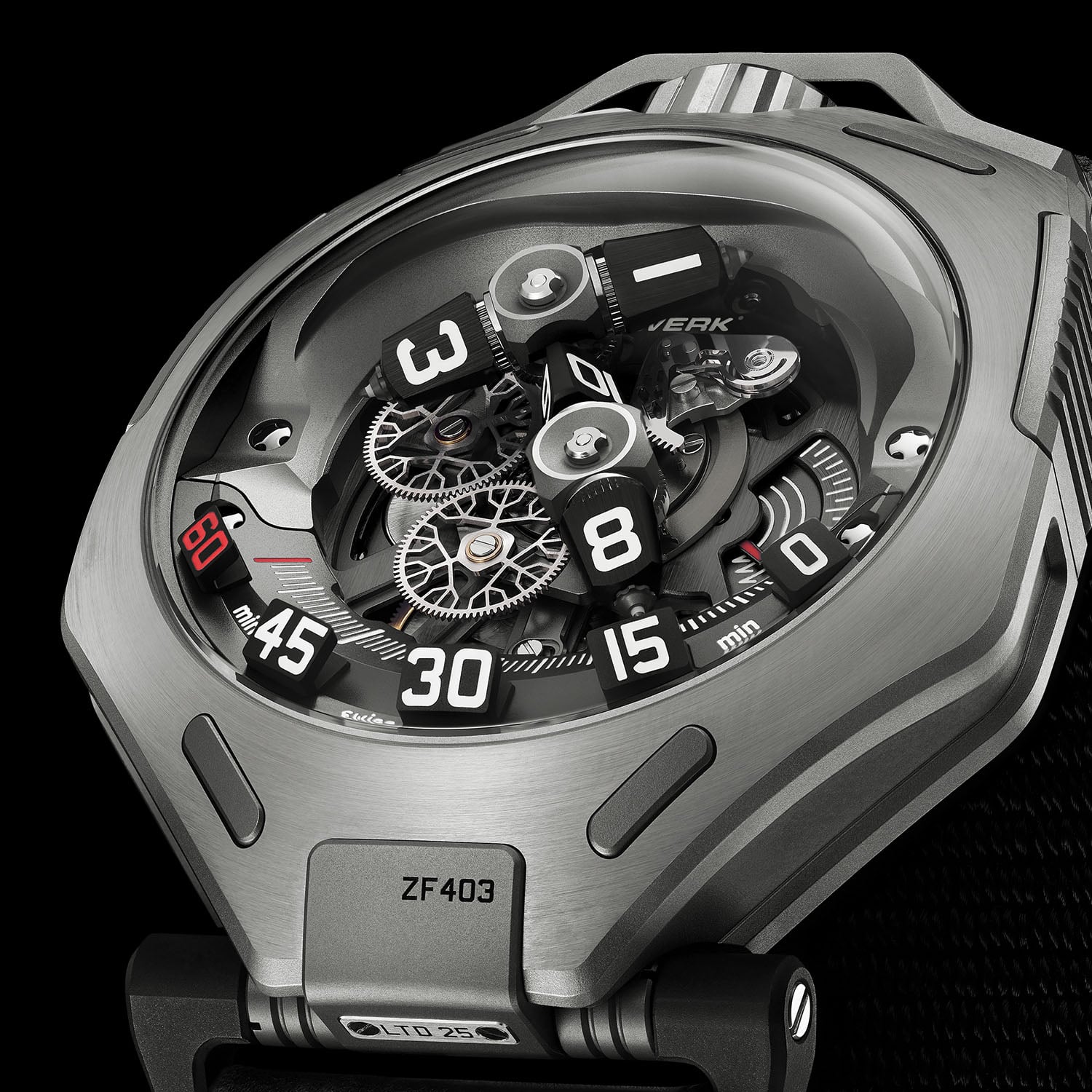
The name points away from Urwerk's usual astronomy and toward quantum physics: a discrete jump between states, rendered mechanically. Two linear hour modules form a T-frame, each end carrying a three-sided rotating prism. Four prisms working in sets of three faces supply the twelve hour numerals between them.
The active hour travels along a curved, 108-degree minute track running from zero to sixty. When the prism reaches the end of that track, three operations fire at once. The T-frame leaps forward and rotates 72 degrees, seating the next prism at the start of the minutes scale.
The crossbar pivots around its midpoint to become the new stem, while the previous stem spins the opposite way to become the new crossbar. All four prisms rotate as well, turning the next numeral into view. The entire reconfiguration happens in one coordinated, instantaneous motion.
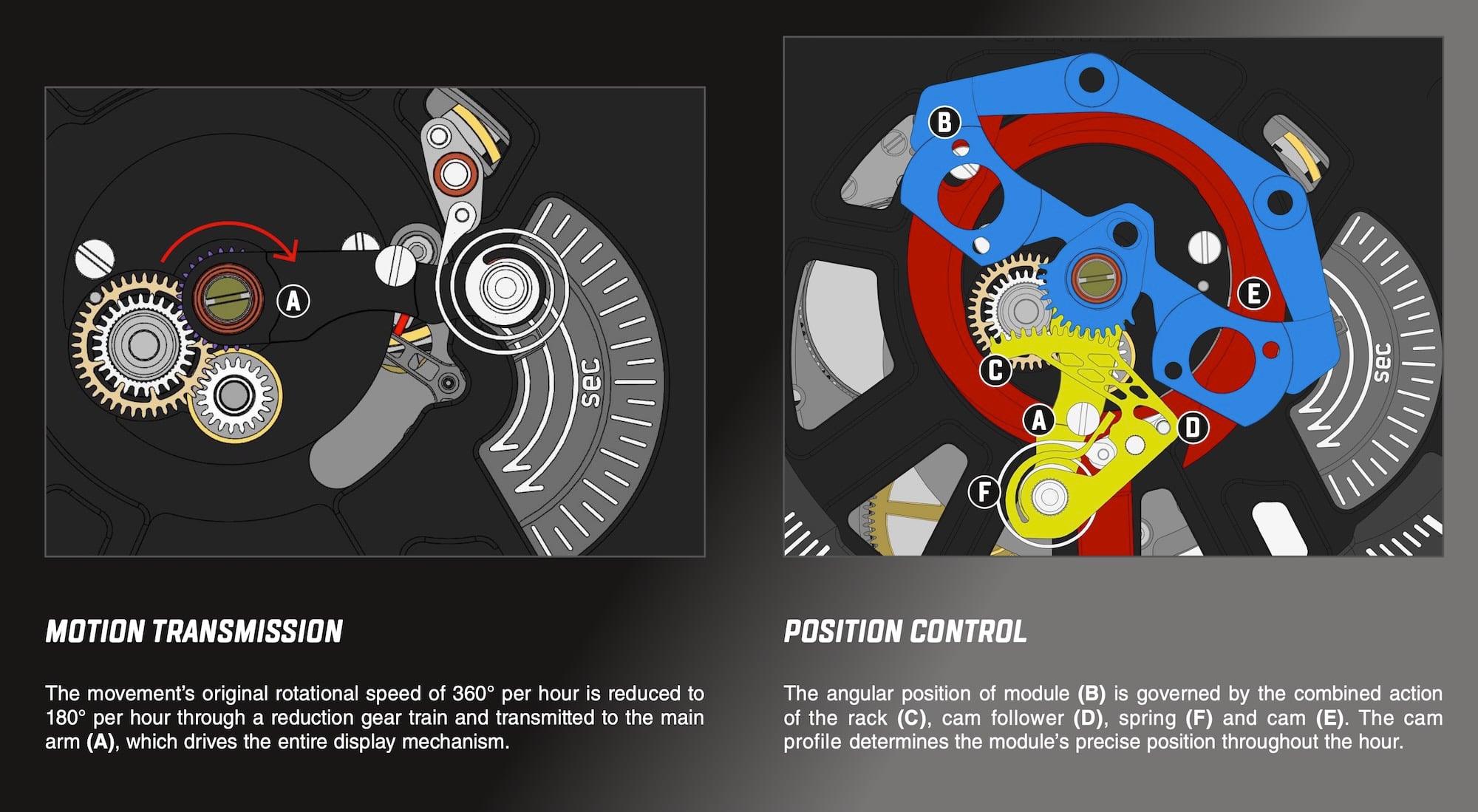
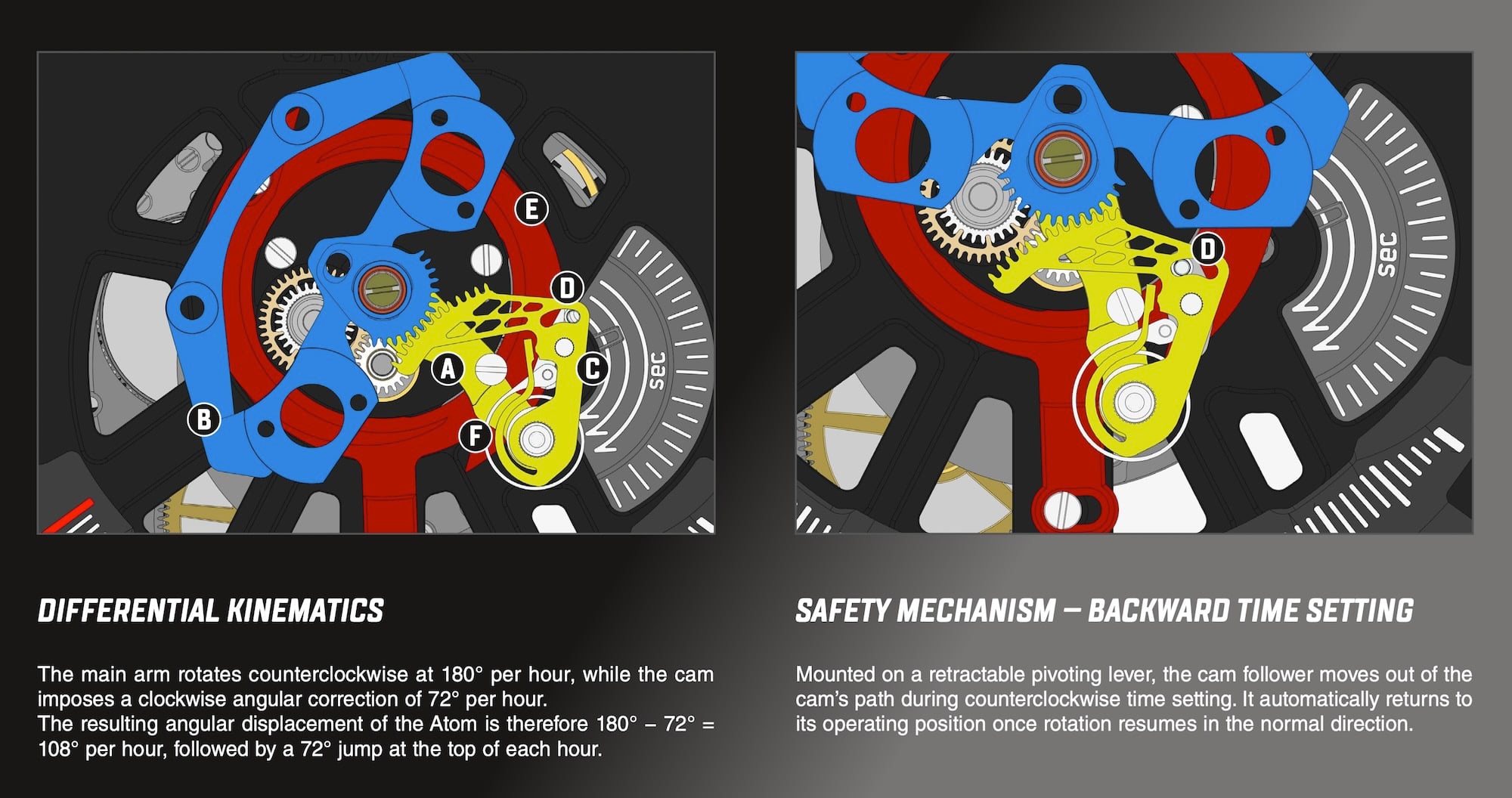
Urwerk's technical sheet lays out the geometry behind the jump. The movement's initial 360 degrees of rotation per hour is stepped down to 180 and passed to the main arm, which turns counterclockwise while a cam applies a clockwise correction of 72 degrees each hour. The result is 108 degrees of travel followed by the abrupt leap.
A rack, cam follower, spring and cam govern the module's position through the hour, blending continuous motion with the sudden transition. Setting the watch backwards is handled with a safeguard: a retractable lever lifts the cam follower out of the cam's path so the mechanism never has to run its normal sequence in reverse.
The display parts mix beryllium copper, brass, anodised aluminium, ARCAP AP1D, titanium and LIGA-processed nickel. Each material answers a different demand, from low mass and structural rigidity to precise geometry and dependable contact between components. Urwerk finishes the movement with circular and straight graining, Côtes de Genève, and chamfered, polished screw heads.
Power comes from the automatic caliber UR-30.01V, built on a Vaucher base with an in-house display module. Urwerk's Dual Flow Turbines, two oscillating weights turning against each other, regulate winding into a double mainspring barrel. They balance the energy the jumping mechanism consumes against the need for a usable reserve.
That reserve is 40 hours by Urwerk's own fact sheet, while another set of specifications quotes 44 hours; the brand has never crossed the 50-hour barrier on any model except the EMC. The movement runs a Swiss lever escapement and monometallic balance at 28,800 vibrations per hour, or 4 Hz, with a flat balance spring.
The case is large because the mechanism demands it: 45.2mm wide, 58.8mm long and 18.25mm thick, all in Grade 5 titanium. Water resistance is 30 meters in Urwerk's documentation and 20 meters in other specifications; either way this is not a watch for the pool. A crossbar up top protects an integrated crown placed at 12 o'clock.
Hinged lugs connect the case to the strap, and the lower lug conceals a small plaque marking the watch as limited to 25 pieces. Running seconds appear on the front through three hands that each show twenty seconds across 120 degrees. A display caseback exposes the Dual Flow Turbine winding system at work.
The instantaneous jump has real engineering teeth. Moving several components at once needs enough energy to finish the transition without recoil or unnecessary stress, and the gear trains have to absorb sudden acceleration without developing play or losing transmission efficiency. Urwerk's answer is to repeat it reliably, hour after hour.
What the T-frame changes for Urwerk
Satellite hours have been Urwerk's calling card since its founding, carried in models such as the UR-120, the UR-150 and the UR-230. Those watches send rotating hour carousels travelling along a graduated minute scale. The UR-300 keeps that wandering-hour idea but rebuilds the mechanism that delivers it.
Where earlier series relied on a single rotating carousel, the Time Quantum scatters the hour indication across four prisms and a frame that alters its geometry. It is the same signature read at a glance, the hour pointing at the minute track, reached through a structure the maison has never used before.
An early hands-on reviewer was candid about the trade-off, noting that the jump takes real power and real estate. The case dimensions are the cost of that room, as is the modest reserve. His stated worry is longevity, given the torque and the number of parts the T-frame demands. But the display itself left him impressed rather than skeptical.
A video being posted to the brand's social channels shows how quickly the display snaps from one hour to the next, and it reportedly lands without any visible rebound. Urwerk's own material stresses the durability of the positioning mechanism, and the watch goes on sale now at CHF 168,000 per version.
Support the content you love — it’s free 🎉
Add Luxe Digital as a preferred source on Google. Our stories will be more likely to appear in Google’s Top Stories. It’s free and supports our team. Thank you!
Add as preferred sourceYou can remove us any time in Google’s source preferences.
Thank you — you’re all set 🎉
Luxe Digital is now one of your preferred sources, so our stories are more likely to appear in Google’s Top Stories.
This briefing is published daily using an AI-powered system crafted by Luxe Digital’s team and finely tuned to meet our editorial standards. While we continuously test and review the output, mistakes can sometimes happen. Tell us if you spot one.
Images: Urwerk UR-300 Time Quantum