
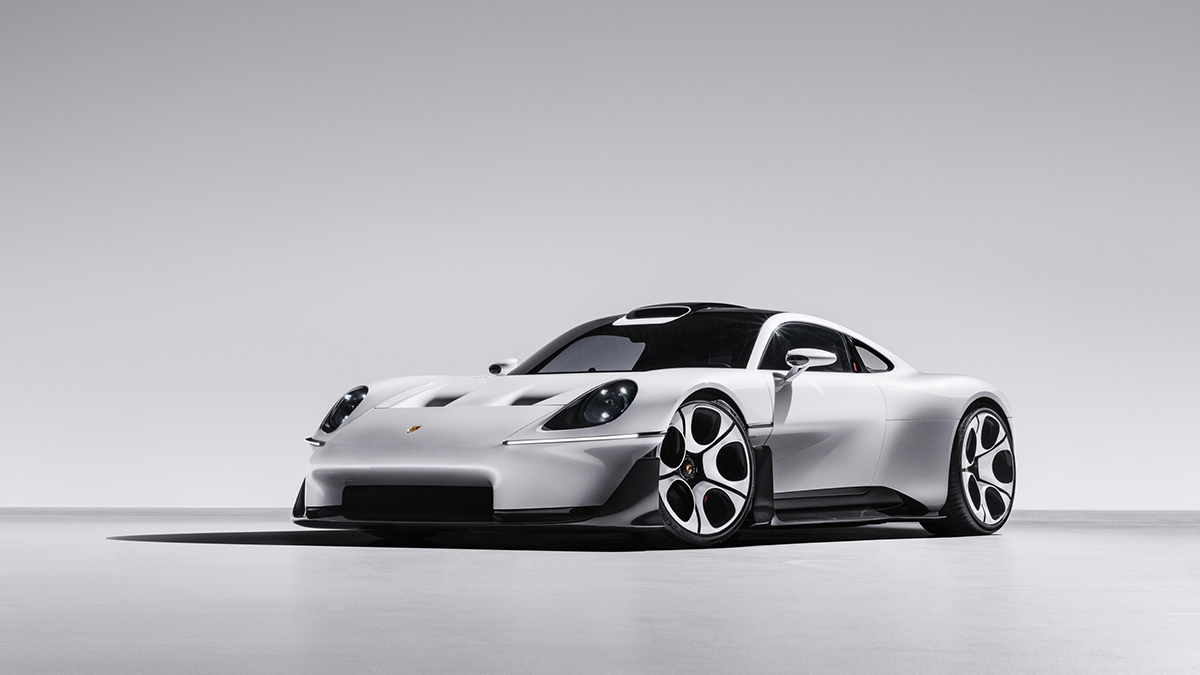
Porsche has unveiled the Mission S, a mid-engined supercar concept that previews the first permanent model line above the 911. The German marque revealed the car on Thursday afternoon in New York City, framing it as a love letter to the sports car.
CEO Michael Leiters confirmed the production version will carry a mid-engine configuration, matching the Carrera GT and 918 Spyder that came before it. The platform underneath will be entirely new, though Porsche has stopped short of confirming anything else mechanical for now.
Porsche has said the model will be a permanent addition to the lineup rather than a one-off or a few-off special. The 911 has gone unbroken in production since 1964, and its predecessors that challenged it were always limited-timers rather than stablemates.
The first car from a new design chief
This is the first vehicle from Tobias Sühlmann, Porsche's new head of design. It carries round headlights drawn from the 911, a flat front similar to the GT1, and a roofline reminiscent of the 959. Clean lines run through the wraparound front and rear lights.
The wheels are a new lightweight set inspired by the dial-design rims of the 928. A radiator fan over the engine echoes the 917 racer, and the rear wing pays tribute to the 959. Sühlmann has avoided reinventing Porsche's look and instead references the marque's back catalog.
Leiters put the philosophy plainly: a Porsche must be recognizable as a Porsche at first glance. He said the Mission S offers a glimpse of the ideas and design features that will shape the company in the coming years, a mission statement for the Sühlmann era.
A cockpit built around feel
The cabin draws on Porsche's first racer, the 550 Spyder, and the 356, in a driver-focused space meant to create a sense of sitting deep within the car. Horizontal feature lines run across the dash from door to door, and the minimalism gives it a timeless quality.
There is no center screen at all. In its place sits a retractable magnetic holder for a smartphone, ready to display navigation. A physical key takes the place of the push-button starter, and it slots into a holder to the left of the steering wheel, much like a vintage 911.
The instrument cluster is digital but recreates the classic five-dial layout, and drivers can choose which Porsche era it mirrors. Physical switches and new push-pull controllers for cabin and driving functions proliferate, blending analog tactility with modern displays.
Powertrain, timing and the price question
Porsche has not committed to a powertrain publicly, but the production line will support pure gasoline powerplants alongside traditional hybrid and plug-in options. There will be no fully electric version, because the automaker sees no demand for one in this segment.
German newspaper Handelsblatt reported last month that the production Mission S will be the first road-going Porsche to feature a flat-eight engine. At the time, a Porsche representative said the company could not speculate or comment on potential future product. Tuner Ruf is also developing a flat-eight.
Porsche has given no launch date and no price. Production is expected to arrive no earlier than 2029. A starting point is anticipated between the roughly $265,000 of a 911 Turbo S and the roughly $331,000 of a Ferrari 296.
The Mission S is the centerpiece of Leiters' upmarket push, which he calls the Sportwagenschmiede '35 strategy, loosely translating to sports car foundry. Executives reportedly prefer super-sports car to hypercar, hinting that a pricier 918 successor could follow as a separate line.
Porsche wants to attract Ferrari and Lamborghini buyers by cutting volumes and raising prices. The average transaction price of its top 10,000 sales is set to climb from around £270,000 to over £300,000, roughly $357,000 to $397,500, with new one-off and few-off specials adding to the mix.
The strategy reaches beyond sports cars. A larger three-row luxury model will slot above the Cayenne, aimed mainly at the US market, and the petrol-powered Macan will return. Production numbers for the Mission S may not be limited, but Porsche expects long early queues.
In our garage coverage we have tracked the supercar field closely, from our ranking of Italian car brands that places Ferrari first to our guide to the world's most expensive cars. The Mission S changes the calculation for anyone weighing a German icon against a Maranello rival.
The previous challengers to the 911 never stayed. The 959 arrived in 1985 as briefly the world's fastest car, the 911 GT1 Straßenversion followed as a street-legal Le Mans racer, and the 918 Spyder landed in 2013. What Porsche has now announced is a line, not a limited fling.
Support the content you love — it’s free 🎉
Add Luxe Digital as a preferred source on Google. Our stories will be more likely to appear in Google’s Top Stories. It’s free and supports our team. Thank you!
Add as preferred sourceYou can remove us any time in Google’s source preferences.
Thank you — you’re all set 🎉
Luxe Digital is now one of your preferred sources, so our stories are more likely to appear in Google’s Top Stories.
This briefing is published daily using an AI-powered system crafted by Luxe Digital’s team and finely tuned to meet our editorial standards. While we continuously test and review the output, mistakes can sometimes happen. Tell us if you spot one.
Images: Porsche