
TAG Heuer is relaunching the Carrera Chronograph Sport in new 42mm versions, timed to Formula 1's first Spanish Grand Prix in Madrid this weekend. TAG Heuer is Official Timekeeper of Formula 1 and Title Partner of the race, and the watch debuts on the same weekend. The new series arrives from September 2026, with a blue leather-strap version following in October in most markets.
European pricing starts at €6,350 for the blue leather-strap model, while the steel-bracelet versions cost €6,550. The new watch is an evolution of the 2020 Carrera Sport Chronograph, which had a 44mm case, shortened Carrera lugs, a ceramic tachymeter bezel and the then-new Heuer 02 movement. TAG Heuer has reworked the proportions six years on.
The case shrinks from 44mm to 42mm, the lug-to-lug measurement drops from 49.8mm to 48.6mm, and the thickness falls from 15.48mm to 14.17mm. Those changes matter for a watch originally defined by its substantial presence, giving the new Carrera a more compact stance without losing its sporty character.
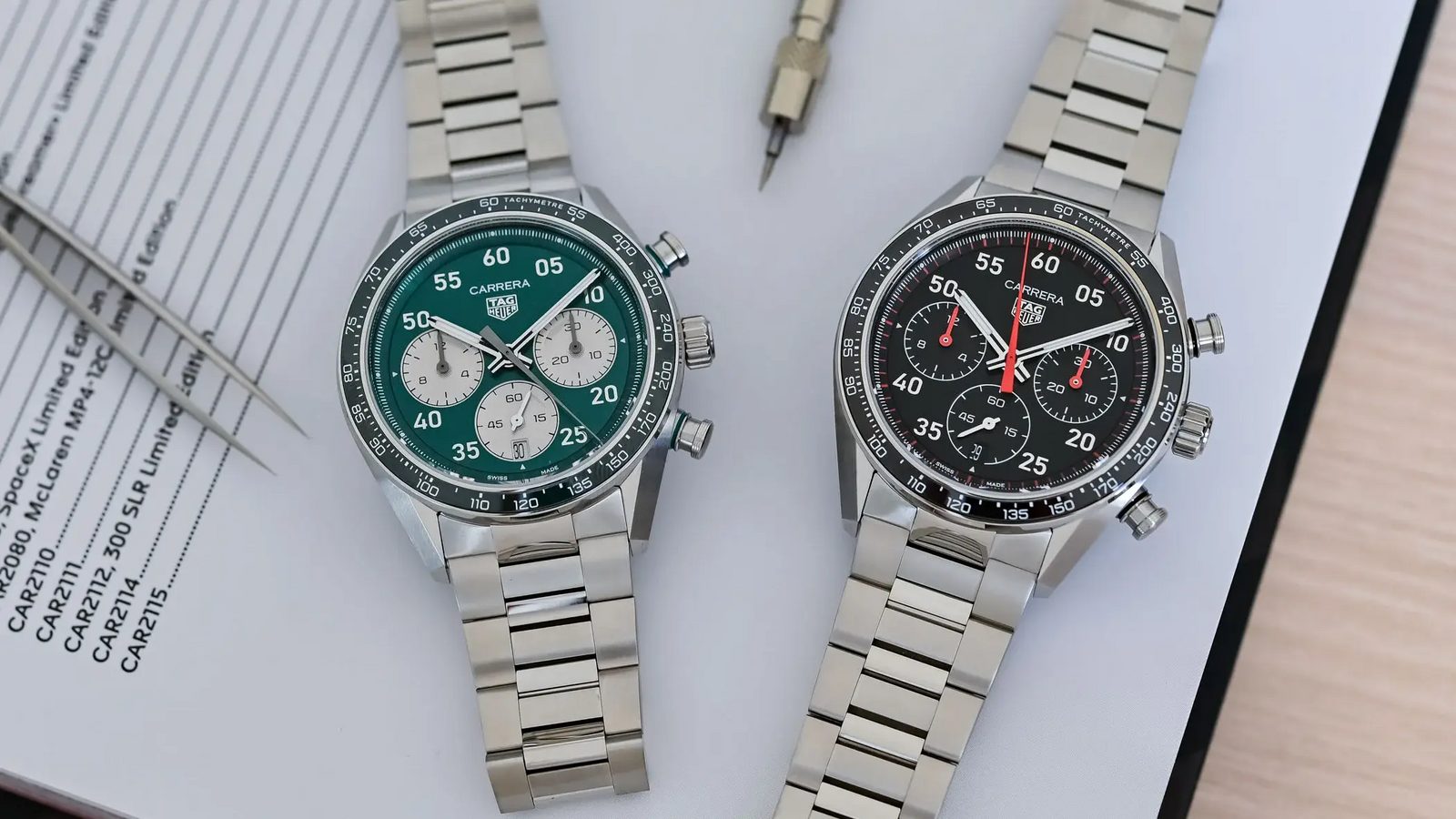
The case keeps its alternating polished and brushed surfaces and faceted Carrera lugs, with more sharply defined sides throughout. The pump-style pushers continue the racing theme, their rounded forms recalling pistons and other mechanical components associated with high-performance engines, and now carry colored rings at the base and grooved rings on top.
The fixed tachymeter bezel pairs a steel outer structure with a ceramic insert engraved with the tachymeter scale, available in black, blue or green depending on the model. A domed sapphire crystal with double-sided anti-reflective treatment covers the dial, and the screw-down sapphire caseback is engraved with a Victory Wreath. Water resistance holds at 100m.
The dial marks the clearest break from the 2020 generation. Baton-style hour markers give way to Arabic numerals for double-digit minutes, and the tricompax layout keeps its 30-minute chronograph counter at 3 o'clock, 12-hour counter at 9 and running seconds at 6, now with a date aperture color-matched to the subdial.
The black opaline model reads as the most overtly racing of the four, pairing black azuré counters with red lacquered chronograph hands and white and red markings on the flange. Blue trades that palette for a sunray dial, silver azuré counters and grey indications, set against a matching ceramic bezel insert.
Silver keeps things plain with a light dial and black counters, while green pairs its own sunray finish with a ceramic bezel to match. Every reference shares rhodium-plated hour and minute hands filled with white Super-LumiNova, though the chronograph hands are grey-lacquered on all but the black-dialled piece.
Power comes from the in-house Calibre TH20-00, an evolution of the Heuer 02 used in the 2020 Carrera Sport. It runs at 28,800 vibrations per hour with a column wheel and vertical clutch, delivers an 80-hour power reserve, and is visible through the sapphire caseback with a TAG Heuer shield oscillating mass finished with Geneva stripes, frosting and circular graining.
The watch rides on a tapered H-shaped steel bracelet with an easy-link adjustment system and a folding clasp with double safety push-buttons. The blue reference can instead be paired with a perforated brown calfskin strap on a steel pin-buckle clasp.
The Carrera's roots in a 1963 road race
The Carrera line dates to 1963, when Jack Heuer designed it around the Carrera Panamericana road race so elapsed time could be read at a glance while driving. That functional premise has carried across six decades of case, dial and movement updates, generation by generation.
TAG Heuer traces to 1860, when 20-year-old Edouard Heuer founded the company as simply Heuer. The pump-style pushers on the new watch still trace to the oscillating pinion Edouard Heuer patented in 1887, the mechanism that lets a chronograph start and stop with a simple push, and it remains in chronographs today.
The company became TAG Heuer only in 1985, after the TAG Group acquired it, and the brand is now part of the LVMH Group. TAG Heuer's own account of its craftsmanship says Heuer chronographs were once precise enough for the brand to produce movements for Rolex.
How the Carrera compares on chronograph engineering
We rank TAG Heuer among the best luxury watch brands, calling the Carrera one of the great chronograph designs and finding its motorsport heritage more credible than any rival at the price. That heritage frames every generation of the Chronograph Sport, including this 42mm version, rather than any claim of reinvention.
A. Lange & Söhne went the other way with its platinum Triple Split, a split-seconds chronograph built to separate hours, minutes and seconds simultaneously. Where that watch pushes chronograph complexity upward, the new Carrera Chronograph Sport trims size and mass while keeping its column wheel and vertical clutch construction intact.
Support the content you love — it’s free 🎉
Add Luxe Digital as a preferred source on Google. Our stories will be more likely to appear in Google’s Top Stories. It’s free and supports our team. Thank you!
Add as preferred sourceYou can remove us any time in Google’s source preferences.
Thank you — you’re all set 🎉
Luxe Digital is now one of your preferred sources, so our stories are more likely to appear in Google’s Top Stories.
This briefing is published daily using an AI-powered system crafted by Luxe Digital’s team and finely tuned to meet our editorial standards. While we continuously test and review the output, mistakes can sometimes happen. Tell us if you spot one.
Image: TAG Heuer