
Sir Norman Foster has designed his first watch, a pair of automatic mechanical timepieces developed with Lebond, an independent Swiss watchmaker that realises designs by leading architects. The collaboration was conceived in partnership with the Design & Innovation Unit of the Norman Foster Foundation.
The result is the Lebond Norman Foster, offered in two versions at launch: the Natural Titanium Edition with a micro-sandblasted case, a brushed-metal dial and a grey rubber strap, and the Black Edition with a matte black DLC-coated titanium case, a black lacquered dial and hands, and a black rubber strap.
Foster approached the project by questioning what a watch should look like. He said the process began with reconsidering a familiar object as a complete system, with the case, strap, dial and movement all part of one whole rather than a case to which a strap is simply attached.
A case with no lugs
That thinking produced the design's defining move: the traditional lugs are gone. The case is 38.5 millimetres wide in Grade 5 titanium, widening to 40 millimetres where it meets the integrated strap, which wraps around the case to create one continuous, streamlined profile.
Removing the lugs gave the watch its continuous line, Foster explained, and also made it more comfortable and more integrated on the wrist. The strap reads as a continuation of the case, and the architect says he began to question the obvious.
Foster chose Grade 5 titanium for performance rather than appearance. The material has an exceptional strength-to-weight ratio and resists corrosion and wear, which matters for something worn continuously. It allowed the pair to lose weight without sacrificing strength while keeping a precise, refined character.
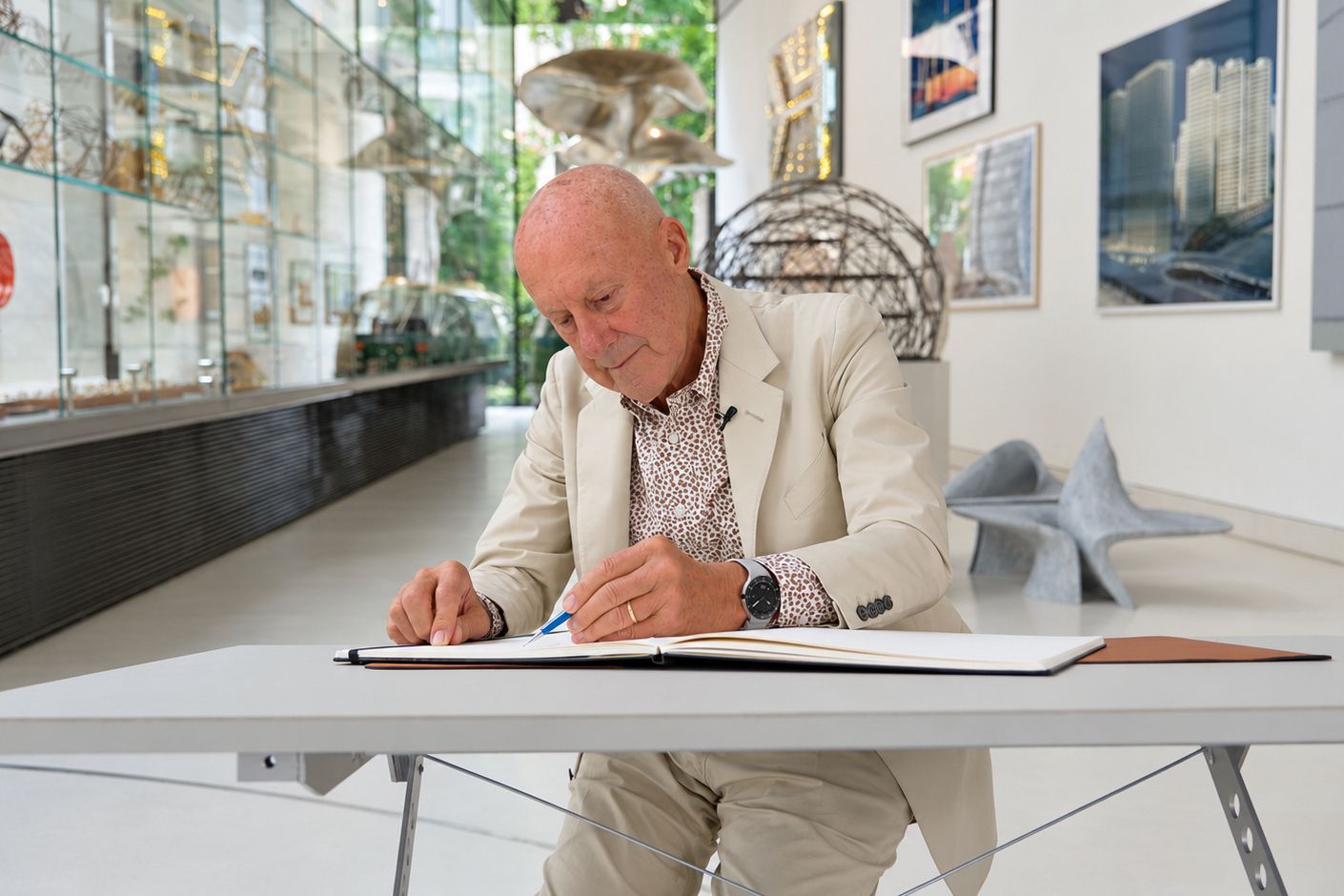
Aviation runs through the design. Foster has long been interested in flying and international travel, and the watch carries a bidirectional, rotating 12-hour bezel which lets the wearer read a second time zone using the main hour hand. The dial's typography is clear and restrained, and the hands are coated in Super-LumiNova for legibility.
The domed sapphire crystal has an anti-reflective coating and the case is water-resistant to 50 metres. The distinctive rotor also nods to aviation design, a practical reference to Foster's history in the air rather than a decorative one.
How an architect approached a watch
Foster is a Pritzker Prize-winning architect and urbanist, and this is his first timepiece. He did not find the change of scale daunting, saying he has never really thought that scale changes the nature of design.
Whether it is a city, a building, a chair or a watch, he said, the questions stay the same: how does it work, how is it made, and how do the parts come together.
The design process, Foster added, was very similar to architecture: one of refinement, sketches, prototypes, adjustments and then more adjustments. One explores options until reaching the essential idea, then keeps refining until everything seems inevitable.
Foster wanted the watch to move between very different situations: working in the studio, standing on a building site, travelling or dressing up for a formal occasion. In his words, it should not feel precious or tied to a single setting.
Customisation is built in. The watch has an easy attachment mechanism that lets the owner swap cases and straps at will, and Foster said more versions will be released over time. A watch is intensely personal, he explained; one wears it, travels with it and it becomes part of everyday life.
Lebond's premise suits that brief. The independent Swiss maison exists to turn leading architects' ideas into wristwear, and Foster's pair arrives in a field we follow closely in our coverage of watches jewelry, where the mechanics of a well-built case, from lugs to crystals, decide a lot.
Foster has long been interested in the relationship between design, engineering and precision, and a watch brings all three together in a very small and personal object. He said reconsidering something so familiar as a complete object made the challenge especially interesting.
No US price has been published for either edition yet, and Lebond has not said when the next versions land. What is clear is the design language: a case, strap, dial and movement treated as one system, built from a material picked for how it performs once it is on a wrist.
Support the content you love — it’s free 🎉
Add Luxe Digital as a preferred source on Google. Our stories will be more likely to appear in Google’s Top Stories. It’s free and supports our team. Thank you!
Add as preferred sourceYou can remove us any time in Google’s source preferences.
Thank you — you’re all set 🎉
Luxe Digital is now one of your preferred sources, so our stories are more likely to appear in Google’s Top Stories.
This briefing is published daily using an AI-powered system crafted by Luxe Digital’s team and finely tuned to meet our editorial standards. While we continuously test and review the output, mistakes can sometimes happen. Tell us if you spot one.
Images: Lebond; (Image credit: Courtesy of Norman Foster Foundation)