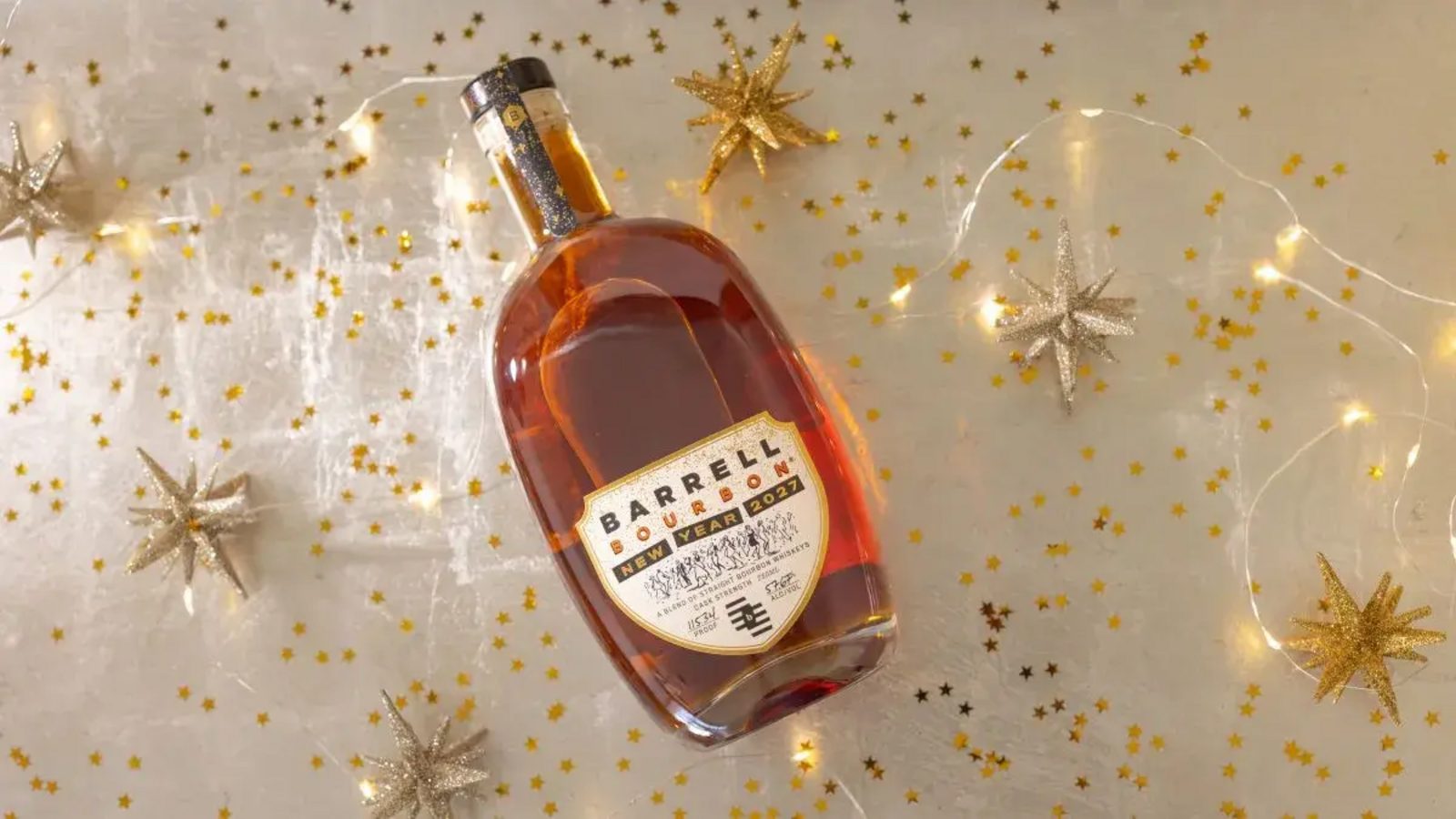

Barrell Craft Spirits has bottled its New Year 2027 bourbon, the tenth edition of the annual limited release, as a cask-strength blend of whiskey drawn from seven different states. The bottle carries a suggested retail price of $85 and began rolling out to retailers earlier this month.
Each bourbon in the blend was made from a distinct mashbill and carries its own age statement. The lineup spans Indiana at 7 to 10 years, Kentucky at 7 and 8 years, Tennessee at 10 and 16 years, and a 13-year-old whiskey from Wyoming.
The remaining three states round out a wide map: Maryland contributes 7- and 8-year-old bourbon, while Texas and Ohio each bring a five-year-old component. Barrell has not disclosed which distilleries supplied any of these whiskeys, a silence it has kept across the series.
When the seven whiskeys are combined, the derived mashbill breaks down to 73 percent corn, 22 percent rye, four percent malted barley, and a single percent of wheat. That rye-forward structure is the frame for a bottle filled at 116.6 proof.
Barrell Craft Spirits was founded in 2013 by Joe Beatrice and built its name on batched bourbon blends and cask-finished whiskeys. Seagrass, finished in Martinique rhum, madeira and apricot brandy casks, and Tale of Two Islands, resting in barrels that once held Jamaican rum and peated Islay malt, are its signatures.
What the tenth edition tastes like
The brand's official tasting notes are as intricate as ever, running to grassy olive oil, maple walnut ice cream, green grape and root beer barrels. On the palate the critic picked up licorice, malted chocolate, cherry pie, pepper spice, orange rind and cream soda.
At 116.6 proof there is some heat, but the review finds nothing that overwhelms or burns out the palate. A little water unlocks a fresh burst of flavor, the kind of transformation a cask-strength bottling is bought for rather than warned against.
The ten-year run began at the end of 2016, when the first New Year was dropped for the 2017 edition. Every successive iteration has changed the component whiskey makeup, so no two years have ever matched, and the series has become a record of what the blender could assemble at the time.
That longevity is the point of the anniversary. Where Barrell's cask-finished expressions show what a finishing barrel can do, the New Year bourbon shows what straight whiskey can do unadorned: no finishing, no flavoring, only mashbills and age laid against each other.
The 16-year-old Tennessee bourbon is the oldest component in the 2027 blend and the anchor around which the younger whiskeys turn. At ten years into the series, that spread of ages is a statement of intent as much as a recipe.
When we covered the Westland Garryana 11, we noted the shift toward single malts bottled at cask strength, and Barrell is the blending counterpart to that movement. We have also weighed in on the wider run of cask-strength releases, from American single malts to rye.
Across our coverage of dining we return to the same test: does the bottle earn its price at the proof it is sold?
Our roundup of the most expensive whiskeys on the market is the other end of the same conversation, where scarcity pushes bottles past the point of being opened. Barrell is a useful counterweight because the entire point of the New Year series is that it is meant to be drunk.
The $85 suggested retail price is unchanged territory for a limited annual blend of this complexity, and the brand's own website points buyers toward specialty retailers. With each edition changing its whiskey makeup, the series rewards the drinker who buys a bottle each year and compares them.
Barrell has not said how many bottles were produced for the 2027 edition, nor which distilleries filled them. The undisclosed sourcing is the one awkward line in an otherwise open recipe, and it is where a curious buyer's guessing begins rather than ends.
The bottle began reaching shelves earlier this month, which means the ten-year anniversary has already left the distillery and is now a question of what remains on retail shelves. Those who want a comparably aged Tennessee bourbon at this price will find the allocation thin.
With the 2027 edition on shelves, the series has now run ten consecutive years without repeating a mashbill, a decade-long argument that blending is a craft rather than a fill-in. The next edition will answer whether the streak continues into an eleventh year.
Support the content you love — it’s free 🎉
Add Luxe Digital as a preferred source on Google. Our stories will be more likely to appear in Google’s Top Stories. It’s free and supports our team. Thank you!
Add as preferred sourceYou can remove us any time in Google’s source preferences.
Thank you — you’re all set 🎉
Luxe Digital is now one of your preferred sources, so our stories are more likely to appear in Google’s Top Stories.
This briefing is published daily using an AI-powered system crafted by Luxe Digital’s team and finely tuned to meet our editorial standards. While we continuously test and review the output, mistakes can sometimes happen. Tell us if you spot one.
Image: Barrell Craft Spirits