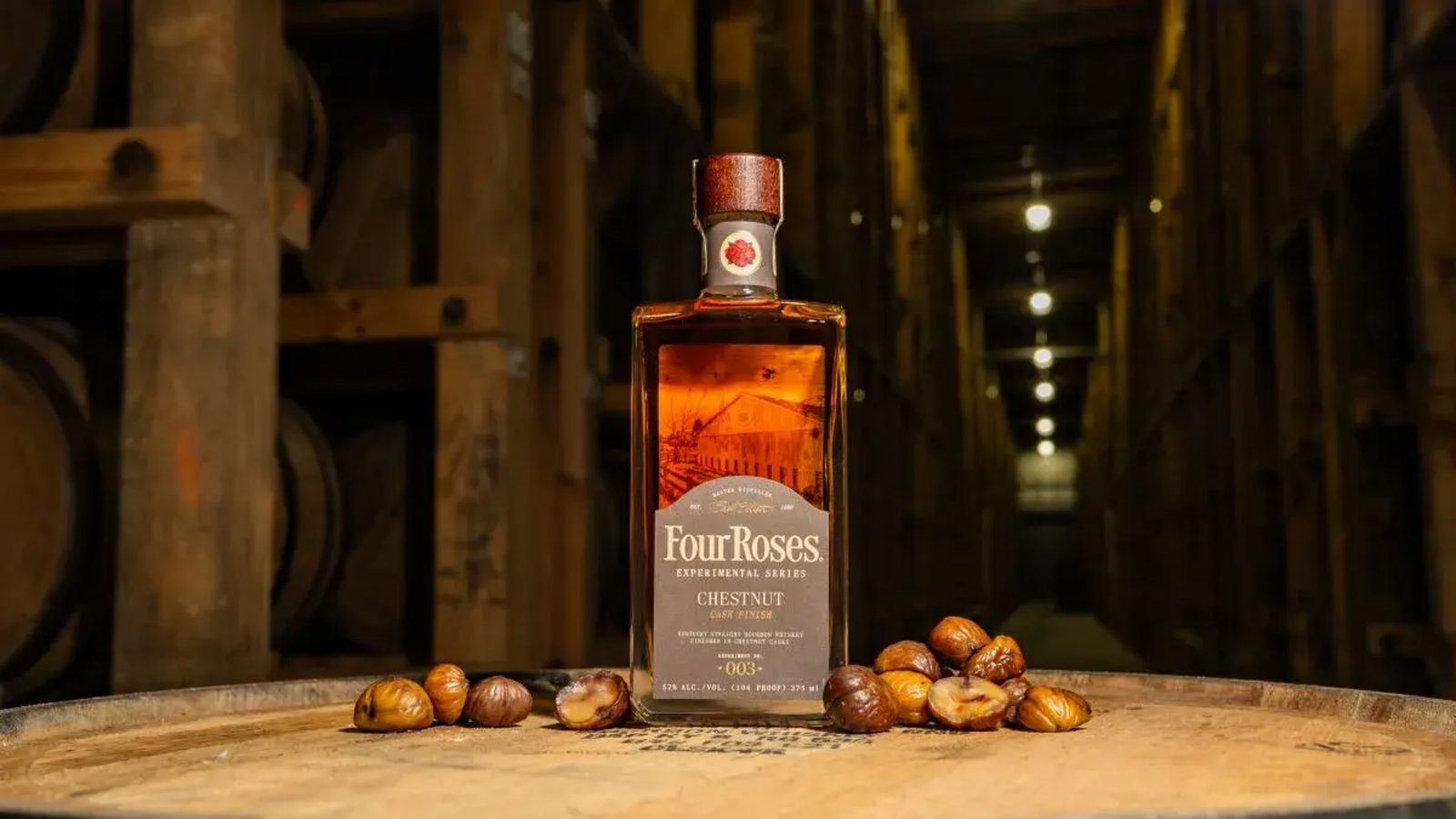

Four Roses has released Experimental Series No. 003: Chestnut, the third cask-finished bourbon in a line the distillery launched this year. The whiskey began as six-year-old OBSK bourbon, then moved into 250-liter chestnut barrels for a finishing period of five to 11 weeks before bottling at 104 proof.
The release is the first chestnut-finished whiskey in the series and follows a first for Four Roses itself, which had never put out a cask-finished bourbon before 2026. The chestnut wood came from Japan, and the barrels were toasted and charred to different levels.
Master distiller Brent Elliott described the appeal in a statement. "To me, what makes this release so interesting is how chestnut wood can enhance and highlight the flavors of a bourbon," he said, adding that the distillery trialed a number of wood types and that chestnut stood out for its unique character.
Elliott explained why the OBSK recipe was chosen as the backbone. "The OBSK recipe had the complexity and spice we were looking for to complement those flavors, creating a bourbon that feels familiar in its foundation but offers new, distinct flavors in the glass," he said.
The letters in that code describe the whiskey's construction. The O stands for the Four Roses distillery, the B marks a high-rye mashbill, the S identifies straight bourbon, and the K names the yeast strain. It is one of ten recipes the distillery uses, drawn from two mashbills and five yeasts.
Across the Experimental Series, Four Roses has used only a few of those ten recipes. The first, finished in mizunara, was built on OBSK; the second, the honey cask finish, combined OESQ and OBSK. The chestnut release returns to OBSK alone.
Chestnut is an uncommon wood in whiskey maturation, though not unheard of. A recent example is the Midleton Very Rare Rare Wood Collection, described as the first Irish whiskey finished in sweet chestnut barrels. Four Roses takes the idea into American bourbon.
A critic who sampled the bourbon at the distillery last spring called it the most rye-like expression in the Experimental Series. Dry, tannic spice leads the palate, alongside vanilla, green apple, brown sugar and maple candy.
The whiskey is bottled in 375 ml format and carries a suggested retail price of $55. It goes on sale at the distillery from November 20, while supplies last. No wider retail rollout was mentioned in the announcement.
How Four Roses builds its bourbon
Four Roses is unusual among bourbon distilleries for using ten distinct recipes. All ten go into the core bourbon, only a few are used for the Small Batch expressions, and a single recipe defines each Single Barrel release.
The distillery has also added new mashbills recently, though that whiskey will not be mature enough to use for a few more years. For now, the Experimental Series works with recipes the distillery already runs.
In our editors' ranking of the best bourbons in the world, Four Roses Single Barrel took the top spot among 15 bottles. We found it complex and full-bodied, with caramel, vanilla, raisins and charred oak behind a long, mellow finish.
The chestnut release differs from that bottle in character. Where the Single Barrel leans on caramel and oak sweetness, the chestnut finish is reported to push toward dry, tannic spice. It is a sideways step from what we rated, not a replacement.
The rules defining bourbon frame all of this. To carry the name, a whiskey must be made in the United States from a mash of at least 51% corn and aged in new charred oak barrels, and Kentucky still accounts for most of the world's supply.
What the experimental line is testing
Mizunara brought one set of aromatics, honey casks another, and chestnut supplies the dry spice that sets it apart from both. Each release changes the finishing wood while drawing on the same or a similar OBSK base.
Four Roses varied the toast and char levels across the chestnut barrels, with finishing times running from five to 11 weeks, before the result was bottled as one 104-proof expression. The small 375 ml format and distillery-only sale limit how many bottles reach buyers.
Support the content you love — it’s free 🎉
Add Luxe Digital as a preferred source on Google. Our stories will be more likely to appear in Google’s Top Stories. It’s free and supports our team. Thank you!
Add as preferred sourceYou can remove us any time in Google’s source preferences.
Thank you — you’re all set 🎉
Luxe Digital is now one of your preferred sources, so our stories are more likely to appear in Google’s Top Stories.
This briefing is published daily using an AI-powered system crafted by Luxe Digital’s team and finely tuned to meet our editorial standards. While we continuously test and review the output, mistakes can sometimes happen. Tell us if you spot one.
Image: Four Roses