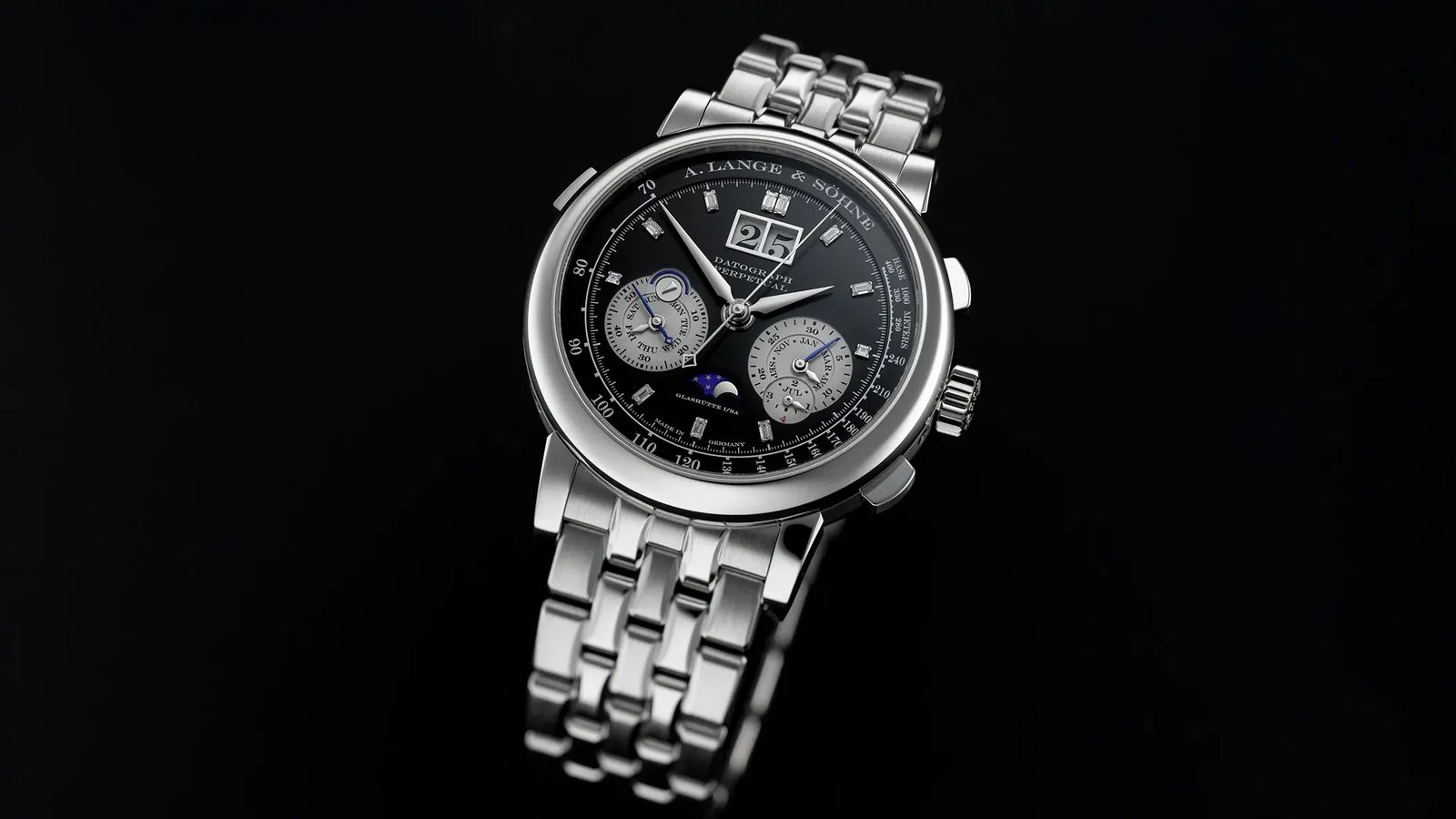

A. Lange & Söhne has brought back the full-platinum bracelet, absent from its line for years, on a new limited edition of the Datograph Perpetual. The watch, reference 410.136E, is restricted to 50 pieces and pairs the 950 platinum bracelet with a glossy black dial set with diamond markers.
The bracelet is the centerpiece and it is entirely new. Nothing in its five rows resembles the old Wellendorff-supplied bracelets, most of which had seven polished links. Instead it alternates brushed and polished links of differing shapes, with pronounced lateral polished chamfers throughout.
The craftsmanship is in-house. Wellendorff, the German jeweller that once supplied Lange's metal bracelets, now focuses exclusively on jewelry and no longer makes watch bracelets, so Lange designed this one itself. It draws on the experience gained from the Odysseus, though the philosophy is jewelry rather than sport.
The clasp carries none of the Odysseus tool-free adjustment. There is no microadjustment at all, and the deployant is flush with the bracelet for a cleaner line. A bold Lange engraving on the folding clasp recalls the inscription found on the old Wellendorff examples.
That absence of adjustment is the one point of friction in the early hands-on reports. A bracelet this heavy, worn slightly loose, will be unwieldy. It is the trade-off Lange accepted in favor of the more elegant silhouette the flush clasp delivers.
The dial is solid silver finished in glossy black, and it is the first black dial on a standard Datograph Perpetual. Earlier iterations carried grey or silver-hued dials. Rhodium-plated sub-dials and white date discs keep the display legible against the dark ground.
Eleven baguette-cut diamonds take the place of the usual baton hour markers, with two of them at twelve o'clock. Lange puts the total weight at roughly 0.13 carats, graded F-G and VVS. The markers at four and eight are deliberately omitted, and there is no luminous material on the watch.
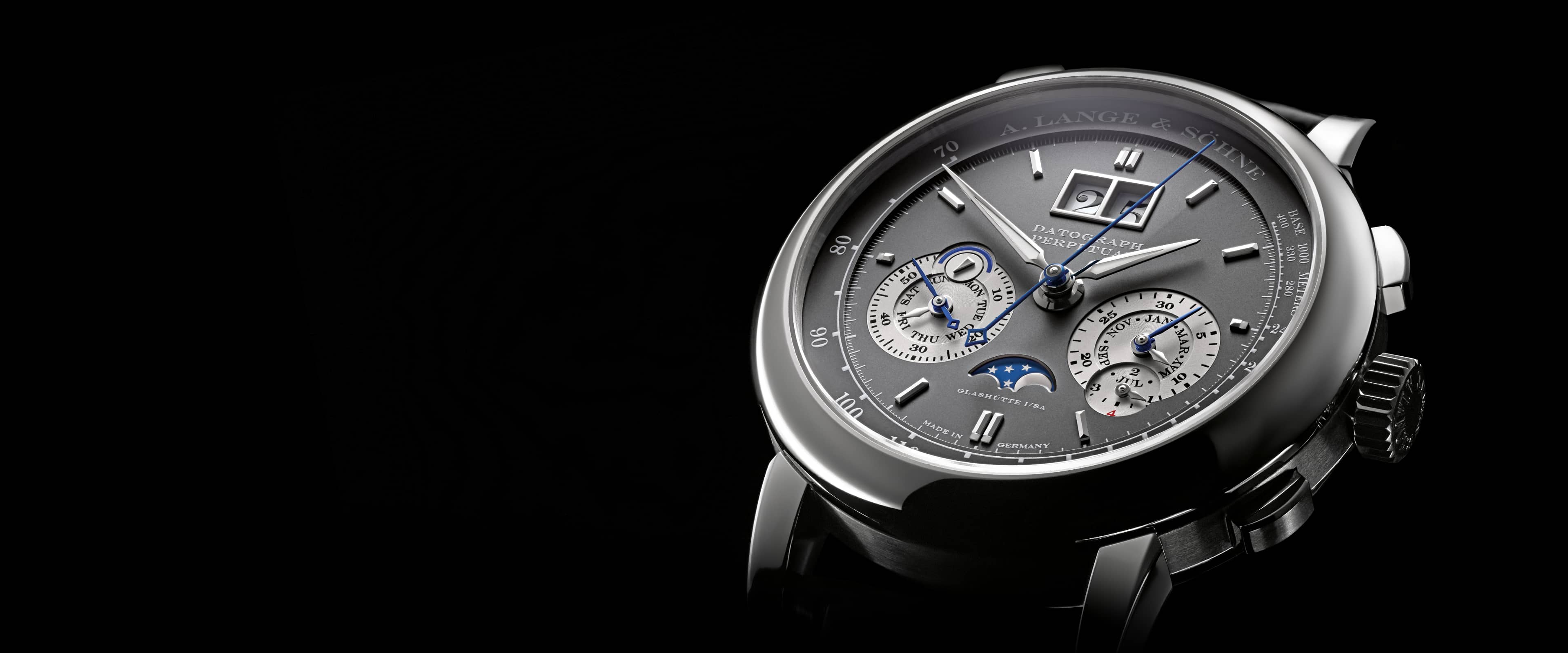
The main hands are white gold, while the chronograph hands are blued steel. A tachymeter scale runs around the dial's perimeter, interrupted only by the arcing A. Lange & Söhne signature above twelve. Two shorter diamonds at three and nine keep the sub-dials unobstructed.
The display is unchanged and dense. The counter at three o'clock carries the elapsed thirty minutes, the month and a leap-year pointer. At nine are the running seconds, the day of the week and a day-night indicator, with the outsize date above forming an equilateral triangle with both sub-dials.
The moonphase is at six o'clock with a solid gold moon disc, balancing the outsize date at twelve. Hours, minutes and chronograph seconds read centrally. A rapid-correction pusher at ten o'clock advances every calendar indication and the moonphase at once, but only acts while the crown is pulled out.
That pusher carries two safety locks. Besides requiring the crown to be withdrawn, it deactivates as the calendar approaches midnight and for a short window after. The individual calendar correctors are recessed pushers set into the sides of the case.
The movement is the manually wound L952.1, unchanged from prior references and built on the first-generation Datograph base with a perpetual calendar on top. It has 556 components, 45 jewels, beats at 18,000 vibrations per hour and stores a modest 36 hours of power.
That power reserve is the acknowledged weakness on a hand-wound perpetual calendar. A flyback chronograph with a lateral clutch and column wheel, the caliber also has a German silver mainplate, a hand-engraved balance cock, ribbing and beveled edges seen through the sapphire back.
A bracelet with a collecting history
The first-generation Datograph, launched in 1999, was offered with Wellendorff bracelets carrying their own reference numbers, including the soldered 453.035 and the detachable 453.135 with straight ends. Adding one ran into the tens of thousands of euros, so relatively few were ordered and most watches left the factory on leather.
Some unsold bracelets were melted down and recycled into watch cases, which is one reason complete examples are now exceptionally rare. Auction house Loupe This recently sold a first-generation 19mm straight-end platinum Wellendorff bracelet, without its watch, for $116,000, noting such bracelets are rarely found separately.
The Datograph is, with the Lange 1, probably the most important model the Saxon house has made, a hand-wound chronograph with a new in-house movement at a time when few existed. The Datograph Perpetual followed in 2006 as the first Lange to unite a chronograph with a perpetual calendar and outsize date.
This edition arrives on the model's 20th anniversary, and on 24 October, the date marking Lange's 1994 revival in Glashütte. In our ranking of the best luxury watch brands, we place the German house firmly in the conversation with Patek Philippe, Audemars Piguet and Vacheron Constantin.
The case is 950 platinum, 41mm across and 13.5mm thick, matching the white gold permanent model, with 30 meters of water resistance. With the bracelet the watch may approach 300 grams, though one reviewer found it wears better than the numbers suggest.
Lange gives the price only on request. Estimates range from around EUR 250,000 to around EUR 280,000. Each watch is individually numbered on the case back and the 50 pieces are available through Lange boutiques, likely reaching only the brand's largest collectors.
Support the content you love — it’s free 🎉
Add Luxe Digital as a preferred source on Google. Our stories will be more likely to appear in Google’s Top Stories. It’s free and supports our team. Thank you!
Add as preferred sourceYou can remove us any time in Google’s source preferences.
Thank you — you’re all set 🎉
Luxe Digital is now one of your preferred sources, so our stories are more likely to appear in Google’s Top Stories.
This briefing is published daily using an AI-powered system crafted by Luxe Digital’s team and finely tuned to meet our editorial standards. While we continuously test and review the output, mistakes can sometimes happen. Tell us if you spot one.
Images: A. Lange & Söhne