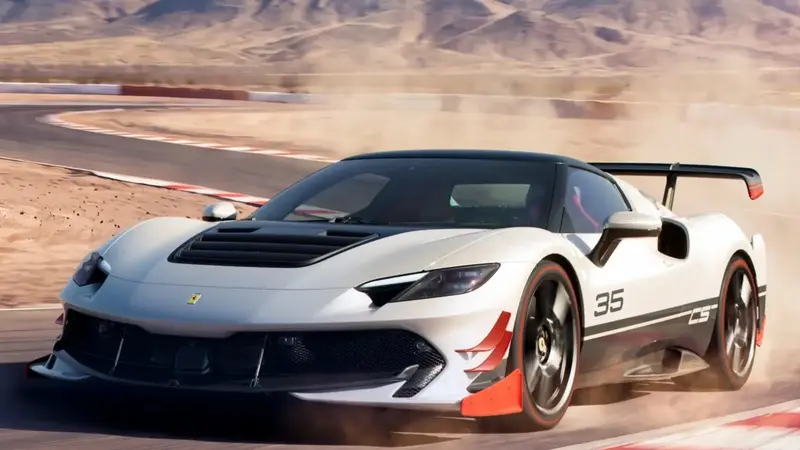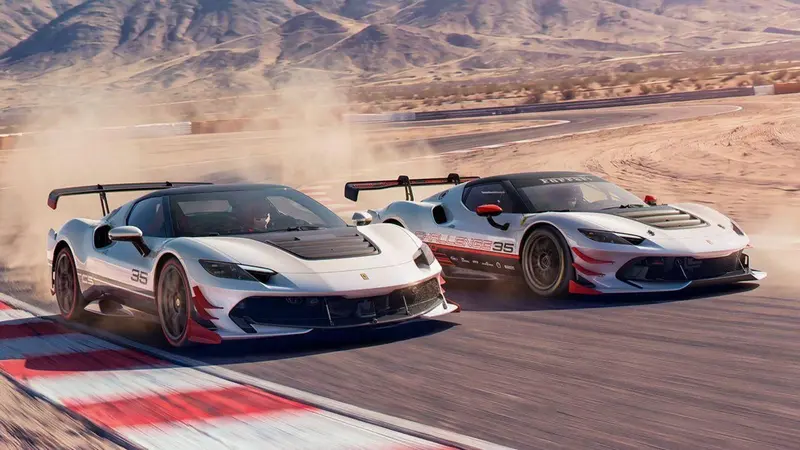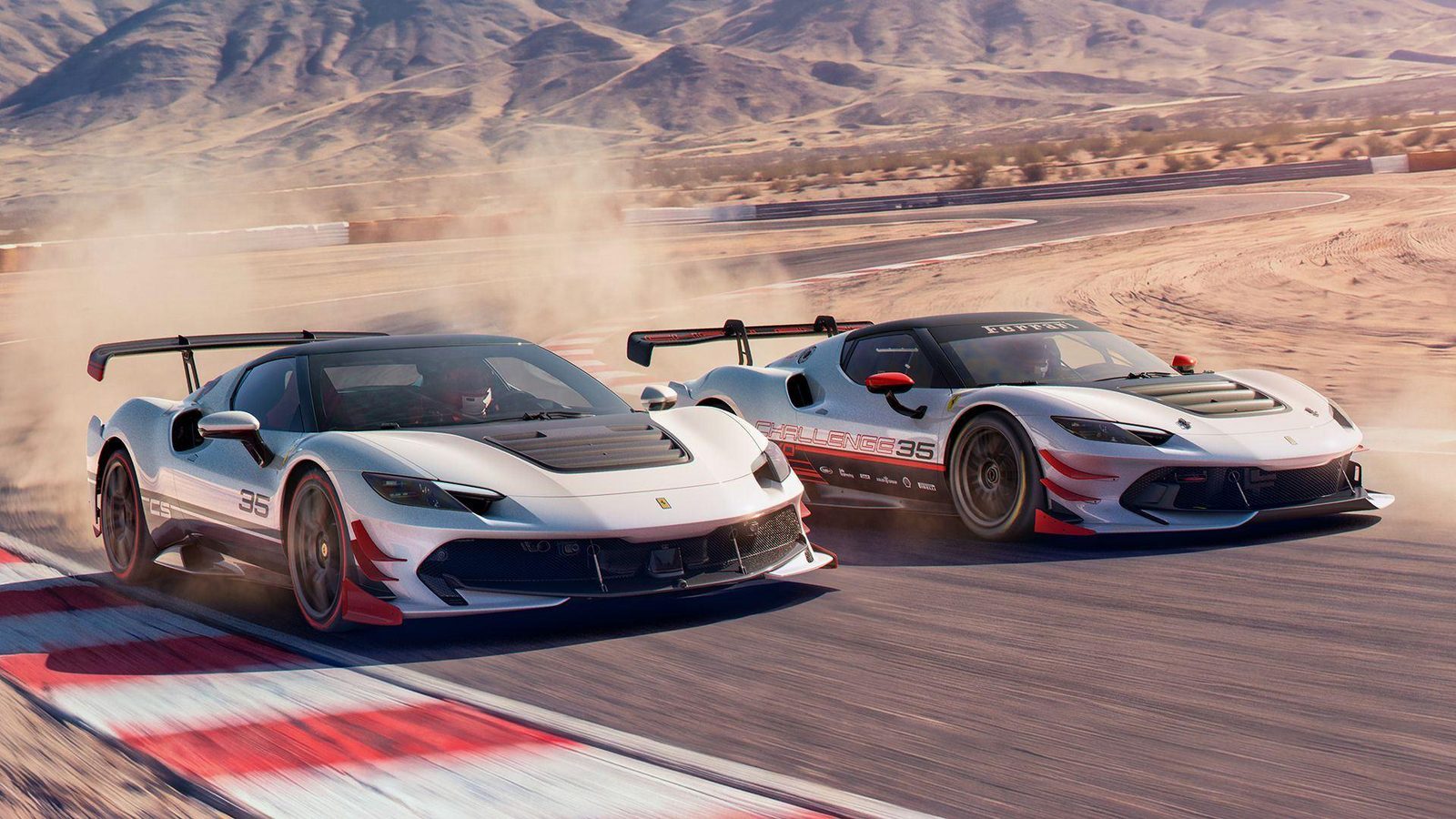

Ferrari pulled the covers off two new variants of its V-6 296 on Saturday at Finali Mondiali in Barcelona, the season-ending celebration of its 34-year-old Challenge Trofeo Pirelli amateur racing series. One car is street-legal, the other exists for the track.
The powertrain switch
Both drop the plug-in hybrid system that the standard 296 uses to spike output to 820 hp. The road-going 296 Challenge Stradale makes 670 hp and the 296 Challenge Evo makes 700 hp, matching the approach the previous 296 Challenge race car had already taken.
The Challenge Stradale revives a name last used in 2003, when Maranello lightened and stiffened the 360 Modena to build the 360 Challenge Stradale, a model that now trades at a meaningful premium over the standard coupe nearly a quarter century on.
The weight and aero gains are the real story. The new Stradale is 308 pounds lighter than the stock 296 GTB and generates 1,360 pounds of downforce at 155 mph. The Challenge Evo carries the same reduction and adds more aero and chassis work for sharper lines.
Gianmaria Fulgenzi, Ferrari's chief product development officer, framed the car around connection rather than output. "We wanted to change the paradigm and not just increase horsepower at all costs," he said, "but instead to move towards a car that is all about a better relationship with the driver."
The Stradale goes on sale in the second quarter of 2027 with a sticker around $320,000. The Challenge Evo, closer to $400,000, reaches buyers in Q1, timed so European and North American racers can take delivery before the Challenge season opens.
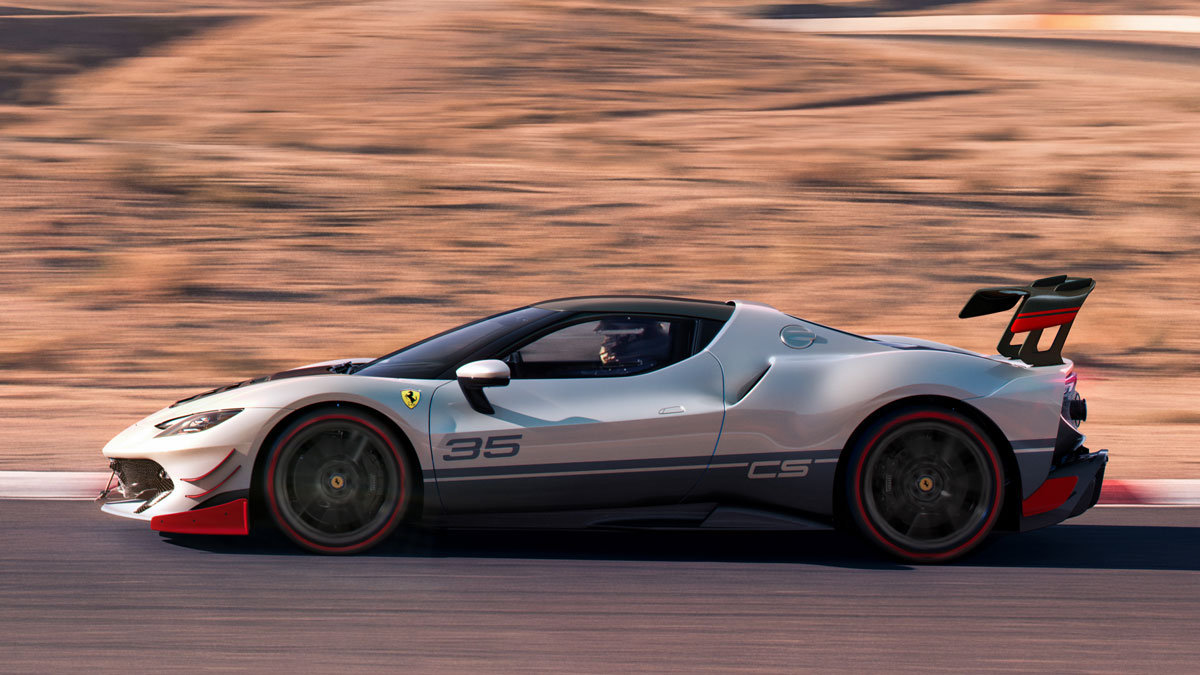
Ferrari now offers more than half a dozen versions of the 296. The lineup is built on the hybrid 296 GTB coupe and 296 GTS folding hardtop, joined in 2025 by the Speciale and Speciale A with an extra 60 hp, slipperier bodywork, better brakes and a tauter suspension.
The 296 GT Modificata, a limited track-only edition revealed this fall, was the first to set aside the electric motors. Its owners run non-competitive laps through the Club Competizioni GT program, a counterpart to the Corse Clienti circle for vintage F1 and FXX cars.
The Stradale up close
Up close in Barcelona's convention center, the Stradale reads as barely contained aggression. A bumper wing at the front aids road holding, the hood carries a large insert housing the radiator outlets, and the rear wears an adjustable wing only slightly tamer than the Evo's.
Inside are proper race lap and shoulder harnesses. The car is technically road legal but carries a pit-lane posture, and Ferrari is offering options that push further: a track-only exhaust that a dealer can install and remove, and a stripped interior that leaves much of the chassis exposed.
That stripped cabin is a first for a production Ferrari, removing all superfluous trim. On the mechanical side the V-6 is retuned for low-end torque, and the eight-speed dual-clutch F1 transmission prioritizes torque at high loads and smoothness at lower revs.
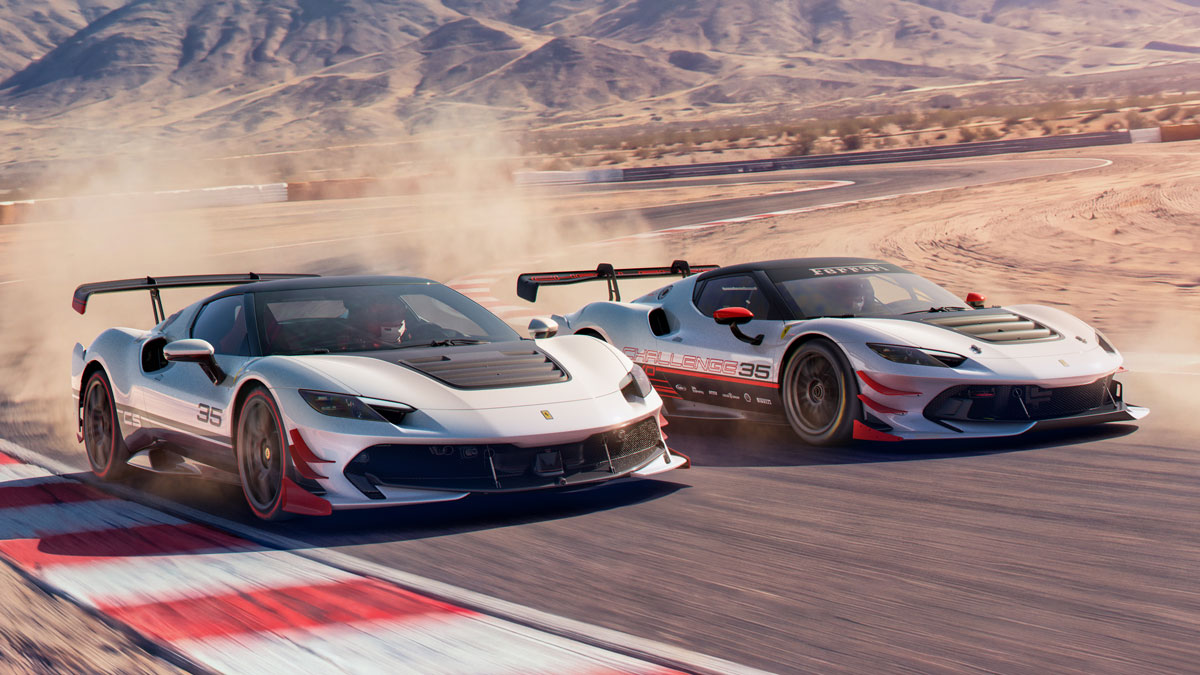
The Stradale borrows directly from the race series, including dedicated spring rates and carbon-ceramic brakes claimed to feel identical to the Evo's. Unlike its track sibling, it keeps a full suite of driver assists, from adaptive cruise control to driver-drowsiness alerts.
The Challenge Evo
The Challenge Evo is the tenth iteration of the Challenge race car and trades in incremental gains aimed at skilled drivers. Aerodynamics, braking and engine management all move it closer to the pro-series GT3 Evo, which it shadows under the Prancing Horse's ladder.
In maximum-downforce trim, the Evo laps Mugello 0.8 seconds quicker than the current 296 Challenge, with 12 percent more downforce and 4 percent less drag. The rear wing's angle of attack grows 4 percent, and drivers get more aero adjustability for next season.
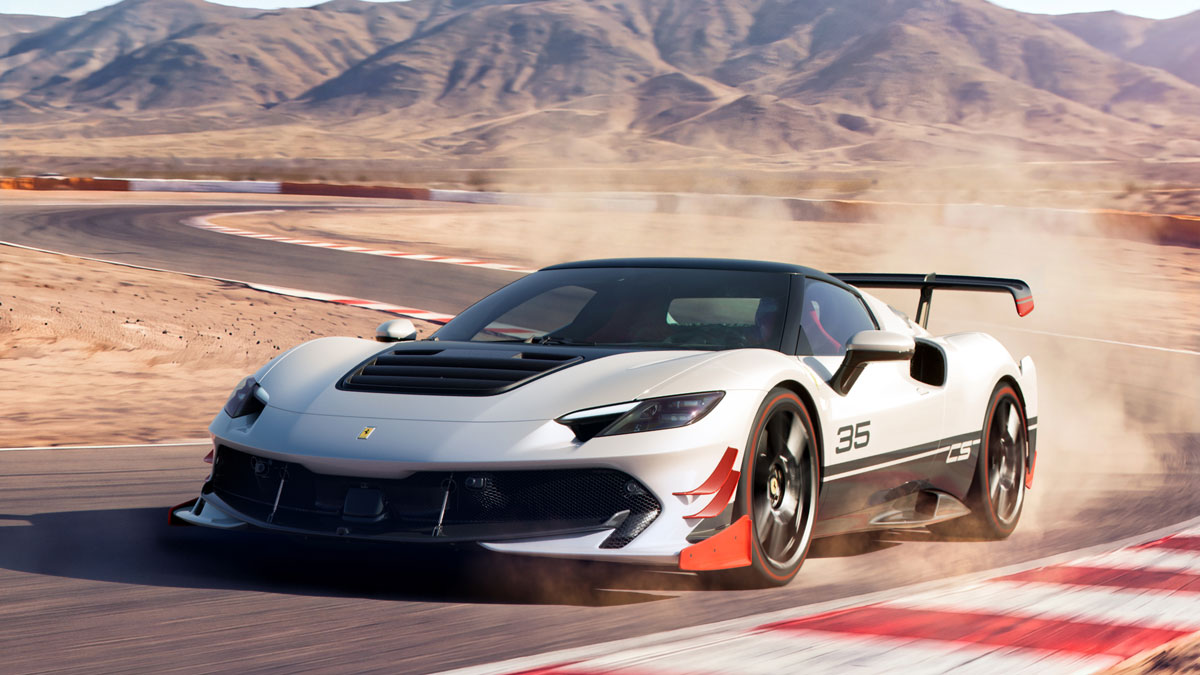
Both cars ride on model-specific Pirelli P Zero R and P Zero Trofeo RS rubber, a choice that should pay off when next year's Challenge series adds 40-minute endurance races to the calendar. Ferrari has not yet put either car in the hands of journalists.
We have followed the 296's path into track trim closely: our earlier coverage of the Challenge Stradale recorded the switch from the hybrid to a fixed-wing 670 hp layout before this full debut, and Ferrari tops our ranking of the best Italian car brands.
That ranking places the marque first for a reputation forged with a record 16 constructors' championship wins, with the 488 its all-time best-seller. Among our most expensive cars list sits the 250 GTO, whose $70 million private-sale record still anchors the top of the market.
The Stradale joins production in 2027 and the Evo reaches racers in early 2026, leaving the coming Challenge season as the field's first real test of whether the new aero and endurance-race pace deliver on Fulgenzi's promise of a better driver relationship.
Support the content you love — it’s free 🎉
Add Luxe Digital as a preferred source on Google. Our stories will be more likely to appear in Google’s Top Stories. It’s free and supports our team. Thank you!
Add as preferred sourceYou can remove us any time in Google’s source preferences.
Thank you — you’re all set 🎉
Luxe Digital is now one of your preferred sources, so our stories are more likely to appear in Google’s Top Stories.
This briefing is published daily using an AI-powered system crafted by Luxe Digital’s team and finely tuned to meet our editorial standards. While we continuously test and review the output, mistakes can sometimes happen. Tell us if you spot one.
Images: Ferrari