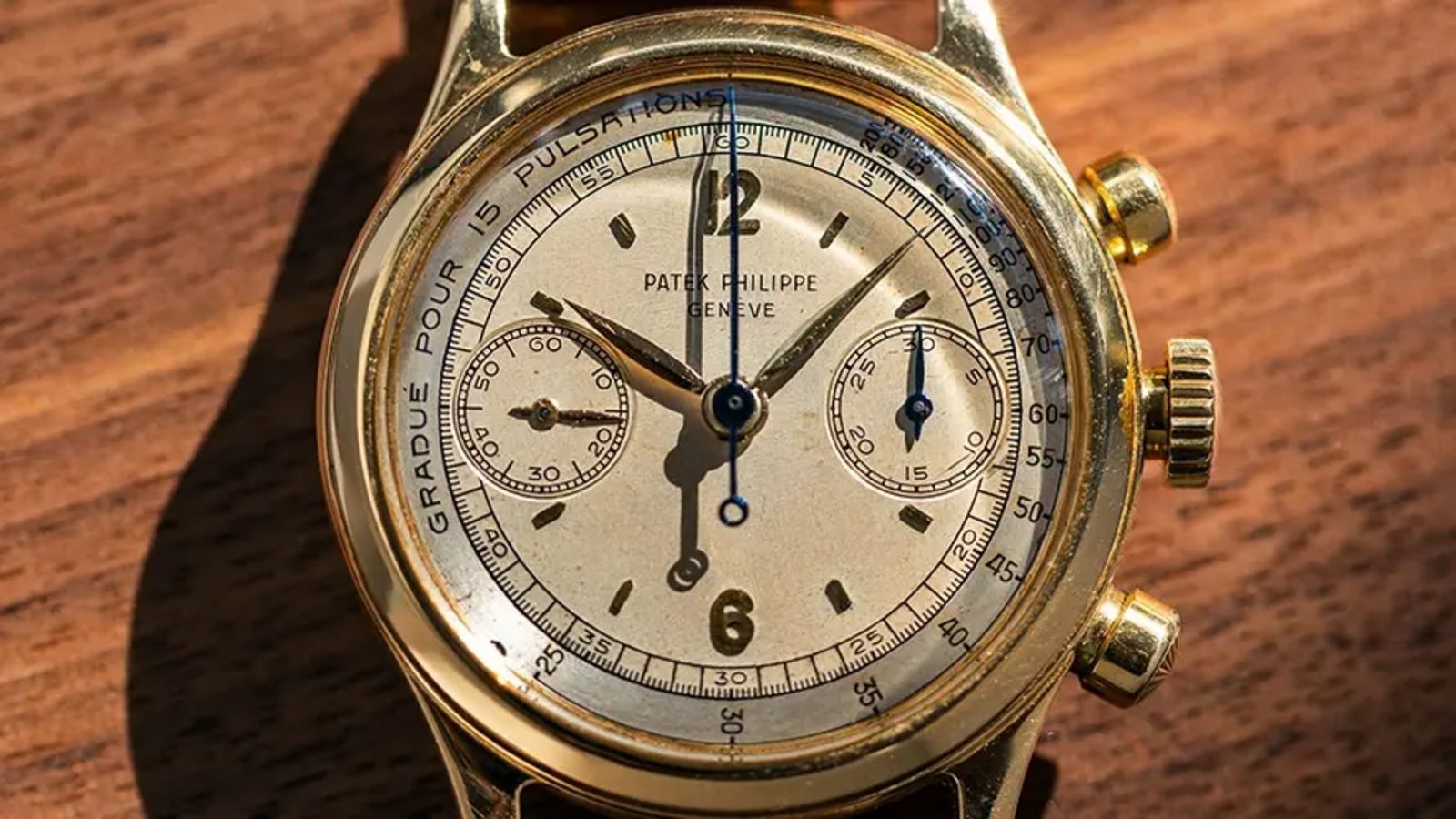

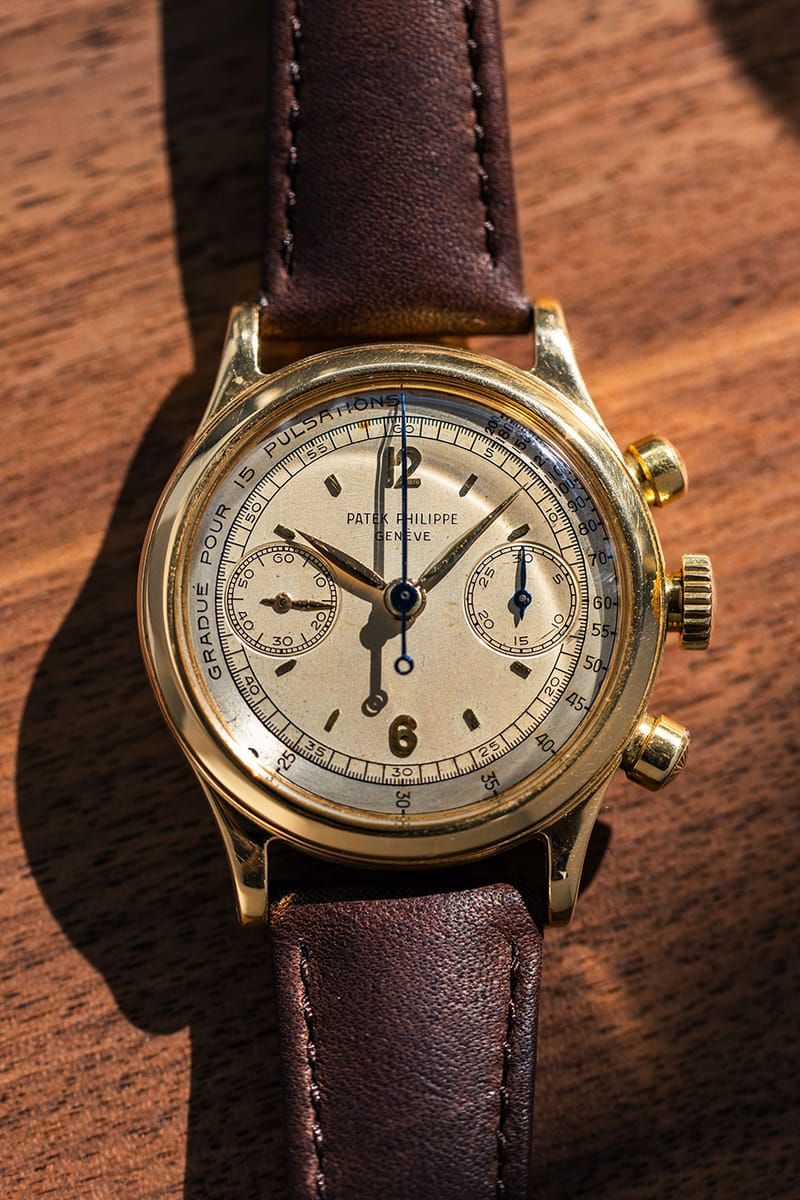
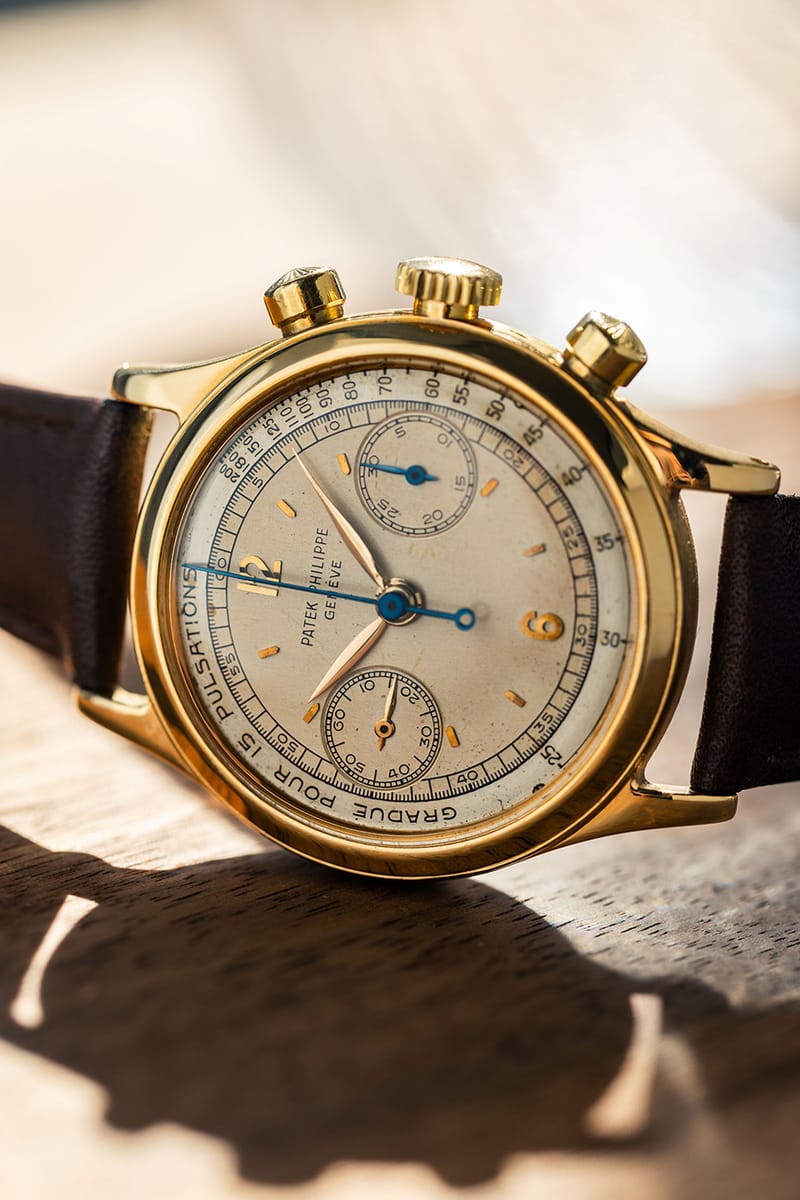
The Patek Philippe Reference 1563, known as "The Doctor," is the centerpiece of Sotheby's The Human Touch exhibition in Zürich. The 1943 watch holds a place none of its rivals can claim: it is the earliest known water-resistant split-seconds wristwatch in horological history, and Sotheby's has not put a price on it.
The watch began life as something else entirely. It started as a Reference 1436 split-seconds chronograph carrying movement number 862,420. At the request of its first owner, Patek Philippe rehoused the movement in that same year, 1943, giving the piece the identity collectors now search for.
The new home was a screw-back water-resistant case measuring 34.8mm, built by Taubert & Fils. That firm had taken over the case-making business of François Borgel and kept its "FB" hallmark. The case drew on the Reference 1463 but was made taller to accommodate the split-seconds movement.
The converted watch received a new case number, 630,552, and its case is stamped "Key 11" and "FB." It also gained a two-tone pulsation dial, a scale a physician would use to read a patient's heart rate. That detail is what separates "The Doctor" from every other example of the reference.
Only three examples of the Reference 1563 appear in Patek Philippe's archives, and just two carry the dedicated Taubert & Borgel case. Their case numbers run consecutively: 630,551 and 630,552. The lower number was fitted in 1946 to the watch later owned by Duke Ellington.
This one, 630,552, was cased three years earlier, in 1943. That gap makes "The Doctor" the oldest of the three known examples, and the only one fitted with a pulsation dial. The reference itself stayed unknown to the public for decades after it was built.
That changed in 1998, when Ellington's watch surfaced at Antiquorum. The sale prompted Patek Philippe to issue an Extract from the Archives that officially confirmed the reference existed. Until then, collectors had no documentary proof of the water-resistant split-seconds.
"The Doctor" carries its own Extract, dated August 6, 2024, which verifies the reference, the movement and case numbers, and the 1943 conversion. It was also part of Jean-Claude Biver's collection. The other two examples sit elsewhere: one in a private collection, one at the Patek Philippe Museum in Geneva.
Patek Philippe is the maison we rank second only to Rolex among luxury watch brands, a name that defines the summit of haute horlogerie alongside Audemars Piguet and Vacheron Constantin. A maker known for never taking a shortcut, it built this reference's reputation on precisely the kind of one-off conversion now on display.
What the watch is worth
Sotheby's has published no estimate or price for "The Doctor," leaving the figure as to be announced. The market points toward a serious number. A steel Reference 1436, the watch this piece began as, sold for 6.3 million Swiss francs, around $7.4 million, and that was before the water-resistant conversion entered the equation.
Auction records in this corner of the collector market keep moving. The most anyone has actually paid is $31 million, for the Patek Philippe Grandmaster Chime Ref. 6300A-010 at Only Watch in November 2019. The highest figure attached to any watch, $55 million, is Graff's own valuation for The Hallucination, never sold.
A steel Patek Ref. 1518 took $17.6 million at Phillips Geneva in November 2025. An F.P. Journe Resonance reached $13.9 million in New York in June 2026, the most ever for an independent watchmaker. Against those marks, a one-of-three Patek with this history sits comfortably in seven-figure territory.
The third example, and what comes next
The reference's three examples offer a clean dividing line: the Duke Ellington watch, this "Doctor," and the piece at the Patek Philippe Museum in Geneva. Two are out of reach, one on long-term display and one in private hands. That concentration is part of why the Zürich showing matters.
The exhibition gives collectors a rare chance to study the earliest water-resistant split-seconds in person before it potentially returns to private ownership. Sotheby's has said nothing further about whether "The Doctor" will be offered at one of its Geneva sales or remain on view.
The watch also deepens our coverage of watches jewelry, where Patek Philippe's current collection anchors the top of the pocket-watch field and its pieces repeatedly set the auction benchmarks we track. A piece like this reinforces the maison's standing as the reference point for rare complications.
For the moment, the only certainty is the location. "The Doctor" is on view in Zürich as part of The Human Touch, a named Patek Philippe with a pulsation dial, an Extract verifying its 1943 conversion, and a provenance that runs through one of modern horology's best-known collectors.
Support the content you love — it’s free 🎉
Add Luxe Digital as a preferred source on Google. Our stories will be more likely to appear in Google’s Top Stories. It’s free and supports our team. Thank you!
Add as preferred sourceYou can remove us any time in Google’s source preferences.
Thank you — you’re all set 🎉
Luxe Digital is now one of your preferred sources, so our stories are more likely to appear in Google’s Top Stories.
This briefing is published daily using an AI-powered system crafted by Luxe Digital’s team and finely tuned to meet our editorial standards. While we continuously test and review the output, mistakes can sometimes happen. Tell us if you spot one.
Images: Patek Philippe