
Arnold & Son has updated its DSTB deadbeat-seconds watch with hacking functionality, launching the DSTB Stop-Seconds in time for WatchTime NY. Two limited editions, Cliff Grey and Kingsand, arrive in 5N red gold and platinum, each capped at 18 pieces.
The red gold version costs $58,700 and the platinum edition $72,500. Both carry a markup of a little over a thousand dollars over the outgoing references in their respective metals, despite the two upgrades now added to the line.
The headline change is stop-seconds. Hacking lets the wearer halt the seconds hand while setting the time, and it matters most on a watch whose entire architecture is built around an oversized, jumping seconds display.
What changes on the dial
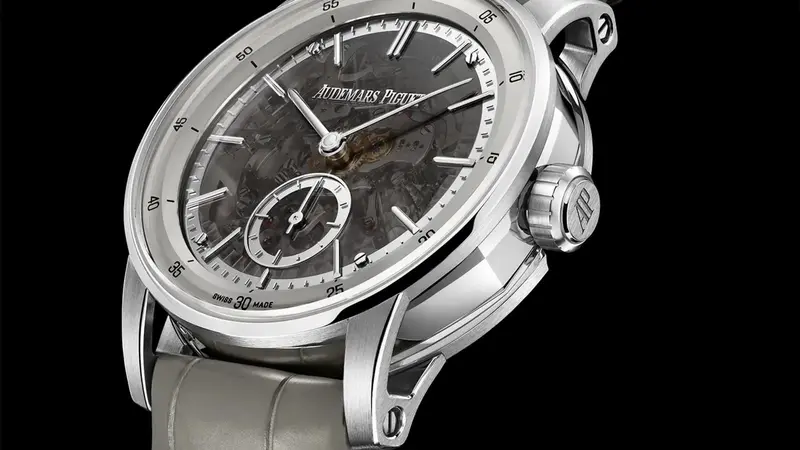
The deadbeat, or true-seconds, complication is the focus of the design. Its mechanism is isolated from the rest of the caliber, so a few bridges, gears and the release mechanism are on full display, turning the constantly beating movement into pulses that move the seconds hand once per second.
The layout is asymmetrical. The true-beat mechanism takes up much of the area between nine and twelve o'clock, beside an oversized railroad seconds track printed in blue that frames each jump of the hand.
The lever of the deadbeat mechanism is shaped like the anchor in the Arnold & Son logo, itself an homage to John Arnold's marine chronometers. It is executed in blued steel, though the anchor can feel a little too graphical against an otherwise elegant dial.
The hour and minute subdial is offset near five o'clock, made of white opal and slightly raised from the main dial. New this time, it is concave: its center sinks back toward the base level, and the printed Roman numerals curve along the slope. Earlier DSTB editions had a flat opal subdial.
One wish remains, given the watch's emphasis on chronometry: minute markings on that subdial. They are absent.
The base dials are grained and receive their colour from a PVD coating: light grey on the red gold model, pale gold on the platinum edition as a warm contrast. Both are quite sparkly in direct light, yet legibility is unaffected.
Movement, case and wearing size
Both editions run on the in-house automatic A&S6303 caliber, which offers deadbeat seconds plus hacking seconds and a power reserve of 55 hours. Finishing includes radial Côtes de Genève on the bridges, anglage, blued screws and several brushing techniques.
The rotor carries guilloché decoration and the anchor logo again. The movement is housed in a 42mm case in 5N red gold or platinum, with a case height of 12.95mm and water resistance of 30 meters.
On the wrist the DSTB Stop-Seconds wears large, as earlier versions have. The expansive dial and thin bezels make it look bigger than it is, and most complicated Arnold & Son models come in larger cases.
The movement diameter is 36.2mm, which leaves hope for a downsized design someday. For now the size serves a watch meant as a showcase for a dramatic jumping seconds complication, and the dial elements fill the front intentionally.
Arnold & Son is the Swiss manufacture named for eighteenth-century English watchmaker John Arnold and built around large moonphase and astronomical complications. It belongs to the Citizen Group as a prestige property alongside Angelus, and Pascal Béchu leads both.
Citizen's portfolio reaches well beyond Japan, with Bulova, Frederique Constant, Alpina and La-Joux Perret among its key properties. Arnold & Son stands out within it mostly through its price point and its complicated high horology offerings.
For collectors wanting a well-finished, distinctive take on high-end deadbeat seconds, these two editions are more compelling than before. Stop-seconds and the concave stone subdial arrive without a large jump in price over the outgoing versions.
Support the content you love — it’s free 🎉
Add Luxe Digital as a preferred source on Google. Our stories will be more likely to appear in Google’s Top Stories. It’s free and supports our team. Thank you!
Add as preferred sourceYou can remove us any time in Google’s source preferences.
Thank you — you’re all set 🎉
Luxe Digital is now one of your preferred sources, so our stories are more likely to appear in Google’s Top Stories.
This briefing is published daily using an AI-powered system crafted by Luxe Digital’s team and finely tuned to meet our editorial standards. While we continuously test and review the output, mistakes can sometimes happen. Tell us if you spot one.