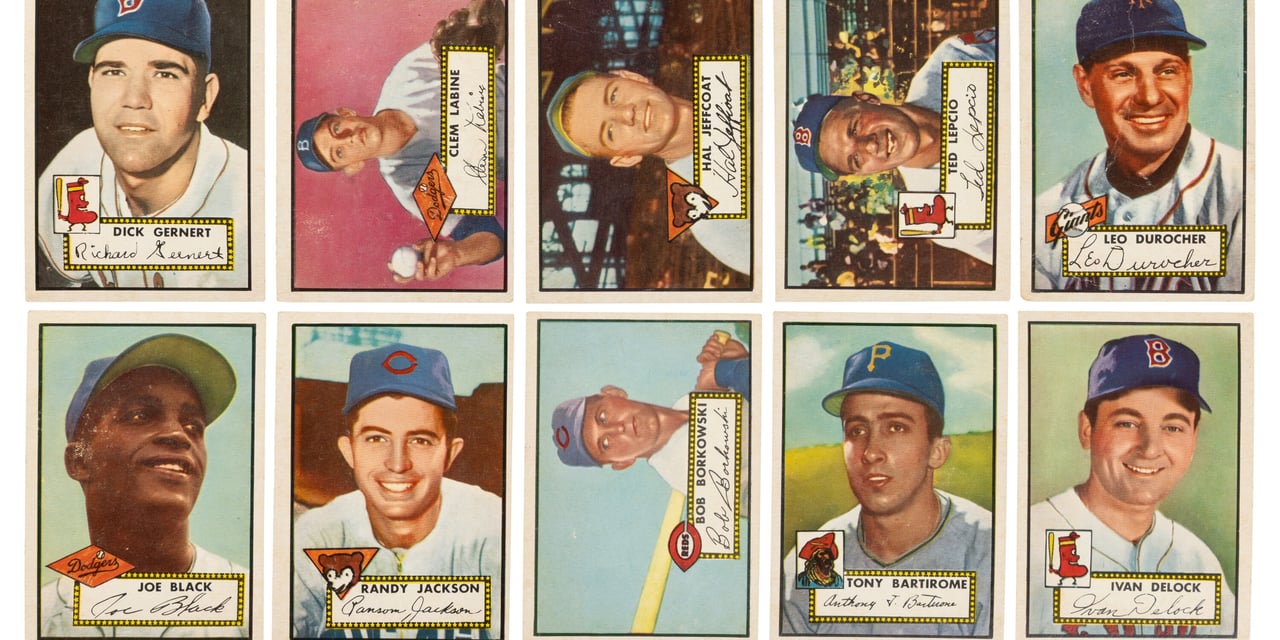
Somewhere in your house, or in a box in a parent’s garage, there is a shoebox of baseball cards that has sat there for decades on the maybe. You have asked, more than once, whether one of them is the card worth a fortune. It is not a foolish question. The answer is almost always no.
Here is how wide that gap is. One card on this list sold for eleven million dollars after someone pulled it from a hobby box at a card shop in Florida. Two copies of the 1969 Topps Reggie Jackson, graded differently, sold for $1,005,600 as a PSA 10 and $99,000 as a PSA 9, at the same auction house on back-to-back days. And by 1991 the industry was printing an estimated five billion cards a year. That is most of why the box in the garage is worth nothing.
Does your shoebox hold one of the exceptions? That depends on the decade, the print run, and a grading scale most people have never heard of.
Every figure here is a completed sale, each one carrying a grade, an auction house and a date. There is one deliberate exception, a card that sold raw and privately and says so in its own entry.
Coins and stamps went through the same arithmetic on different material. The world’s most valuable coins and the rarest stamps ever printed are ranked by the identical two forces that set the prices on this list, scarcity and condition, whatever the object is made of.
The 13 most valuable baseball cards ever sold
| Rank | Card | Grade | Price |
|---|---|---|---|
| 1 | 1952 Topps Mickey Mantle | SGC 9.5 | $12,600,000 |
| 2 | 2026 Topps Chrome Shohei Ohtani Dual Gold Logoman | Ungraded | $11,000,000 |
| 3 | 1909-11 T206 Honus Wagner | SGC 2 | $7,250,000 |
| 4 | 1914 Baltimore News Babe Ruth | SGC 3 | $7,200,000 |
| 5 | 2013 Bowman Chrome Aaron Judge Superfractor | BGS 9.5 | $5,200,000 |
| 6 | 1933 Goudey Babe Ruth #53 | PSA 9 | $4,212,000 |
| 7 | 2009 Bowman Chrome Mike Trout Superfractor | BGS 9 | $3,936,000 |
| 8 | 1951 Bowman Mickey Mantle | PSA 9 | $3,192,000 |
| 9 | 1916 M101-4 Sporting News Babe Ruth | SGC 7 | $1,770,000 |
| 10 | 1955 Topps Roberto Clemente | PSA 9 | $1,150,000 |
| 11 | 2024 Topps Chrome Paul Skenes MLB Debut Patch | PSA 10 | $1,110,000 |
| 12 | 1969 Topps Reggie Jackson | PSA 10 | $1,005,600 |
| 13 | 1952 Topps Jackie Robinson | PSA 9 | $984,000 |
1952 Topps Mickey Mantle: $12,600,000
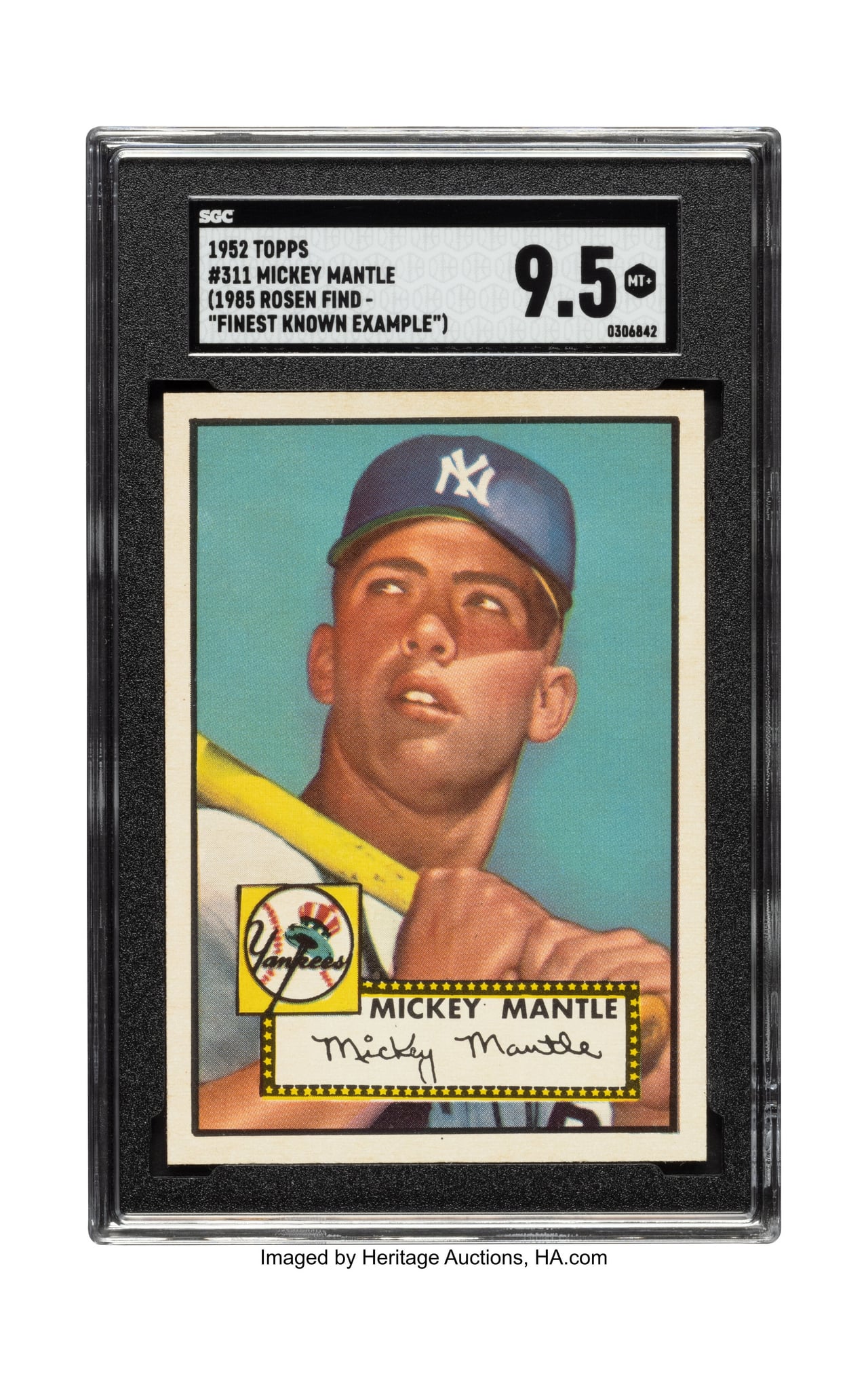
Bowman got to Mickey Mantle first in 1951, so the 1952 Topps card, for all its legend, is not his rookie. What it did was make Topps the company that mattered.
The release arrived in two series, and the high numbers, the ones that carried Mantle at #311, shipped so late in the season that kids had already moved on to football. Topps was left with unsold high-number cases, and in 1960 the company dumped a barge of them into the Atlantic Ocean.
This example belonged to Anthony Giordano, who bought it in 1991 from the dealer Al “Mr. Mint” Rosen. SGC graded it 9.5, the finest known, and an anonymous buyer from Rye, New York paid $12,600,000 for it.
| Set | 1952 Topps #311 |
|---|---|
| Grade | SGC MT+ 9.5 |
| Sold | August 27, 2022 |
| House | Heritage Auctions |
| Price | $12,600,000 |
2026 Topps Chrome Shohei Ohtani Dual Gold Logoman: $11,000,000
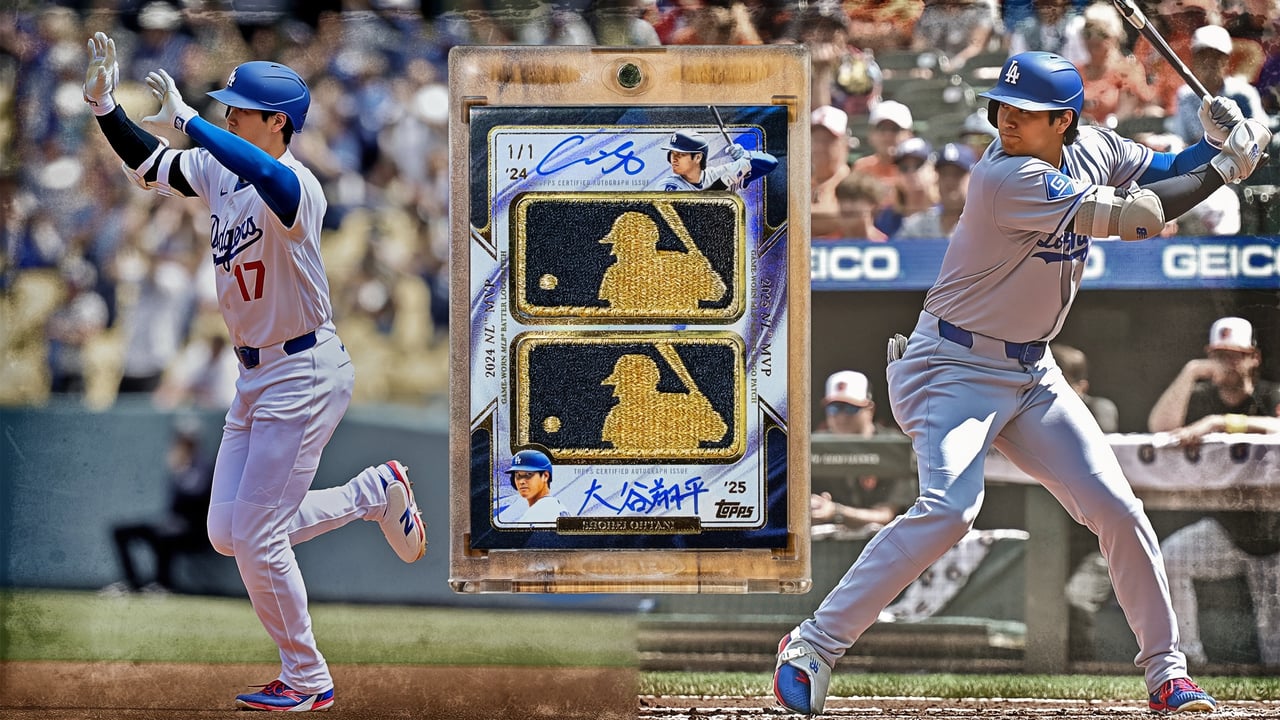
One card on this list did not wait a century to become money. It sold in the summer of 2026.
Topps made exactly one. It carries two gold MLB logo patches cut from jerseys Ohtani wore during his back-to-back National League MVP seasons of 2024 and 2025, plus his signature in English and in kanji. The patches trace to individual games: one from a two-homer night against the Orioles on September 7, 2025, the other from a leadoff home run off Jacob deGrom at Dodger Stadium on April 12, 2026.
An anonymous collector pulled it from a hobby box of Topps Chrome at Boca Sports Cards in Boca Raton, Florida. That collector contacted Matthew Allen, a high-end collector who had posted a $6.5 million bounty on Instagram for the card, and they negotiated privately to $11 million. It sold raw and ungraded, a population of one with nothing to compare against. That is the one deliberate exception in this list, and it ranks third among all sports cards ever sold, behind the Mantle and a Jordan-Bryant basketball card.
| Set | 2026 Topps Chrome Dual Gold Logoman, 1-of-1 |
|---|---|
| Grade | Ungraded |
| Sold | July 2026 |
| House | Private sale |
| Price | $11,000,000 |
1909-11 T206 Honus Wagner: $7,250,000
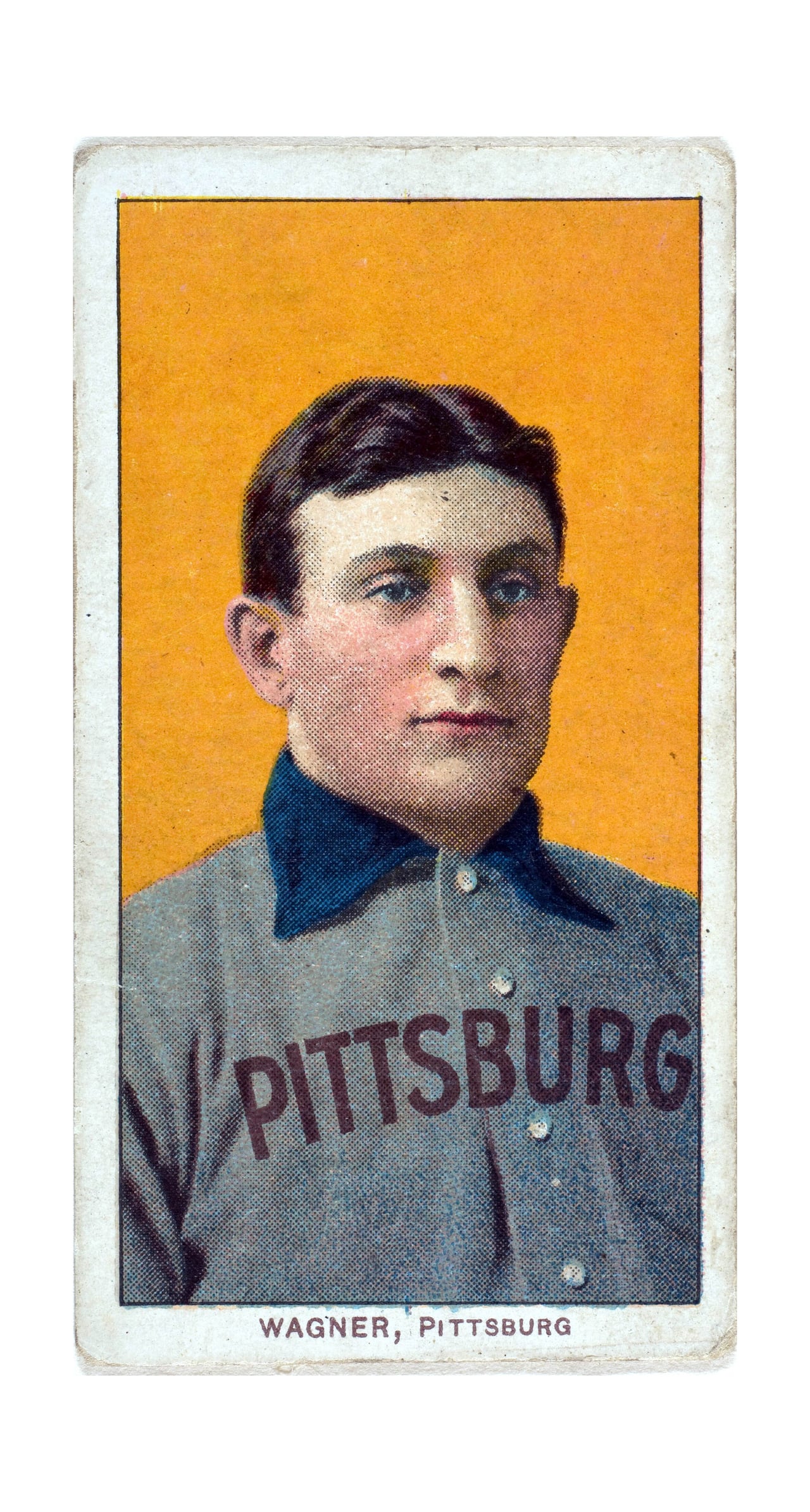
This is the most famous baseball card in the world. No copy of the T206 Honus Wagner exists in mint condition. Roughly 50 to 60 are known, most of them worn.
American Tobacco pulled the card from production early. The usual explanation is that Wagner objected to his image selling cigarettes to children, though some historians argue he simply wanted to be paid. This copy carries a Sweet Caporal back and an SGC grade of 2, one step above poor, with the wear plain. It changed hands privately in August 2022 for $7,250,000 through Goldin, beating the $6.6 million another copy fetched a year earlier.
| Set | 1909-11 T206, Sweet Caporal back |
|---|---|
| Grade | SGC 2 (Good) |
| Sold | August 2022 |
| House | Private sale brokered by Goldin |
| Price | $7,250,000 |
1914 Baltimore News Babe Ruth: $7,200,000
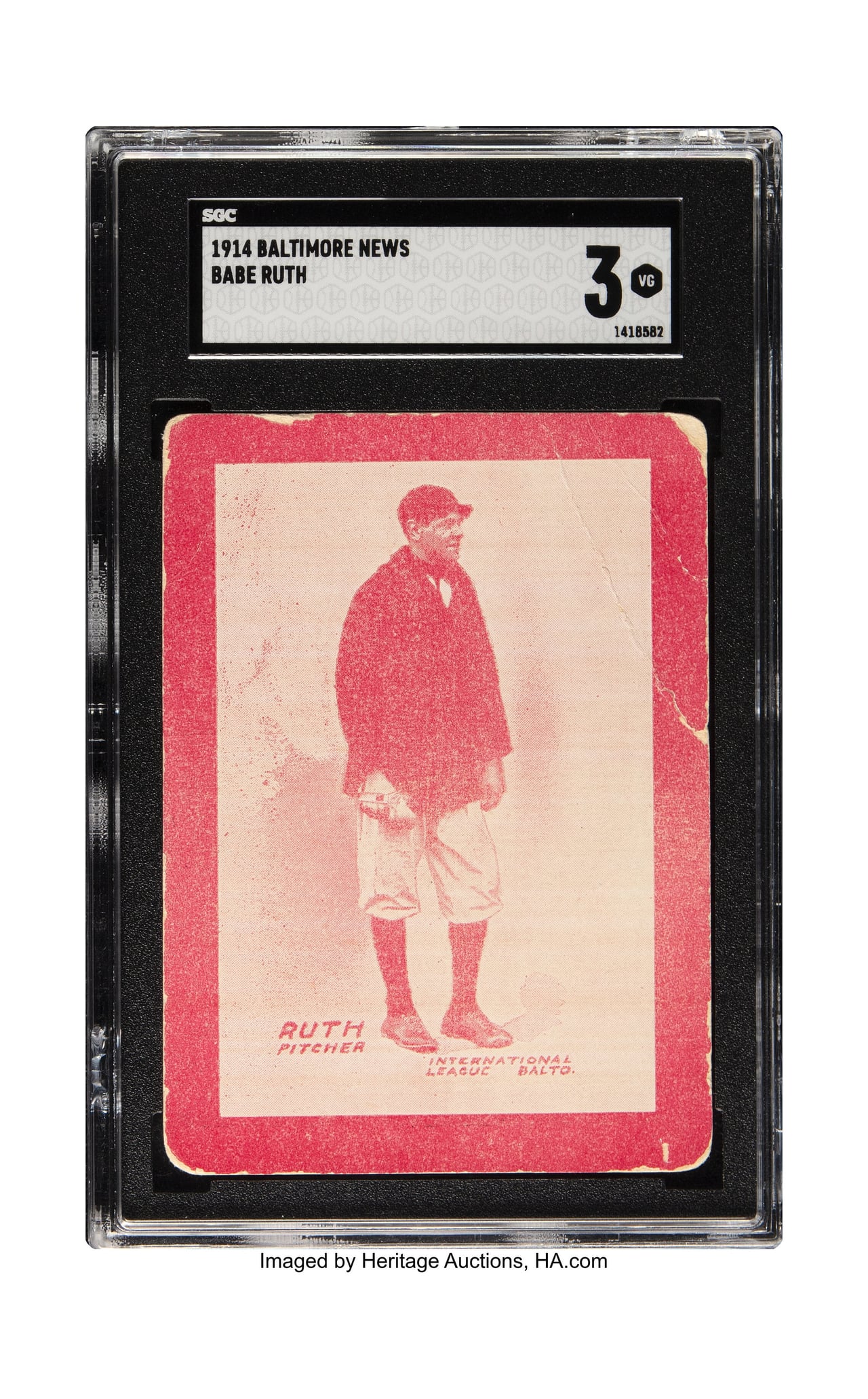
Ruth is 19 in this picture, a pitcher in the uniform of the minor-league Baltimore Orioles. It was a newspaper promotional issue, not a national release, and about ten are known to survive. Collectors call it his true rookie card.
The card had not appeared publicly in more than a decade, and no example in this condition had reached auction in over fifteen years. When Robert Edward Auctions sold it on December 4, 2023, the $7.2 million result fell short of the $10 million estimate and still became the most expensive Babe Ruth item ever sold.
| Set | 1914 Baltimore News (red) |
|---|---|
| Grade | SGC 3 (Very Good) |
| Sold | December 4, 2023 |
| House | Robert Edward Auctions |
| Price | $7,200,000 |
2013 Bowman Chrome Aaron Judge Superfractor: $5,200,000
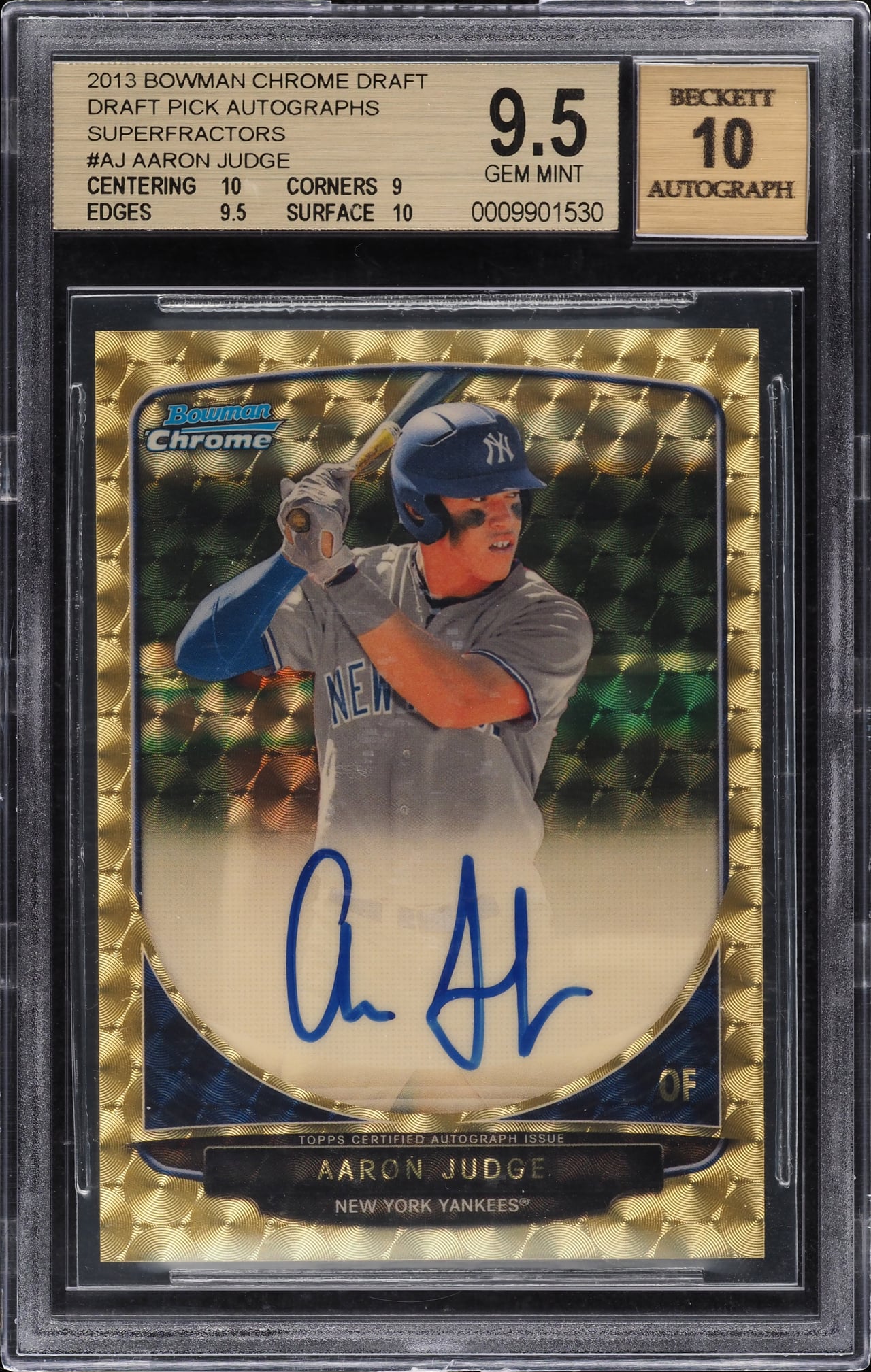
A Superfractor is a one-of-one parallel with a rippled gold finish, and Bowman Chrome puts exactly one in the set per prospect. Judge signed this one directly on the card rather than on a sticker, and on-card autographs command a premium.
The card sat quietly for a decade while Judge became the best right-handed hitter of his generation. BGS graded the card 9.5 and the autograph a perfect 10. Fanatics Collect and Acquir.co brokered the private sale announced March 12, 2026, and at $5.2 million it is the most expensive modern baseball card ever sold, passing the Trout Superfractor below.
| Set | 2013 Bowman Chrome Draft, Superfractor 1-of-1 |
|---|---|
| Grade | BGS 9.5, autograph 10 |
| Sold | March 12, 2026 |
| House | Private sale via Fanatics Collect |
| Price | $5,200,000 |
1933 Goudey Babe Ruth #53: $4,212,000
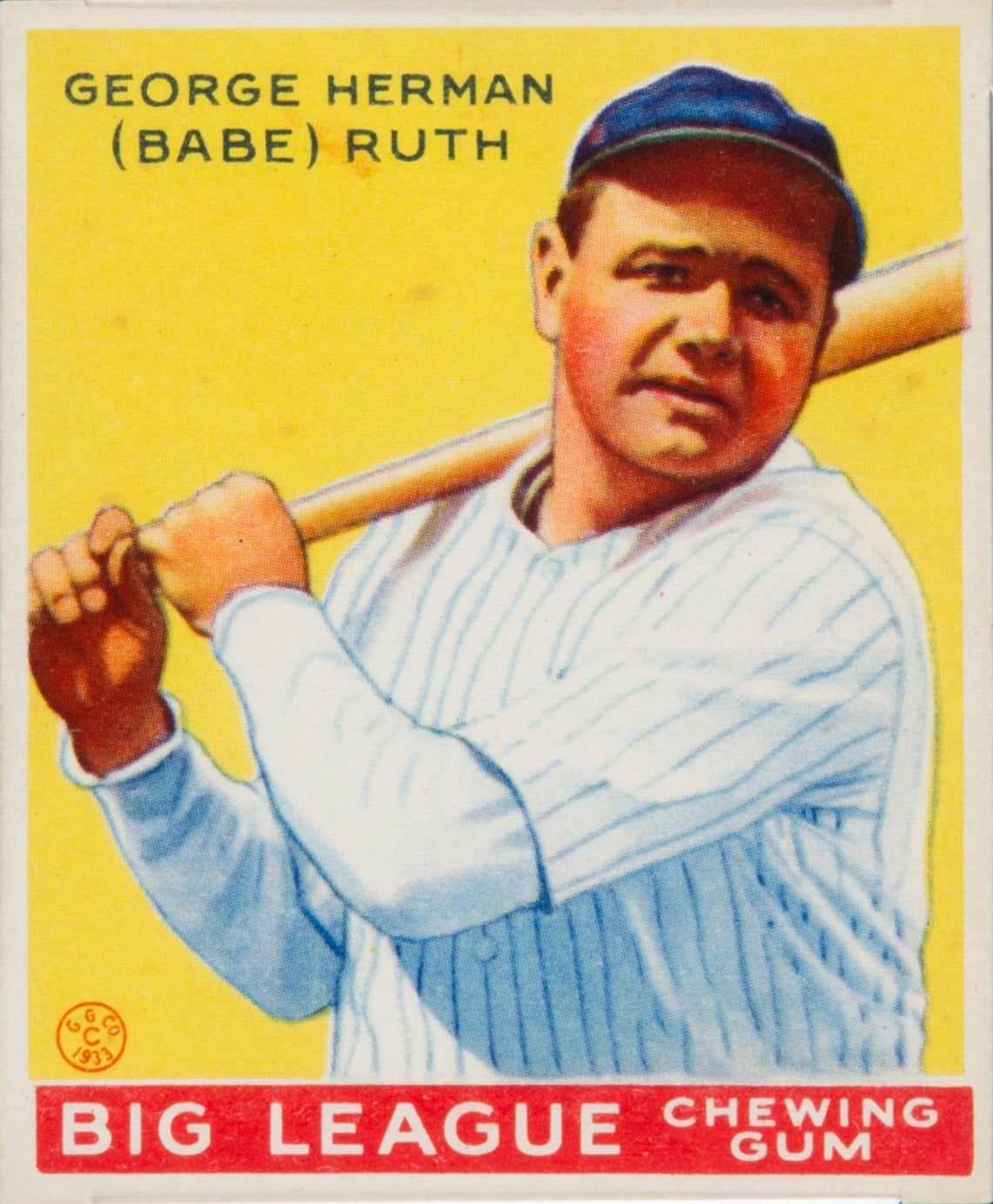
Goudey put four different Ruth cards in its 1933 gum set. #53 is the yellow-background portrait, the hardest of the four to find well centered, and this copy is the only #53 PSA has ever graded Mint 9.
It came from the collection of Dr. Thomas Newman, a Florida neurologist who died of COVID-19 in January 2021. His family consigned more than 900 lots to Memory Lane. The Ruth closed at $4,212,000 on July 11, 2021; the collection as a whole brought $21.5 million.
| Set | 1933 Goudey #53 |
|---|---|
| Grade | PSA 9 (Mint), sole example |
| Sold | July 11, 2021 |
| House | Memory Lane Inc. |
| Price | $4,212,000 |
2009 Bowman Chrome Mike Trout Superfractor: $3,936,000
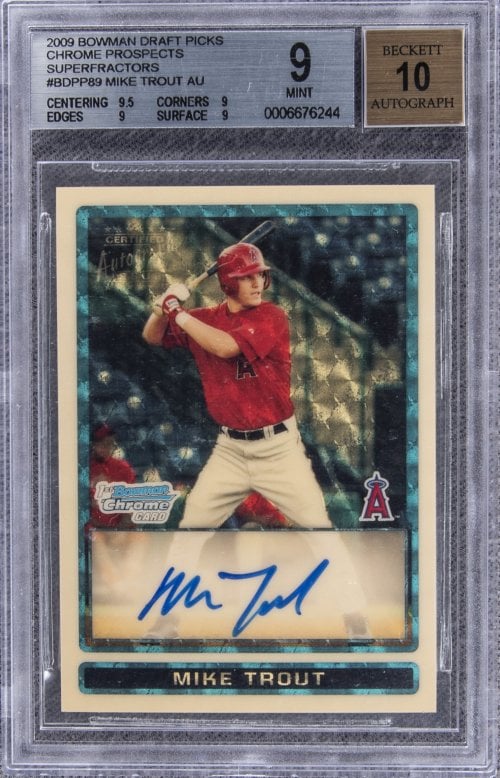
For four years this was the ceiling for any card printed after 1990. Trout signed it as an 18-year-old draft pick out of New Jersey, before the ten-time All-Star seasons. Goldin sold it in August 2020, at the exact moment the pandemic pushed a wave of new money into the hobby, and the $3,936,000 result made headlines outside the collecting press.
BGS graded it 9, not a 10. Chrome stock leaves almost no margin for error, and Superfractors chip at the corners before they leave the pack.
| Set | 2009 Bowman Chrome Draft Prospects, Superfractor 1-of-1 |
|---|---|
| Grade | BGS 9 (Mint) |
| Sold | August 23, 2020 |
| House | Goldin Auctions |
| Price | $3,936,000 |
1951 Bowman Mickey Mantle: $3,192,000
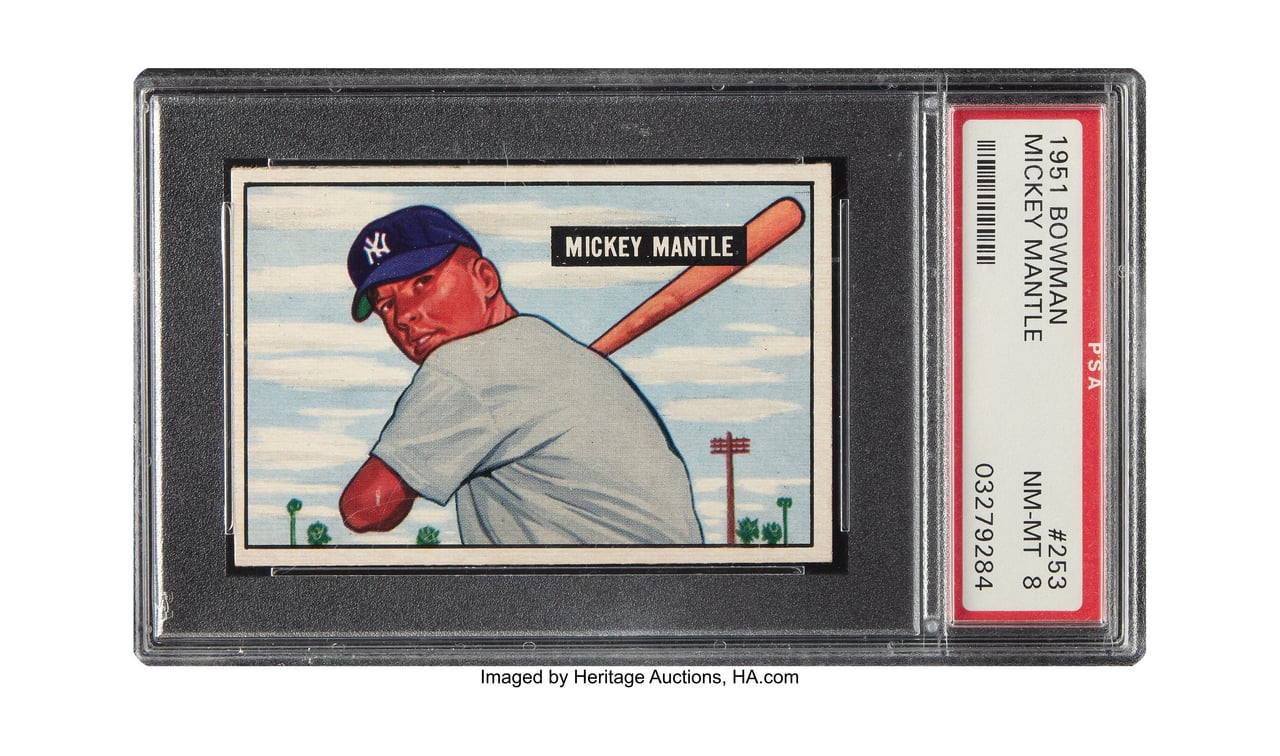
This is Mantle’s actual rookie card, permanently overshadowed by the 1952 Topps. Nine copies have earned PSA Mint 9. This one came from an East Coast collector who spent a decade assembling the finest Mantles he could buy, then consigned fifteen at once.
The $3,192,000 result on December 3, 2022 more than quadrupled the previous record of $750,000, set in April 2018.
| Set | 1951 Bowman #253 |
|---|---|
| Grade | PSA 9 (Mint), one of nine |
| Sold | December 3, 2022 |
| House | Memory Lane Inc. |
| Price | $3,192,000 |
1916 M101-4 Sporting News Babe Ruth: $1,770,000
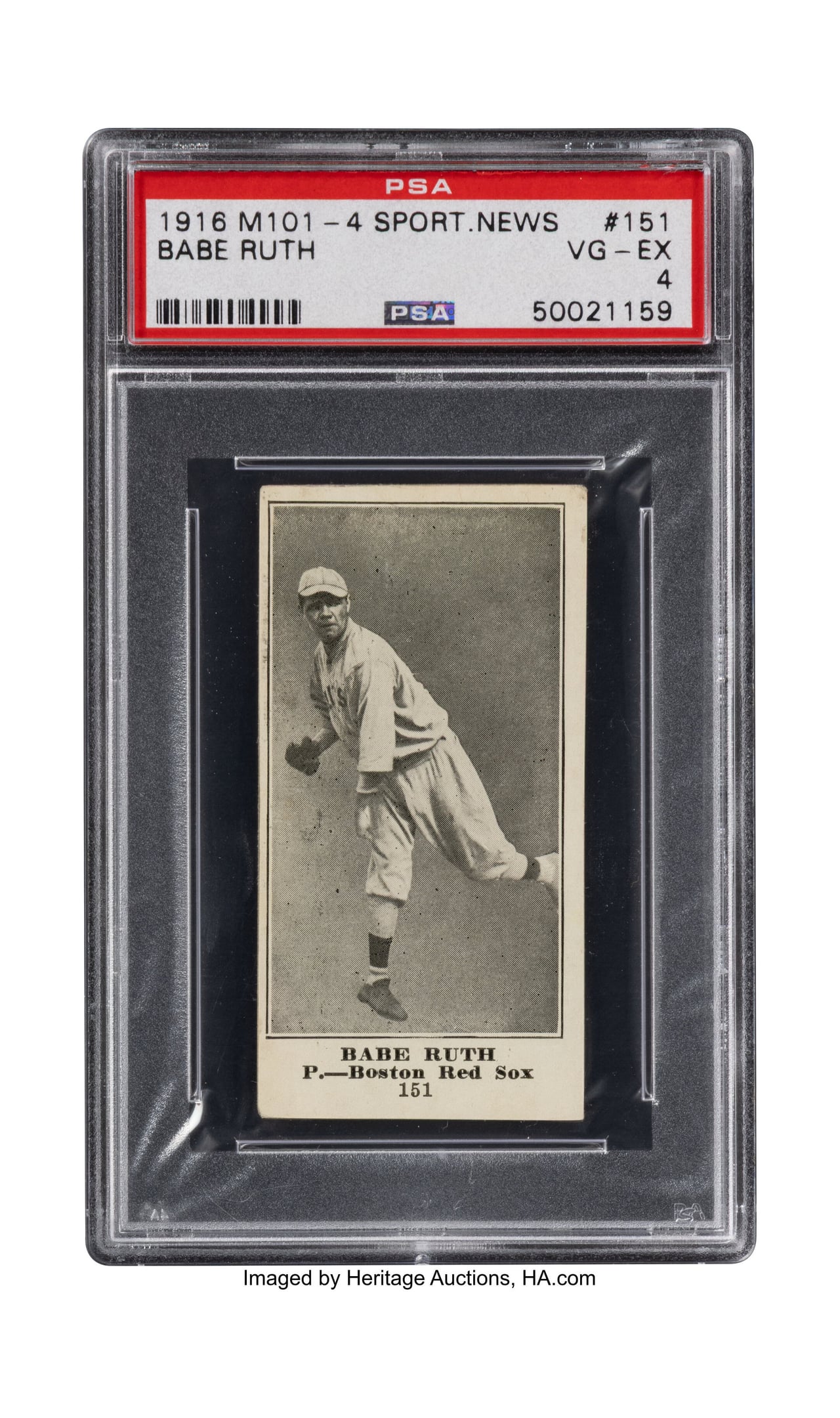
Before the Baltimore News card was widely recognized, this was the Ruth rookie collectors chased. It shows him mid-windup for the Boston Red Sox, still two years from his conversion to the outfield. The M101-4 issue appeared with different advertising backs, distributed by everyone from bakeries to sporting goods stores. Heritage sold this SGC 7 for $1.77 million on February 25, 2023.
| Set | 1916 M101-4 Sporting News #151 |
|---|---|
| Grade | SGC 7 (Near Mint) |
| Sold | February 25, 2023 |
| House | Heritage Auctions |
| Price | $1,770,000 |
1955 Topps Roberto Clemente: $1,150,000
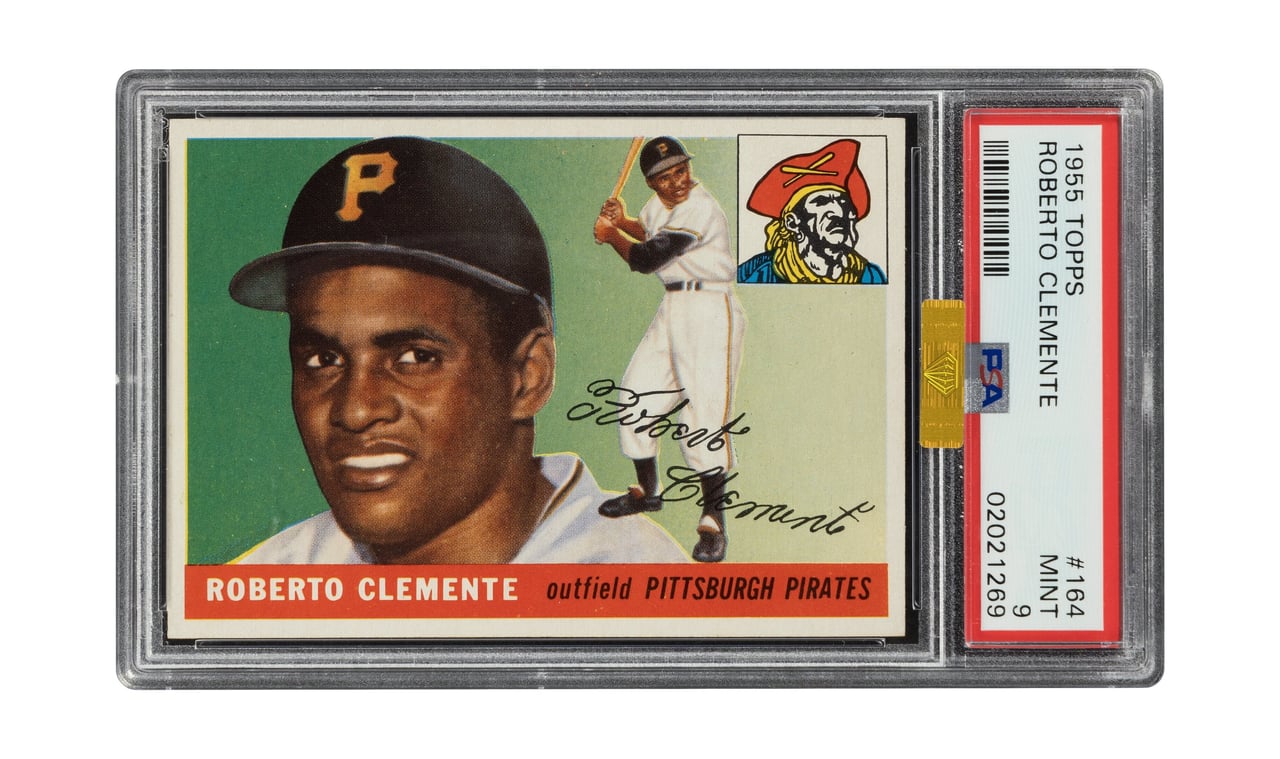
PSA has graded more than 7,400 copies of Clemente’s rookie card. Eleven came back Mint 9, and exactly one came back Gem Mint 10. That scarcity has pushed a PSA 9 Clemente past $1 million four separate times since 2022.
This copy is considered the second-finest known. Heritage handled it as a private sale in August 2025 for $1.15 million, beating the previous high of $1,107,000 by $43,000.
| Set | 1955 Topps #164 |
|---|---|
| Grade | PSA 9 (Mint), one of eleven |
| Sold | August 2025 |
| House | Private sale via Heritage Auctions |
| Price | $1,150,000 |
2024 Topps Chrome Paul Skenes MLB Debut Patch: $1,110,000
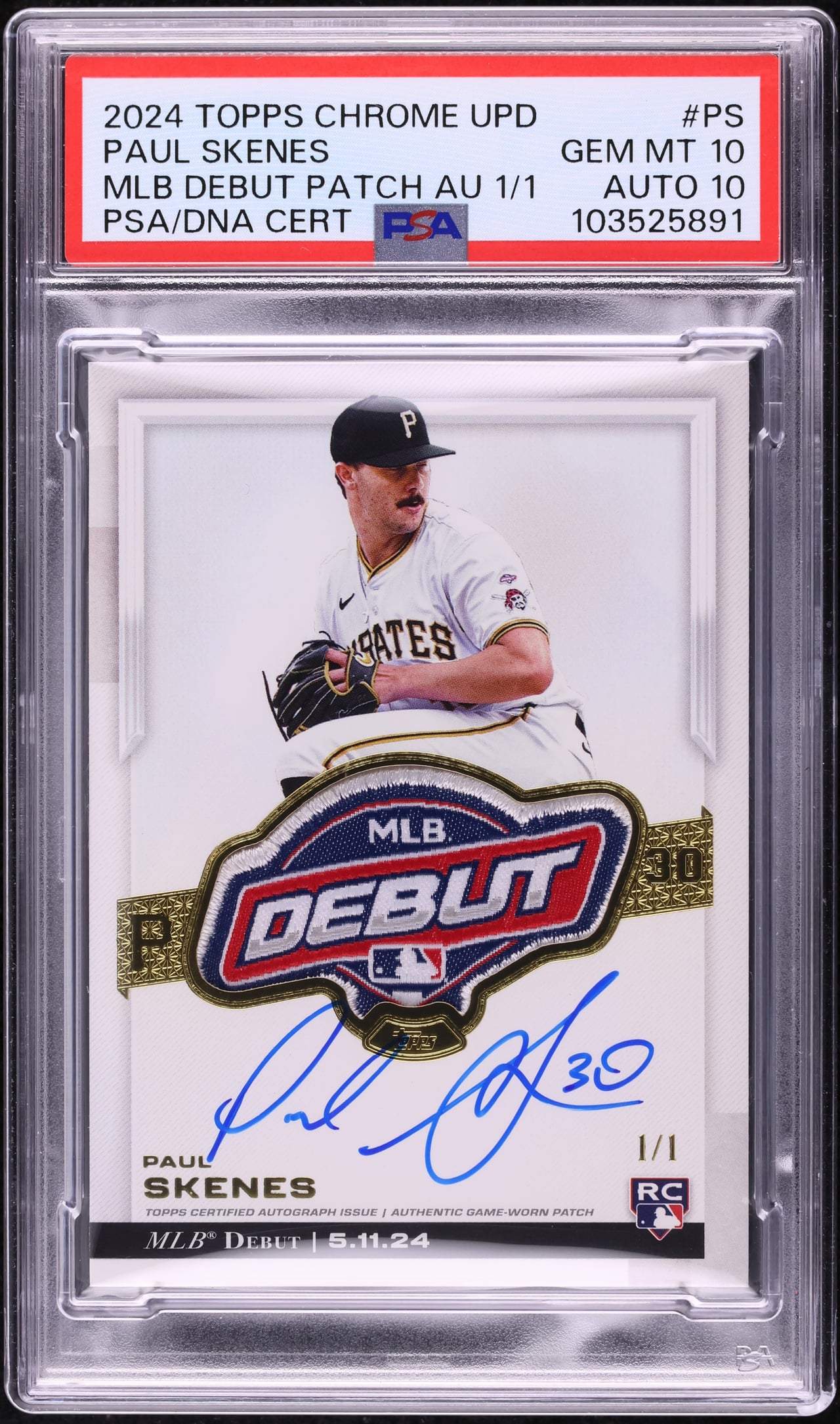
An 11-year-old boy in Southern California pulled this card from a box of 2024 Topps Chrome Update his family bought in December 2024. It holds the full patch Skenes wore on his first day in a Pittsburgh Pirates uniform, plus his autograph. Topps made one.
The family consigned it to Fanatics Collect’s March Premier Auction. Bidding closed just before 1 a.m. on March 21, 2025 at a hammer price of $925,000, and the 20 percent buyer’s premium took the total to $1.11 million. Dick’s Sporting Goods placed the winning bid and displayed the card at its Ross Park store in Pittsburgh.
| Set | 2024 Topps Chrome Update MLB Debut Patch Auto, 1-of-1 |
|---|---|
| Grade | PSA 10 (Gem Mint) |
| Sold | March 21, 2025 |
| House | Fanatics Collect |
| Price | $1,110,000 |
1969 Topps Reggie Jackson: $1,005,600
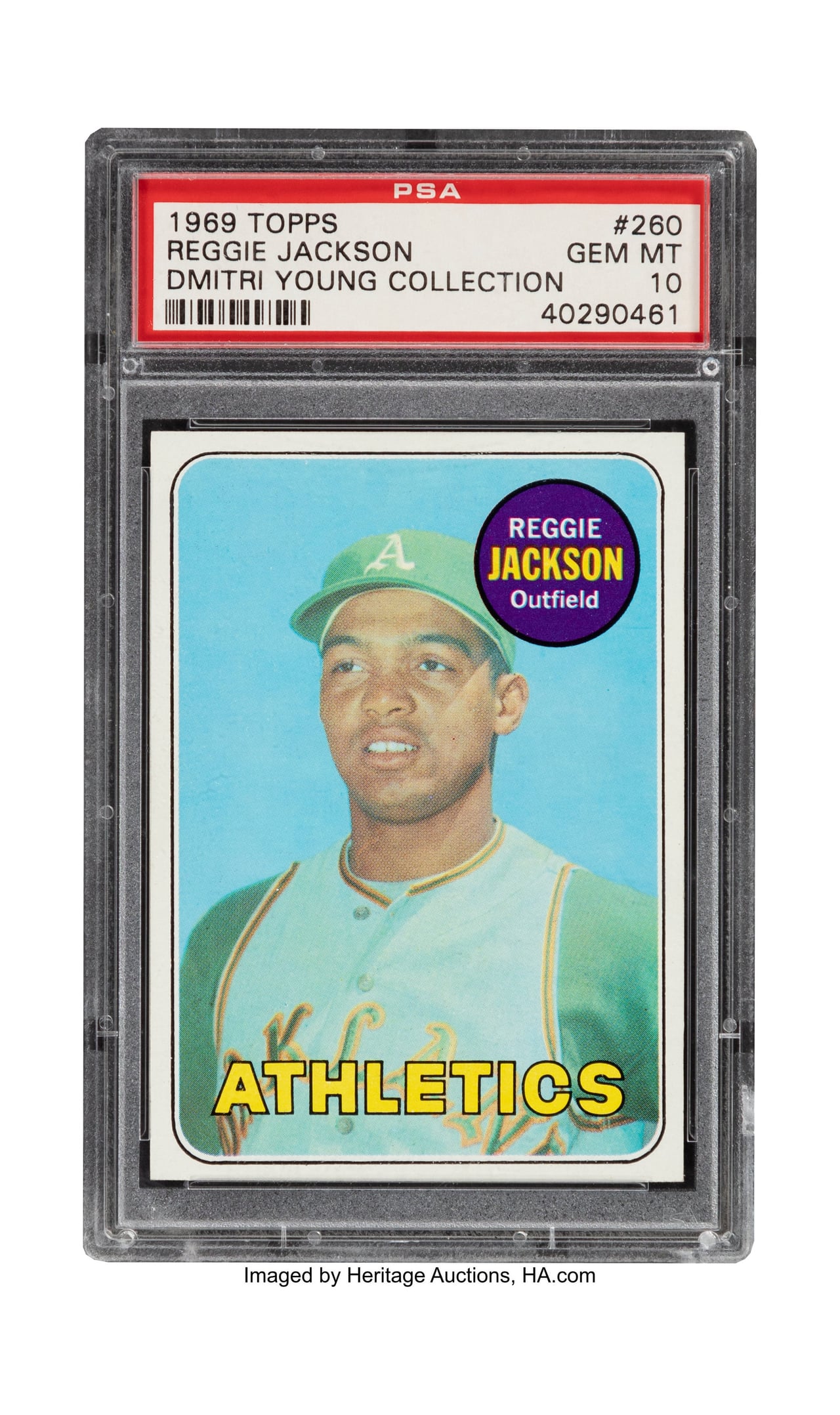
No card on this list makes the argument for grading more bluntly. Nearly 8,000 copies of Jackson’s rookie card sit in PSA holders. One of them is a 10.
That single card came from the collection of Dmitri Young, the former major leaguer who spent his post-playing years assembling high-grade vintage. Heritage sold it for $1,005,600 on February 28, 2021. The next day, a PSA 9 of the same card sold for $99,000. Same player, same year, same cardboard, and the difference between the two is a single point on a grading scale.
| Set | 1969 Topps #260 |
|---|---|
| Grade | PSA 10 (Gem Mint), sole example |
| Sold | February 28, 2021 |
| House | Heritage Auctions |
| Price | $1,005,600 |
1952 Topps Jackie Robinson: $984,000
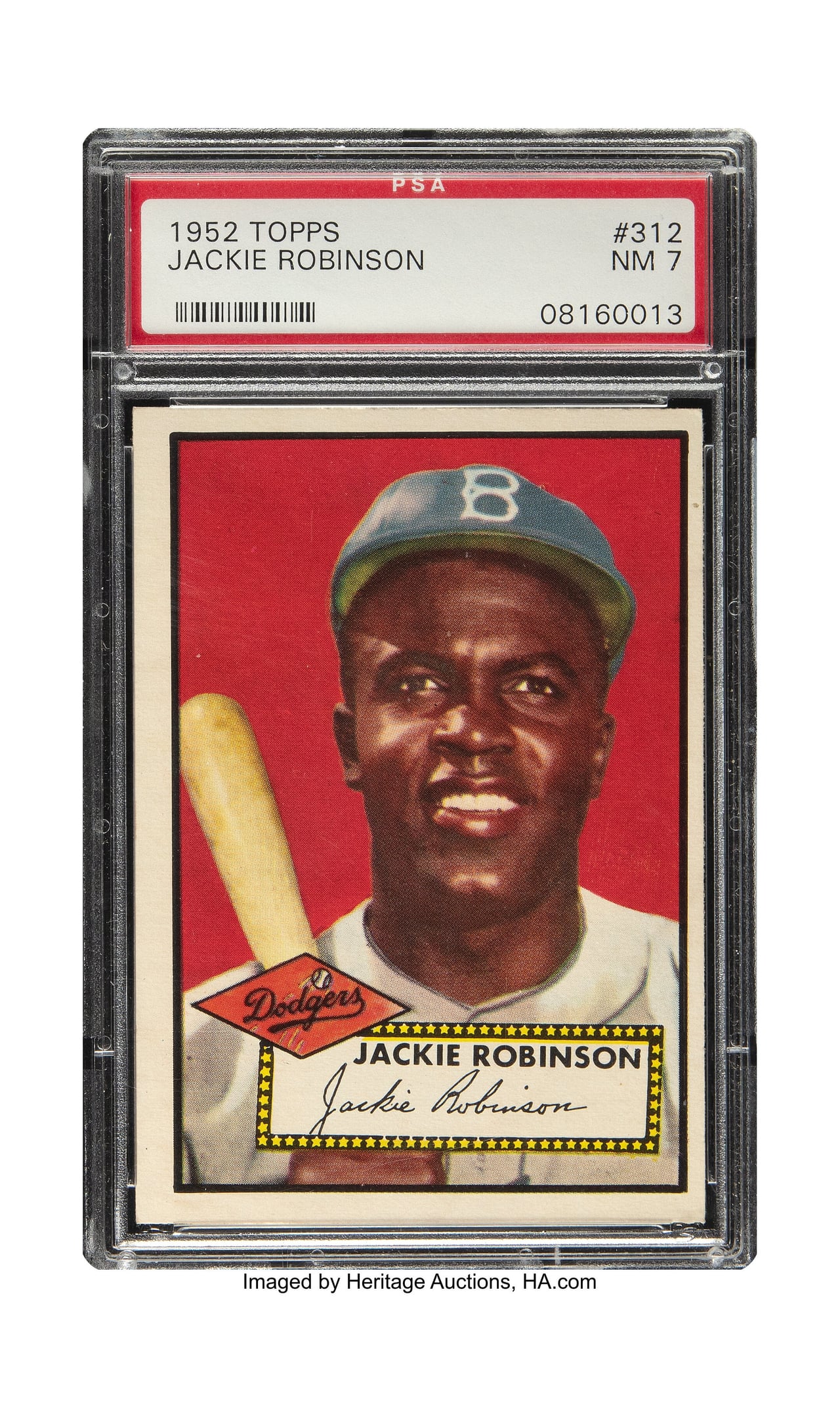
Card #312 sits three numbers from the Mantle at #311, in the same scarce high-number series. Robinson had broken the color line five years earlier. This is not his rookie. Leaf and Bowman both issued Robinson cards in 1948 and 1949. Collectors want the 1952 anyway, for the set it belongs to. Goldin sold this PSA 9 on March 6, 2021 for $984,000.
| Set | 1952 Topps #312 |
|---|---|
| Grade | PSA 9 (Mint) |
| Sold | March 6, 2021 |
| House | Goldin Auctions |
| Price | $984,000 |
Why the pre-war cards are at the top
Nine of the thirteen sales above involve a card printed before 1955, and four of them involve Babe Ruth. It is what happened to the cards themselves before anyone thought to save one.
Cards from the T206 era were packed with cigarettes, not sold on their own. A smoker bought the tobacco and threw away the insert. Nobody was preserving them, nobody had a plastic sleeve, and the paper stock was thin enough to curl in a shirt pocket. Ruth played from 1914 to 1935, entirely inside the period when American card production was smallest and least organized. His 1914 Baltimore News card exists in roughly ten copies, and his 1933 Goudey #53 exists in one PSA 9.
Compare that to Topps printing exactly one Superfractor and telling everyone it did. That is manufactured scarcity on purpose. The pre-war cards are scarce because a century of neglect made them scarce by accident. Both sell for millions.
The most valuable baseball cards of the 1980s
The 1980s is where the shoebox problem begins. Topps was already printing more than a billion cards a year by 1986, and all the value in a 1980s set ends up concentrated in three narrow places: a top rookie card in a perfect grade, a Topps Tiffany parallel, or a genuine printing error. Nothing else in a 1980s Topps set is worth the postage to send to PSA.
Tiffany is the term to know. It means the glossy, white-backed factory version of the flagship set, sold in tiny quantities: about 5,000 sets in 1985, 30,000 in 1987, 25,000 in 1988 and 15,000 in 1989.
The most valuable 1980 Topps baseball cards
Rickey Henderson’s rookie, card #482, is the last great rookie card of the era before the junk wax hit. PSA has awarded it just 26 Gem Mint 10 grades. A Goldin sale on January 3, 2026 reached $183,000, a record for the card.
The previous high was $180,100, set on eBay in February 2021. Henderson died in December 2024, and the market for his cards moved sharply afterward. Everything else in 1980 Topps trades in two and three figures. If that Henderson does not carry a 10, it belongs to the same shoebox as everyone else’s.
The most valuable 1985 Topps baseball cards
Mark McGwire’s rookie, card #401, pictures him with the 1984 US Olympic team rather than a major-league club, and it is the most valuable card in the set. The base version in a PSA 10 set a record of $4,758 at Heritage Auctions on January 31, 2026.
The Tiffany version of the same card is a different animal. A PSA 10 has sold for $30,500 at Heritage, same player, same photograph, same year, with a print run of about 5,000 sets.
The most valuable 1987 Topps baseball cards
The woodgrain borders make the 1987 set instantly recognizable and unusually hard to grade, since every chip along the edge shows. That has not made the cards valuable. Barry Bonds’ rookie, card #320, is worth more than any other card in the set. PSA has graded 1,773 of them Gem Mint 10, and the record sale for one is $1,000.
The same Bonds card printed by O-Pee-Chee, Topps’ Canadian licensee, is a different story. Only 39 have graded PSA 10, and Heritage sold one for $31,500 in January 2026. PSA has graded more than 147,000 cards from the 1987 Topps set in all, and roughly 18 percent came back a 10.
The most valuable 1988 Topps baseball cards
1988 Topps is the low point of the decade for value. The most valuable card in the set is a Nolan Ryan base card, #250, and a PSA 10 reaches around $500. Tom Glavine’s rookie, card #779, is the set’s marquee rookie, and a PSA 10 of the base card last traded at $85.
The Tiffany Glavine has sold as high as $1,775 on eBay in April 2021 and as low as $898 in March 2024. A valuable 1988 Topps card is glossy, has a white back, and came out of a factory set someone’s parents bought as an investment.
The most valuable 1989 Topps baseball cards
Randy Johnson’s rookie, card #647, is the set’s most valuable card. PSA has graded more than 10,000 of them, and a Gem Mint 10 trades in the low hundreds.
The other marquee rookies, John Smoltz at #382, Craig Biggio at #49 and Gary Sheffield at #343, are all Hall of Fame or near-Hall of Fame players, and none of their base cards clears $100 in a perfect grade. Ken Griffey Jr. does not appear in the 1989 Topps base set at all. His Topps rookie is card #41T in the Traded set, and while a PSA 10 of the base version sells for a few hundred dollars, the Tiffany version of #41T is the one worth hunting, with a print run of roughly 15,000 sets.
The most valuable baseball cards of the 1990s and the junk wax problem
If the 1980s started the flood, the early 1990s finished it. Most cards printed between 1988 and 1994 are worth close to nothing. By 1991, with Topps, Fleer, Donruss, Upper Deck, Score, Pinnacle and Stadium Club all competing, the industry was producing an estimated five billion cards a year.
The 1989 Upper Deck Ken Griffey Jr. #1 is the emblem of the era: beautifully designed, the card that launched the premium-card category, and roughly two million copies were printed across three years. PSA has graded more than 4,000 of them Gem Mint 10, and the record sale for an unsigned PSA 10 is $5,300, set on eBay in October 2025.
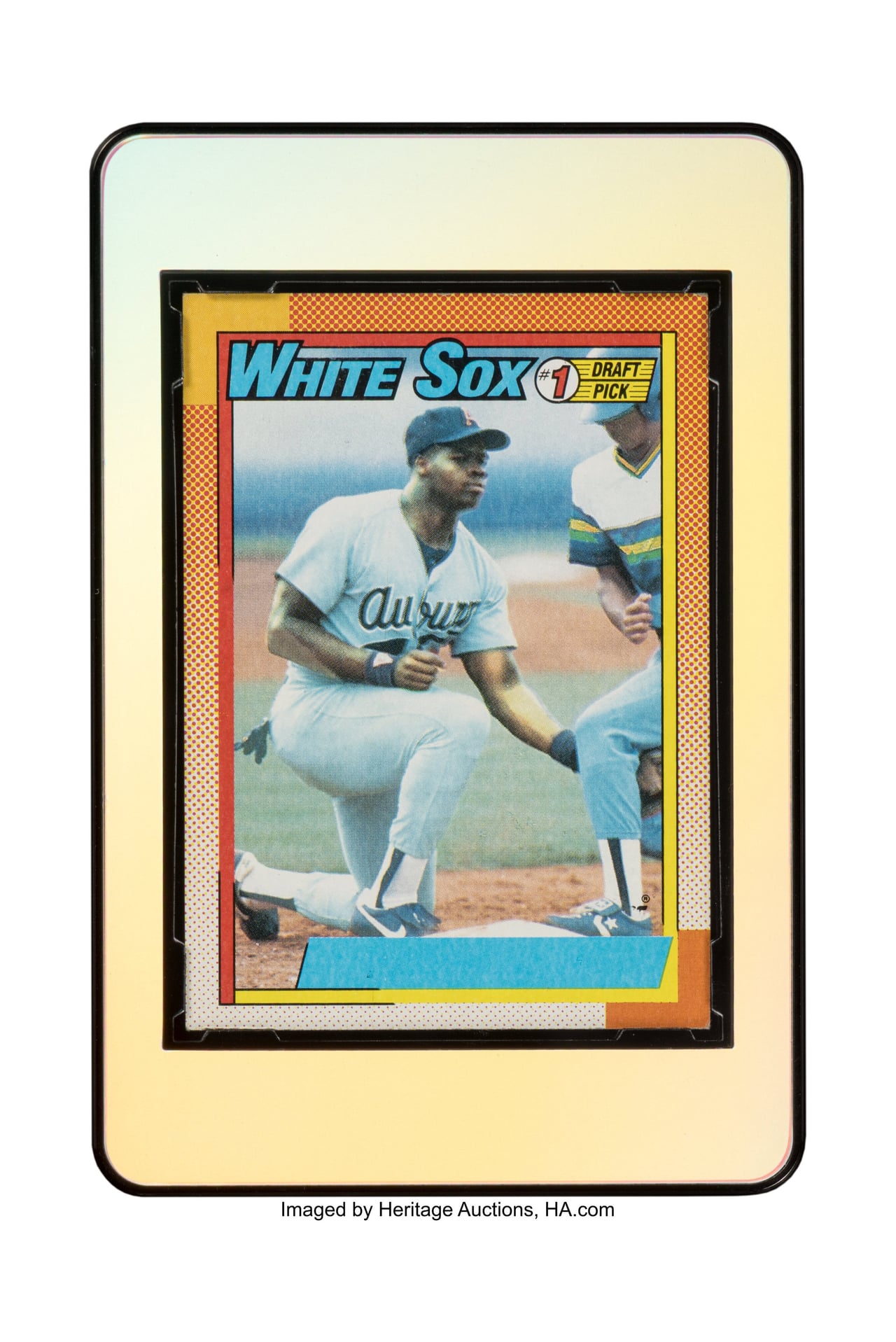
Before you recycle the binder, check it for three narrow exceptions. The first is a printing error caught and corrected. The 1990 Topps Frank Thomas #414 left the press without his name on the front, Topps fixed it fast, and only one example has ever graded PSA 10. Heritage sold that card for $183,000 on March 2, 2026, after it changed hands at $170,400 in December 2022 and $148,840 in November 2024.
The second is a card printed on foil or chrome stock. The 1993 SP Derek Jeter #279 is the case study. PSA has graded more than 26,000 of them, and only 22 are Gem Mint 10, because the silver foil surface shows every handling mark. Memory Lane sold a PSA 10 for $340,736 in its Summer Rarities auction in September 2025.
The third is a serial-numbered insert. Numbered parallels and refractors arrived in the mid-1990s and changed the math permanently: a card stamped 3 of 100 was scarce the day it was printed. Everything else from a 1990s wax box is a shoebox card. Keep it because you liked the player.
Comics went through the identical squeeze a few years later, on cheaper stock. Every comic book that has ever sold for serious money was printed before 1970, and the speculative boom of the late 1980s left a whole decade of paper worth close to nothing. Our guide to the most valuable comic books draws the line in the same place we have drawn it here.
What makes a baseball card valuable?
Four factors decide the price, and they do it in this order.
Grade comes first. Third-party graders assign a 1 to 10 for centering, corners, edges and surface, and the Reggie Jackson result is the cleanest illustration on record: $1,005,600 as a 10, $99,000 as a 9, sold one day apart. Population matters as much as the grade itself. A PSA 10 is only meaningful when few others exist.
Print run sets the ceiling. No condition, story or player can rescue a card that exists in hundreds of thousands of copies, and a 1985 Topps Tiffany McGwire outsells the identical base card by more than six times.
Rookie cards carry a premium. A rookie card is the player’s first mainstream, licensed issue. Neither Jackie Robinson’s 1952 Topps nor Mickey Mantle’s 1952 Topps is one.
Centering decides more grades than damage. Most cards that fail to reach a 10 have sharp corners and a clean surface. They lose on a border that is 60/40 instead of 55/45.
One factor sits outside the list. A card needs a reason to be famous. The T206 Wagner is worth millions partly because it was pulled from production, and partly because it has been the answer to “what is the most valuable baseball card” for eighty years.
Our guide to the most expensive Pokémon cards covers the same pattern: grade decides the price. The 1998 Pikachu Illustrator brought $16,492,000 as the only PSA 10 in existence and $900,000 as a PSA 7. It is the same card in both sales.
The same logic drives the most valuable Beanie Babies, the most expensive Bearbricks and the rarest Nike shoes ever made: in every one of those categories, a manufactured or accidental scarcity turned an ordinary object into money.
Methodology and sources
Every figure here is a completed sale, no price-guide estimates, asking prices, insurance valuations or active listings. Several famous cards were cut from the ranking because their headline numbers traced back to a listing rather than a transaction. Each entry needed four things: a named buyer or auction house, a sale date, a realized price including the buyer’s premium, and a grade from PSA, SGC or BGS.
Public sales come from the archives and results announcements of Heritage Auctions, Robert Edward Auctions, Goldin, Memory Lane and Fanatics Collect. Private sales are the ones those houses or the buyers confirmed publicly.
One entry breaks the grading rule on purpose. The 2026 Topps Chrome Ohtani sold raw, straight out of the pack, and no grading company has seen it. We state that in its own entry rather than leaving the second-largest sale in the sport off the list.
Every price is the realized total with the buyer’s premium included, not the hammer. Outlets sometimes report the two interchangeably, and the gap is large. Mike Trout’s Superfractor closed at a $3.2 million hammer and $3,936,000 all in, and both numbers have been printed as the sale price.
Population figures come from PSA’s population report and reflect counts published at the time of writing. Those numbers move as more cards are submitted, so a Gem Mint 10 that is one of nine today may be one of eleven next year.
Frequently asked questions about the most valuable baseball cards
What baseball cards are actually worth money?
Are 80s and 90s baseball cards worthless?
What baseball cards are valuable right now?
What are the most valuable baseball cards from the 1980s?
Products featured here are independently selected by our editors. If you buy through our retail links we may earn an affiliate commission — it never changes the price you pay, and it never decides our verdicts. Read our earnings disclaimer.