You know the longbox. It’s in your basement, or your parents’, and every comic inside was bagged and boarded sometime in the 1990s because someone was sure it would pay off eventually. Did any of it actually pay off?
Fewer than 100 copies of the single most valuable book on this list are believed to survive in any condition. One of the sales below came out of three brothers clearing their late mother’s attic. One of the copies in this ranking once belonged to Nicolas Cage.
Below is the full ranking of the most valuable comic books ever sold, then the honest look at what your own 1980s and 1990s longbox is worth.
The 15 most valuable comic books ever sold
| Rank | Issue | Grade | Price |
|---|---|---|---|
| 1 | Action Comics #1 (1938) | CGC 9.0 | $15,000,000 |
| 2 | Superman #1 (1939) | CGC 9.0 | $9,120,000 |
| 3 | Batman #1 (1940) | CGC 9.4 | $6,000,000 |
| 4 | Amazing Fantasy #15 (1962) | CGC 9.6 | $3,600,000 |
| 5 | Captain America Comics #1 (1941) | CGC 9.4 | $3,120,000 |
| 6 | Marvel Comics #1 (1939) | CGC 9.0 | $2,427,778 |
| 7 | Detective Comics #27 (1939) | CGC 7.0 | $2,318,000 |
| 8 | Fantastic Four #1 (1961) | CGC 9.6 | $2,040,000 |
| 9 | All-Star Comics #8 (1941) | CGC 9.4 | $1,620,000 |
| 10 | Showcase #4 (1956) | CGC 9.6 | $900,000 |
| 11 | X-Men #1 (1963) | CGC 9.6 | $871,999 |
| 12 | Tales of Suspense #39 (1963) | CGC 9.8 | $840,000 |
| 13 | The Incredible Hulk #1 (1962) | CGC 9.2 | $825,000 |
| 14 | Detective Comics #1 (1937) | CGC 8.5 | $638,250 |
| 15 | Flash Comics #1 (1940) | CGC 9.6 | $450,000 |
Grade decides as much of the price as the date does, and every figure above carries its CGC or CBCS number.
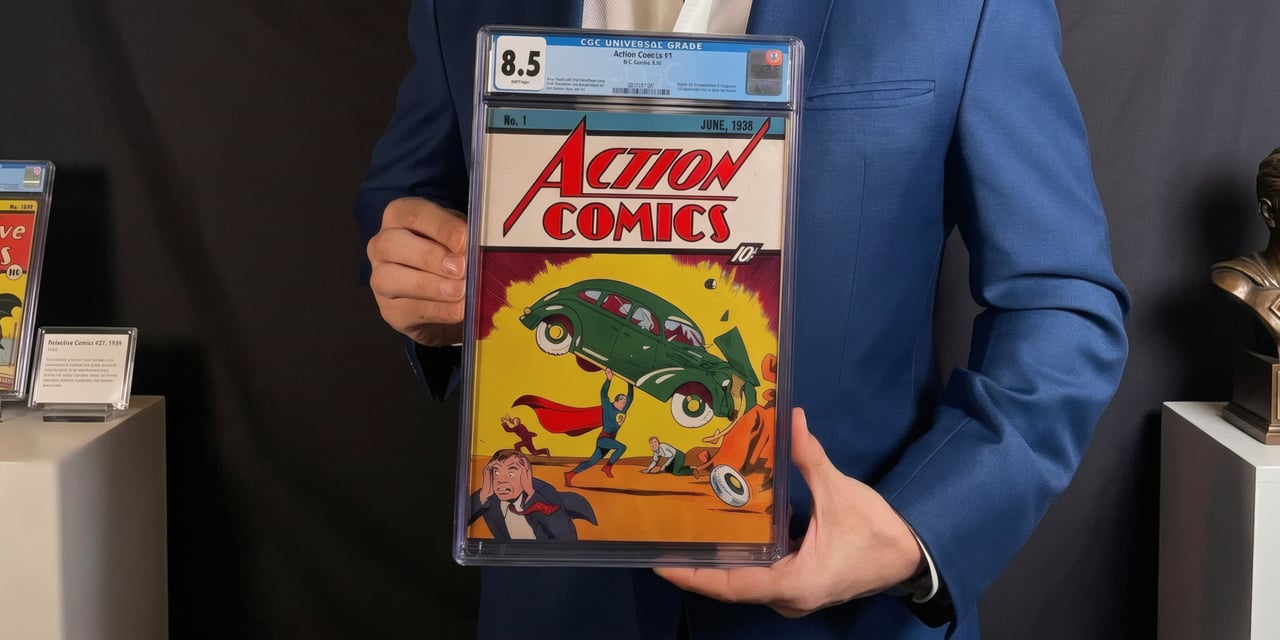
Action Comics #1: $15,000,000

This is the book that started the superhero. Action Comics #1 put a caped strongman lifting a car on its June 1938 cover, and the character was Superman.
Fewer than 100 copies are believed to survive in any grade, and the great majority are worn, brittle or restored. This one is a CGC 9.0 with no restoration, the joint finest known. It is the copy Nicolas Cage owned, lost and recovered.
Metropolis Collectibles and ComicConnect brokered the private sale for $15 million in January 2026. That broke the previous comic record of $9.12 million.
| Issue | Action Comics #1 (DC, June 1938) |
|---|---|
| Grade | CGC 9.0 (universal, unrestored) |
| Sold | January 2026 |
| House | Private sale via Metropolis Collectibles / ComicConnect |
| Price | $15,000,000 |
Superman #1: $9,120,000

Three brothers were clearing out their late mother’s attic when they found this one. They sent it to CGC, and it came back a 9.0, the sole highest copy known.
Superman earned his own title within a year of his debut, and Superman #1 arrived in the summer of 1939. It reprinted his origin and added new material, and it is scarcer in high grade than almost anything except the Action Comics that preceded it.
It sold for $9.12 million at Heritage Auctions on November 20, 2025, and held the all-time comic record for seven weeks until Action Comics #1 passed it. A second Superman #1, graded CGC 8.5, sold privately for $7 million in February 2026 as part of a combined $13 million deal alongside the Batman #1 below.
| Issue | Superman #1 (DC, Summer 1939) |
|---|---|
| Grade | CGC 9.0 (sole highest known) |
| Sold | November 20, 2025 |
| House | Heritage Auctions |
| Price | $9,120,000 |
Batman #1: $6,000,000

Batman had already debuted in Detective Comics #27, so Batman #1 is not his first appearance. Many collectors want it more anyway. The Spring 1940 issue gave the Joker and Catwoman their first appearances in the same book.
This is the highest-graded copy in existence at CGC 9.4. It last sold at auction for $2.22 million in 2021, so the new price nearly tripled the issue’s own record.
Heritage Auctions and SemperFi Comics completed the private $6 million transaction in February 2026, bundled with the CGC 8.5 Superman #1 for a $13 million combined sale.
| Issue | Batman #1 (DC, Spring 1940) |
|---|---|
| Grade | CGC 9.4 (highest known) |
| Sold | February 2026 |
| House | Private sale via Heritage Auctions / SemperFi Comics |
| Price | $6,000,000 |
Amazing Fantasy #15: $3,600,000

For a stretch in 2021, this was the most expensive comic in the world.
Amazing Fantasy #15 is the first appearance of Spider-Man, printed in August 1962 in a title that was about to be cancelled. Marvel gave a teenage hero the last issue of a dying anthology. Spider-Man was still popular decades after Amazing Fantasy folded.
The CGC 9.6 copy that set the mark is one of the finest known, and Spider-Man’s pull as a character keeps the demand deep. Heritage Auctions sold it for $3.6 million on September 9, 2021, breaking a record that an Action Comics #1 had set five months earlier.
| Issue | Amazing Fantasy #15 (Marvel, August 1962) |
|---|---|
| Grade | CGC 9.6 |
| Sold | September 9, 2021 |
| House | Heritage Auctions |
| Price | $3,600,000 |
Captain America Comics #1: $3,120,000

This copy comes from the San Francisco pedigree, a hoard of exceptionally preserved golden-age books, and it graded CGC 9.4.
Captain America Comics #1 landed in March 1941, months before the United States entered the war, and put Cap on the cover throwing a punch at Adolf Hitler. Timely, the company that became Marvel, published it. High-grade Timely war-era comics are genuinely rare, because wartime paper drives were pulping exactly this kind of material.
Heritage Auctions sold it for $3.12 million on April 7, 2022, a record for any Captain America comic.
| Issue | Captain America Comics #1 (Timely, March 1941) |
|---|---|
| Grade | CGC 9.4 (San Francisco pedigree) |
| Sold | April 7, 2022 |
| House | Heritage Auctions |
| Price | $3,120,000 |
Marvel Comics #1: $2,427,778

This is the famous Pay Copy, so called because Funnies Inc. founder Lloyd Jacquet used it to record payments to contributors, writing amounts, dates and check numbers on the pages themselves. That provenance makes it a one-of-a-kind object, and it graded CGC 9.0.
Marvel Comics #1 is where the company began. The October 1939 issue introduced the original android Human Torch and the Sub-Mariner, and it carries the Timely name that would later become Marvel.
ComicConnect sold it for $2,427,778 in November 2025, a record for the issue and the most any Marvel comic has ever brought.
| Issue | Marvel Comics #1 “Pay Copy” (Timely, October 1939) |
|---|---|
| Grade | CGC 9.0 |
| Sold | November 2025 |
| House | ComicConnect |
| Price | $2,427,778 |
Detective Comics #27: $2,318,000

It sold as a CGC 7.0, well short of mint, and still cleared $2.3 million.
Detective Comics #27 is the first appearance of Batman, from May 1939. It is the Batman counterpart to Action Comics #1, the book that introduced the only character who ever rivaled Superman. The same copy sold for $1.5 million in November 2020, so it gained more than $800,000 in a little over five years.
Heritage Auctions sold it for $2,318,000 on February 28, 2026, a record for Batman’s first appearance.
| Issue | Detective Comics #27 (DC, May 1939) |
|---|---|
| Grade | CGC 7.0 |
| Sold | February 28, 2026 |
| House | Heritage Auctions |
| Price | $2,318,000 |
Fantastic Four #1: $2,040,000

Fantastic Four #1 launched the modern Marvel universe in November 1961. Stan Lee and Jack Kirby built the template of the flawed, arguing superhero team here, and everything from Spider-Man to the X-Men followed.
Only two copies exist at CGC 9.6, and none grade higher. That scarcity at the top of the census carries the price more than character demand does.
Heritage Auctions sold this white-page 9.6 for $2.04 million on September 12, 2024, the highest price for any Fantastic Four book and, at the time, the second-highest for any silver-age comic.
| Issue | Fantastic Four #1 (Marvel, November 1961) |
|---|---|
| Grade | CGC 9.6 (white pages, one of two) |
| Sold | September 12, 2024 |
| House | Heritage Auctions |
| Price | $2,040,000 |
All-Star Comics #8: $1,620,000

Wonder Woman’s actual debut is here, in a backup feature dated December 1941 to January 1942, not in Sensation Comics #1, which gave her the cover a month later.
This CGC 9.4 is one of the finest copies of a genuinely scarce golden-age book. Wonder Woman is the third pillar of DC’s golden-age trinity, and her first appearance had never reached this level before.
Heritage Auctions sold it for $1.62 million on June 16, 2022, nearly doubling the issue’s previous record.
| Issue | All-Star Comics #8 (DC, Dec 1941 to Jan 1942) |
|---|---|
| Grade | CGC 9.4 |
| Sold | June 16, 2022 |
| House | Heritage Auctions |
| Price | $1,620,000 |
Showcase #4: $900,000

A police scientist named Barry Allen reinvented the Flash on the cover of this September 1956 issue, and historians credit it with starting the Silver Age, proving superheroes could sell again after a decade in decline.
Few copies survived relative to the book’s importance, so a top example commands a fortune. This one graded CGC 9.6 with white pages, and it is the finest known.
Heritage Auctions sold it for $900,000 in January 2024.
| Issue | Showcase #4 (DC, September 1956) |
|---|---|
| Grade | CGC 9.6 (white pages, highest known) |
| Sold | January 2024 |
| House | Heritage Auctions |
| Price | $900,000 |
X-Men #1: $871,999

A Canadian collector bought this one, and the price set an all-time record for the issue.
The original X-Men #1 arrived in September 1963, another Lee and Kirby creation and the last of Marvel’s founding wave. Decades of films have made the team a household name and kept the first issue in demand. This is the Mound City copy, graded CGC 9.6, one of the best-preserved examples in existence.
ComicConnect sold it for $871,999 in 2022.
| Issue | X-Men #1 (Marvel, September 1963) |
|---|---|
| Grade | CGC 9.6 (Mound City copy) |
| Sold | 2022 |
| House | ComicConnect |
| Price | $871,999 |
Tales of Suspense #39: $840,000

Nothing grades higher than this CGC 9.8, the finest copy on the census. In lower grades, the issue is common.
Tales of Suspense #39 is the first appearance of Iron Man, from March 1963. Marvel introduced Tony Stark in another anthology title, and the character stayed there before graduating to his own book.
Heritage Auctions sold it for $840,000 in April 2024.
| Issue | Tales of Suspense #39 (Marvel, March 1963) |
|---|---|
| Grade | CGC 9.8 (highest known) |
| Sold | April 2024 |
| House | Heritage Auctions |
| Price | $840,000 |
The Incredible Hulk #1: $825,000

The original series lasted only six issues before cancellation, which is why early high-grade copies are hard to find.
The Incredible Hulk #1 introduced Bruce Banner and his green alter ego in May 1962. This copy graded CGC 9.2. Anything higher is exceptionally thin on the census, and the gap between a 9.2 and the few copies above it is steep.
Heritage Auctions sold it for $825,000 on January 14, 2024.
| Issue | The Incredible Hulk #1 (Marvel, May 1962) |
|---|---|
| Grade | CGC 9.2 |
| Sold | January 14, 2024 |
| House | Heritage Auctions |
| Price | $825,000 |
Detective Comics #1: $638,250

Only a handful of copies are known to exist, out of an anthology that predates the superhero entirely.
Detective Comics #1 is the March 1937 debut of the title that would introduce Batman twenty-six issues later. This example graded CGC 8.5, a remarkable state of preservation for a book this old and this fragile. It shattered the issue’s previous high of $228,000, set only a year earlier.
ComicConnect sold it for $638,250 in a record sale.
| Issue | Detective Comics #1 (DC, March 1937) |
|---|---|
| Grade | CGC 8.5 |
| Sold | 2026 |
| House | ComicConnect |
| Price | $638,250 |
Flash Comics #1: $450,000

This one is the Mile High copy from the Edgar Church collection, the most famous pedigree in comics, graded CGC 9.6.
Flash Comics #1 delivered two golden-age debuts in one January 1940 issue, the original Flash and Hawkman. It is among the most important books DC printed, and unrestored high-grade copies almost never surface. The figure here is the standing auction record for the issue, and it dates to March 2010.
Heritage Auctions sold it for $450,000 in 2010, up from $273,125 in 2006.
| Issue | Flash Comics #1 (DC, January 1940) |
|---|---|
| Grade | CGC 9.6 (Mile High / Edgar Church copy) |
| Sold | March 2010 |
| House | Heritage Auctions |
| Price | $450,000 |
The golden age is where the money is
Nine of the fifteen sales above involve a book printed before 1942, and the top three are all pre-1941. The reason is the same one that puts pre-war baseball cards at the top of that market: almost nobody kept these.
Golden-age comics were disposable. Children read them, traded them and threw them away, and the wartime paper drives of the early 1940s pulped millions more for the war effort. A book that started as ten-cent entertainment on cheap newsprint rarely survives eighty years intact.
That scarcity shows up in the CGC census, the public count of how many graded copies exist at each grade. Fewer than 100 copies of Action Comics #1 are believed to survive in any condition. High-grade unrestored examples of the top golden-age keys number in the single digits. When only a handful of a book exists near mint, one sale can reset the record for the whole issue, as it did three times in the ranking above.
Restoration trips up new buyers. CGC uses a blue “universal” label for an unrestored book and a purple label for a restored one, and the difference is enormous. A restored copy is worth a fraction of an unrestored copy at the same numeric grade. A CGC 8.5 restored Detective Comics #27 sold for $520,950 in 2025. The CGC 7.0 unrestored copy in our ranking sold for $2.3 million. The restored book carried the higher number and brought roughly a fifth of the price.
The silver age is where a collector might actually own something
The Silver Age runs from Showcase #4 in 1956 to about 1970, and it is the second tier of value. It is also the first era where an ordinary collector has a realistic chance of owning a genuine key, because these books survive in far greater numbers than golden-age comics do.
Marvel’s founding issues define the era. Amazing Fantasy #15, Fantastic Four #1, The Incredible Hulk #1, X-Men #1 and Tales of Suspense #39 all appear in our ranking, and all trade in the hundreds of thousands at the very top of the grade scale. DC’s silver-age keys rank alongside them, led by Showcase #4 and the first Justice League appearance in The Brave and the Bold #28.
These issues are not rare in worn condition. A reader-grade Amazing Fantasy #15 with a detached cover exists in real numbers, and it sells for a small fraction of the CGC 9.6 record. The seven-figure prices belong only to the tiny population at the top of the census. A mid-grade silver-age key is a nice thing to own and worth a modest amount, well short of the seven-figure prices above.
The 1970s
The Bronze Age, running roughly from 1970 to the mid-1980s, is where print runs began to climb and survival rates climbed with them. That combination caps most of the decade’s value, with a short list of exceptions built on genuinely scarce first appearances.
The Incredible Hulk #181 leads the era. Its 1974 issue is the first full appearance of Wolverine, and it is the most valuable mainstream comic of the decade. A CGC 9.8 copy sold for $146,000, the first to pass $140,000, and only a lone CGC 9.9 is above it on the census.
Giant-Size X-Men #1 from 1975 is the other Bronze Age landmark, introducing the new international X-Men team that became Marvel’s biggest franchise. A CGC 9.8 reached about $67,900 at its peak. A CGC 9.8 copy sold for just $22,860 in September 2025 as the market cooled.
Everything else from the 1970s trades far lower. The decade’s other keys, from the first Punisher in Amazing Spider-Man #129 to the first Ghost Rider in Marvel Spotlight #5, are affordable in mid grade and only climb in perfect grade. If you have a longbox of 1970s comics, look for those few specific issues in a slab. The rest of the run is worth little.
The 1980s and 1990s

If you have a box of comics from the 1980s and 1990s in the attic, it is almost certainly worth very little.
By the early 1990s the industry was printing to feed a speculator bubble, the same cycle that had already hit most valuable baseball cards a few years earlier, this time on cheaper stock, and single issues routinely sold in the millions. X-Men #1 from 1991 sold more than eight million copies. Publishers polybagged variants, printed foil and hologram covers, and stamped “collector’s item” on comics they made by the truckload. A sealed polybagged issue from 1993 is worth roughly what it cost, because everyone bought two and put one away exactly as instructed.
Three narrow categories carry real value from these years, and it is worth checking your box for them.
The scarce indie is the first. Teenage Mutant Ninja Turtles #1 from 1984 had a print run of around 3,000 copies, printed by two creators with no distribution and no expectation of a sequel. A CGC 9.8 first printing sold for $250,000 at ComicConnect in January 2022. It is the genuine exception the decade produced, and the mostly black cover means high grades are brutally hard to find.
The key first appearance is the second. New Mutants #98 from 1991 introduced Deadpool, and a CGC 9.8 trades in the $4,000 to $8,000 range, with a perfect CGC 10.0 reaching around $15,000. Batman Adventures #12 from 1992 gave Harley Quinn her first appearance, and a CGC 9.8 sells around $2,000. Amazing Spider-Man #300 from 1988 is the first full Venom, and a CGC 9.8 peaked near $4,000 in the 2021 bubble and has softened since. These are the best the era offers, and none of them reach six figures.
The newsstand copy is the third. For some otherwise identical modern comics, the newsstand edition is the version that carries a premium.
Everything else from a 1990s wax box is a reader copy, worth keeping for the story rather than the return.
Comic books worth money: how to actually check
Readers who search for “comic books worth money” usually want a price, and the real answer comes from completed sales, not price guides. Price guides like Overstreet publish reference values the whole hobby knows, but a guide value is only an estimate. It tells you what a book might be worth in theory. Actual sale prices can be very different.
Search completed sales instead of active listings. A listing is what a hopeful seller wants. A completed sale is what a buyer actually paid, and the gap between the two is often enormous, especially for overproduced modern comics where listings ask hundreds and sales close in single digits. The auction archives of Heritage Auctions, ComicConnect and ComicLink are public, and they show real prices with real grades attached.
If a book looks genuinely valuable, get it graded before you sell it. A raw comic and a slabbed one are different products to a serious buyer, because the slab certifies the grade and guarantees the book has not been restored. For a common issue that certainty is not worth the fee. For a scarce key in high grade, grading turns a guess into a certified price.
What determines a comic book’s value
Five factors set the number, and they compound.
Grade comes first. Third-party graders like CGC and CBCS assign a 1 to 10 on a book’s cover, spine, corners and pages. The Detective Comics #27 above is the cleanest illustration on record: an unrestored CGC 7.0 sold for $2.3 million while a restored 8.5 of the same issue brought $520,950. Population matters as much as the grade itself, because a CGC 9.8 only means something when few others exist.
Restoration changes everything. A blue CGC label is universal and unrestored. A purple label is restored, and a restored book is worth a fraction of an unrestored one at the same numeric grade. Trimming, color touch and added pieces all drop a book onto the purple label. Always check the label color first.
Print run sets the ceiling. No story, character or grade can rescue a comic that exists in millions of copies. A 1938 Action Comics survived in fewer than 100 known copies. A 1991 X-Men #1 survived in millions.
First appearances carry the premium. The first appearance of a major character is almost always the most valuable book in its run. Batman’s debut in Detective Comics #27 outsells his own #1. Wolverine’s debut in Hulk #181 leads the entire Bronze Age.
Newsstand versus direct edition decides value among modern copies. After 1979, comics shipped in two forms. Direct editions went to comic shops and carry a small diamond or logo in the barcode box. Newsstand editions went to supermarkets and drugstores and carry a full UPC barcode. For many modern keys, newsstand copies are far scarcer, because shops bought most of the print run and newsstands often shredded unsold copies. A newsstand Batman Adventures #12 can sell for double the direct edition in the same grade.
Page quality matters too. CGC notes a book’s pages as white, off-white or brittle, and white pages command a premium on any vintage book. Two copies at the same grade can differ in price on page color alone.
Methodology and sources
Every figure in this article is a completed sale. We did not use Overstreet guide values, insurance appraisals, asking prices or active listings, and we cut several famous books from the ranking because their headline numbers traced back to a listing rather than a transaction.
Each entry needed four things to qualify: a named auction house or a publicly confirmed private sale, a sale date, a realized price, and a grade from CGC or CBCS. The public sales come from the archives and results announcements of Heritage Auctions, ComicConnect and ComicLink. The private sales are the ones those houses or the buyers confirmed publicly, and each says so in its entry.
Grade decides price in this market more than in almost any other collectible, so no price appears here without its grade attached. Where a copy is restored, the entry says so. Population and census figures come from CGC’s public census and reflect the counts published at the time of writing. Those numbers move as more books are submitted, so a sole finest copy today may be one of two next year, and prices move with them.
For more collectibles that outgrew their original price tags, see the most valuable baseball cards ever sold, the most valuable Beanie Babies of all time, and, at the far end of the market, the most expensive paintings and the most expensive Banksy works ever sold.
Frequently asked questions about the most valuable comic books
What is the most expensive comic book ever sold?
What comic books are worth money?
Are 80s and 90s comic books worth anything?
Are 1970's comics worth anything?
How to check if a comic book is worth money?
Products featured here are independently selected by our editors. If you buy through our retail links we may earn an affiliate commission — it never changes the price you pay, and it never decides our verdicts. Read our earnings disclaimer.