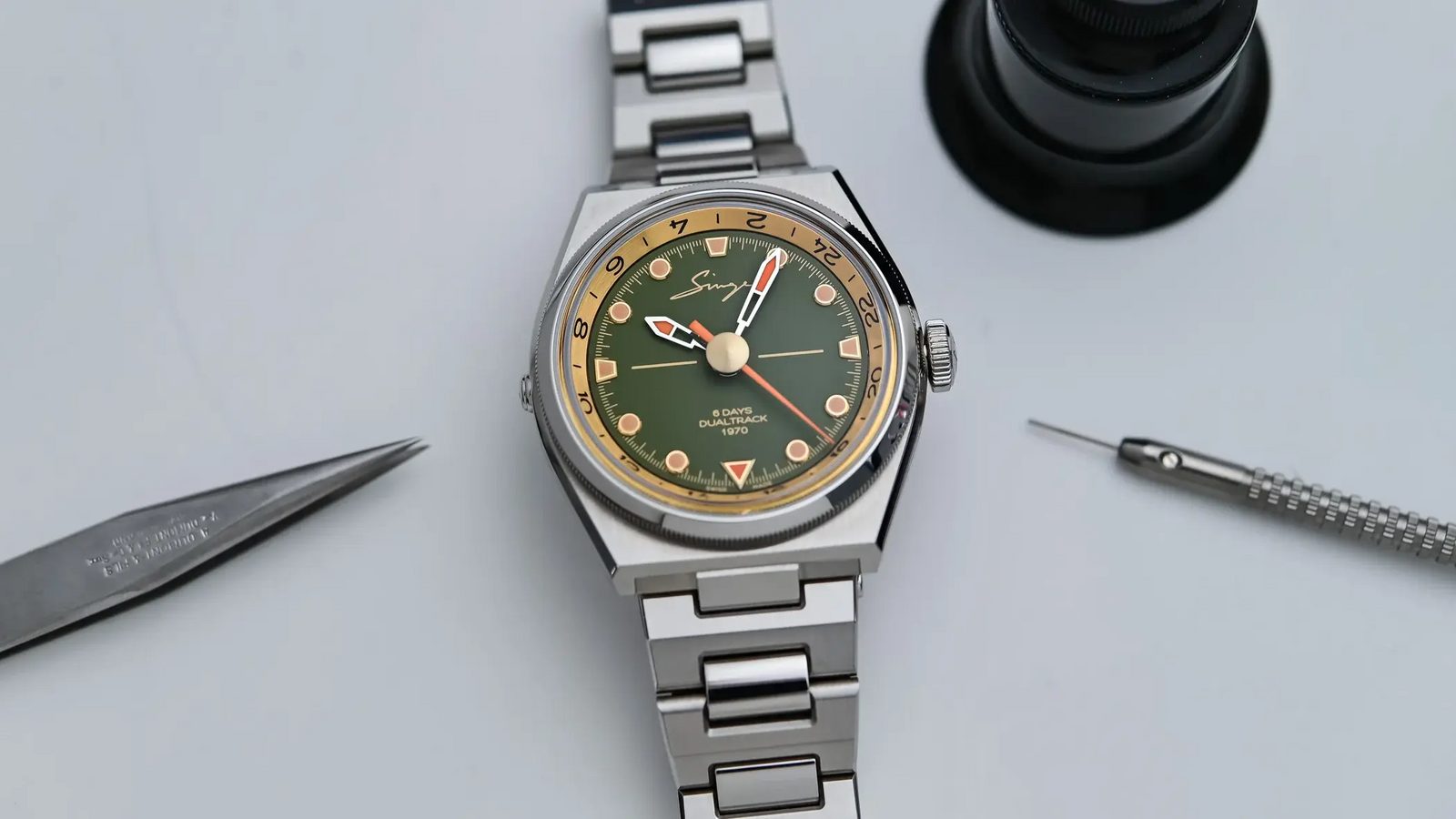
Singer Reimagined has introduced the 1970 DualTrack, a GMT collection that marks the independent watchmaker's first step away from the track-ready chronographs that have defined it since 2017. The steel watch carries a dual-time display and will reach official Singer retailers in October 2026, priced at CHF 23,500 excluding VAT.
The new model shrinks the display concept first shown on Singer's earlier 43mm DualTrack down to a 40mm case, matching the diameter of the brand's existing 1969 family. Case thickness drops to 12.6mm, making the 1970 the slimmest watch Singer has produced to date.
That slimness required more than a smaller case. Singer redesigned the case geometry entirely, moving from rounded 1960s forms to sharper, more faceted lines, and paired it with a fully integrated stainless steel bracelet rather than a strap, a first for the brand's design language.
Where the design comes from
Singer Reimagined was founded in 2017 by Rob Dickinson, known for Singer Vehicle Design, and watch designer Marco Borraccino, built on a shared enthusiasm for 1960s and 1970s automotive styling. Motors for the brand's movements are produced by master watchmaker Jean-Marc Wiederrecht of Agenhor, whose engineering underpins the whole collection.
The 1970 collection leans on that period directly, citing the angular, sculptural cars designed by Bertone and Marcello Gandini as reference points. Singer says the early 1970s replaced the flowing, rounded forms of the previous decade with more assertive, faceted shapes across architecture, furniture and design.
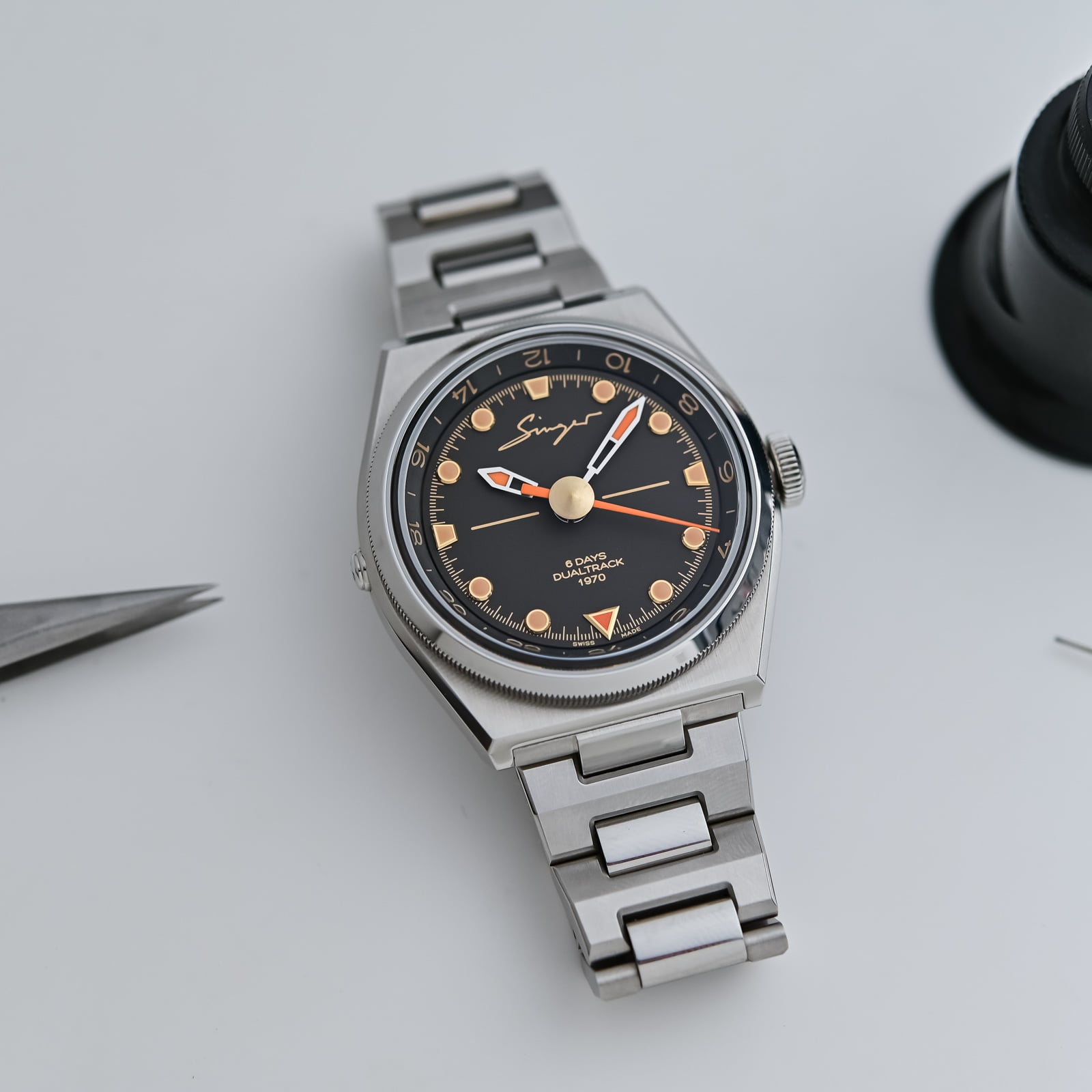
The flat, tonneau-shaped case middle carries a brushed sporty finish, with sloping bevels picked out in mirror polish and a fluted, polished bezel on top. The integrated bracelet, which Singer calls the Track Curb, takes its link shape from racetrack curbing and tapers from 22mm at the lugs to 18mm at the clasp.
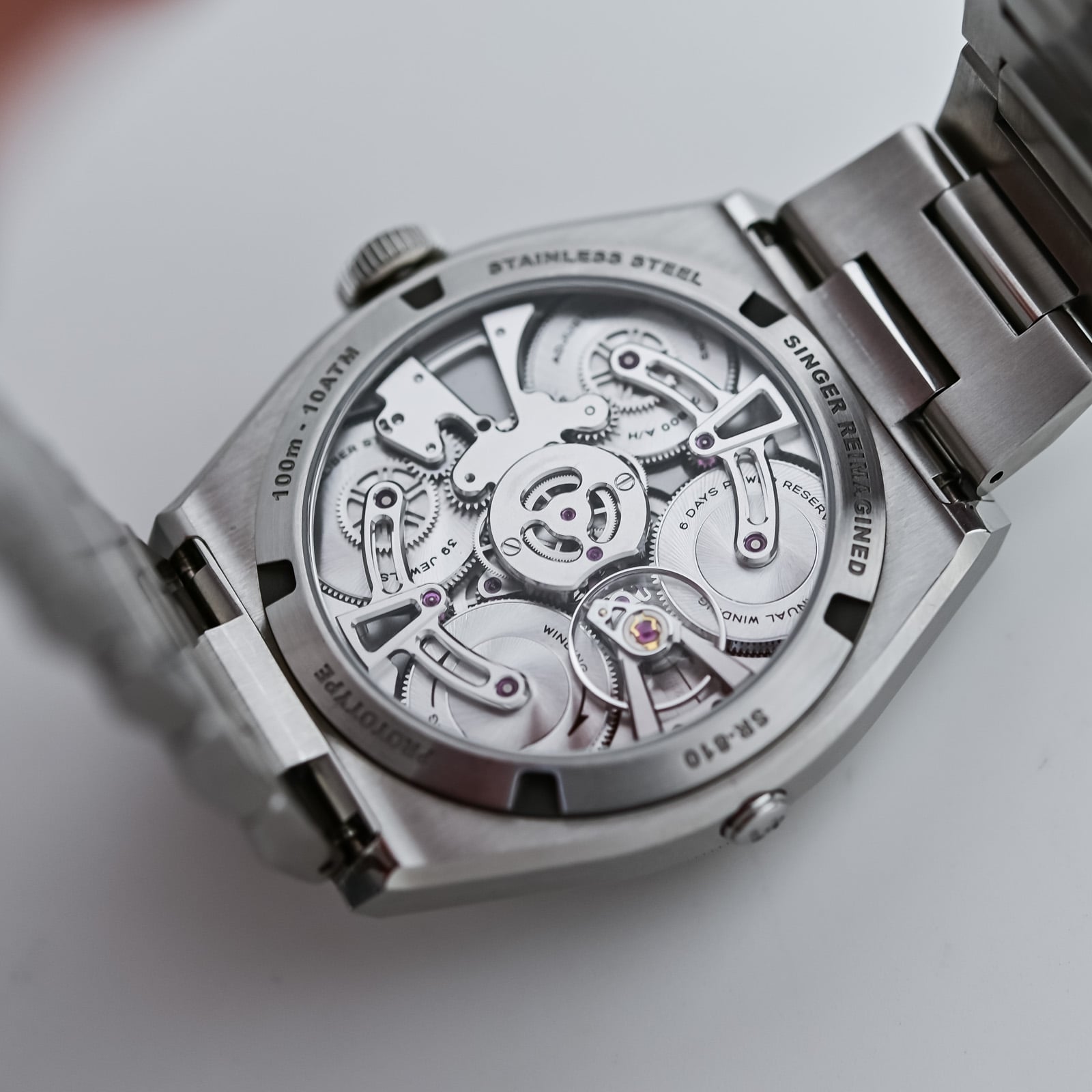
That bracelet also carries a built-in fine-adjustment system at the clasp, and its finishing mirrors the case: brushed surfaces with a polished central link and polished sides. The caseback is screwed down but fitted with a sapphire crystal, so the movement remains visible. Water resistance is rated to 100 metres.
How the dual time display works
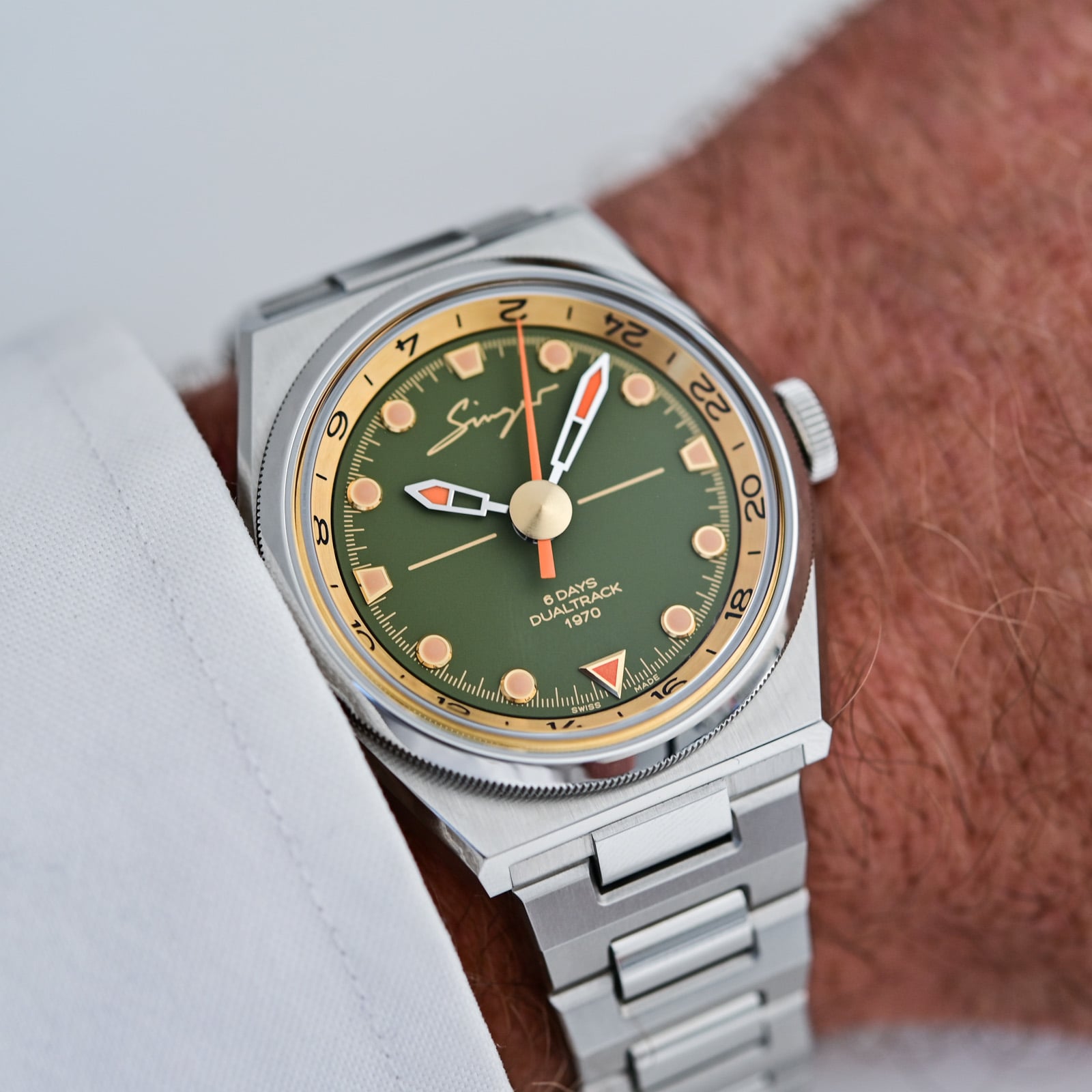
Singer has simplified the standard GMT function rather than adding to it. The central dial shows local time as normal, while a peripheral rotating 24-hour flange reads out home time at 6 o'clock, with no extra hand or secondary scale cluttering the layout.
Setting the second time zone is handled through a discreet corrector at 9 o'clock on the case, which advances the flange in one-hour increments. Singer frames the approach as a pragmatic answer to a genuinely modern need, favoring legibility over adding a fourth hand.
The 1970 DualTrack comes in three dial colors: Khaki, a long-running Singer signature; Cobalt Blue, offering the strongest contrast on the range; and Dark Espresso Brown, described by the brand as the warmer, quieter option of the three.
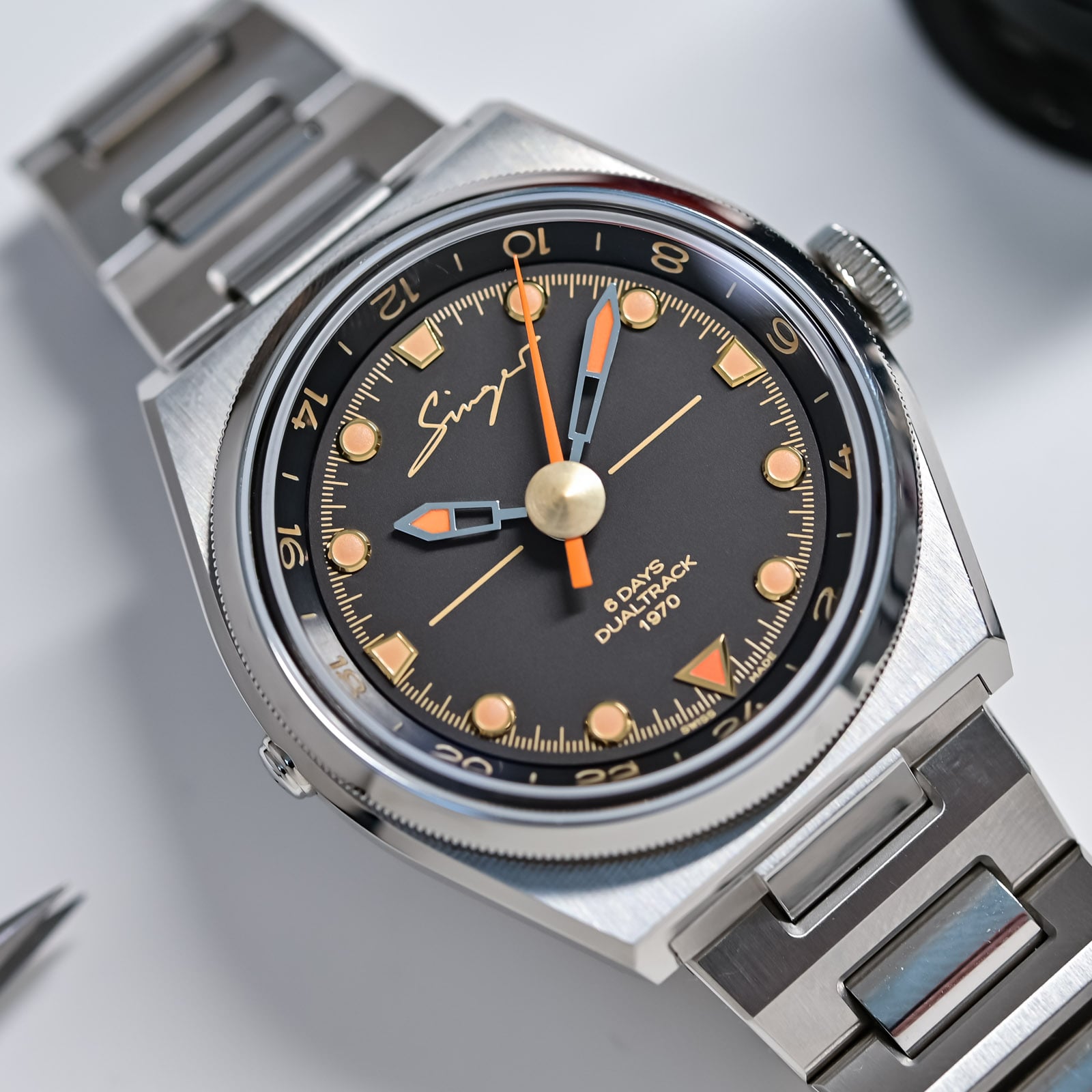
All three dials share golden, faceted, mirror-polished hour markers finished in cream-colored Super-LumiNova, a nod to period-correct 1970s palettes. The rhodium-plated hour and minute hands carry orange Super-LumiNova inserts, and the orange seconds hand emerges from beneath a golden cabochon, a Singer signature.
What powers the slimmer case
The 1970 DualTrack runs on the new Calibre 4 Slim Dual Time, a re-engineered version of Singer's proprietary base Calibre 4 built specifically to fit the thinner case. Watchmakers cut the movement's profile down to 6.6mm while retaining four barrels and a six-day power reserve.
The two sets of double barrels are flat and rotate in series and parallel, letting engineers hold torque stability without adding vertical bulk. Singer treats the movement redesign as central to the watch, not incidental to fitting a smaller case around an existing engine.
We have tracked the GMT segment closely as more independent and heritage names push into it: Tudor's revived Northflag traded its power reserve display for a GMT function, and our review of the Bulova Wilton GMT looked at how the complication reaches more accessible price points.
Singer's version stands apart from both, priced well above mainstream GMT territory and built around a display mechanism the brand designed specifically to avoid a conventional second hand. It gives our coverage of watches jewelry a rare case of an independent brand rethinking a familiar complication from scratch rather than adding it wholesale.
Singer has not disclosed production numbers or whether the 1970 collection will expand beyond this steel reference, and the brand's chronograph lines continue alongside it.
Sources
This briefing is published daily using an AI-powered system crafted by Luxe Digital’s team and finely tuned to meet our editorial standards. While we continuously test and review the output, mistakes can sometimes happen. Tell us if you spot one.
Images: Singer Reimagined