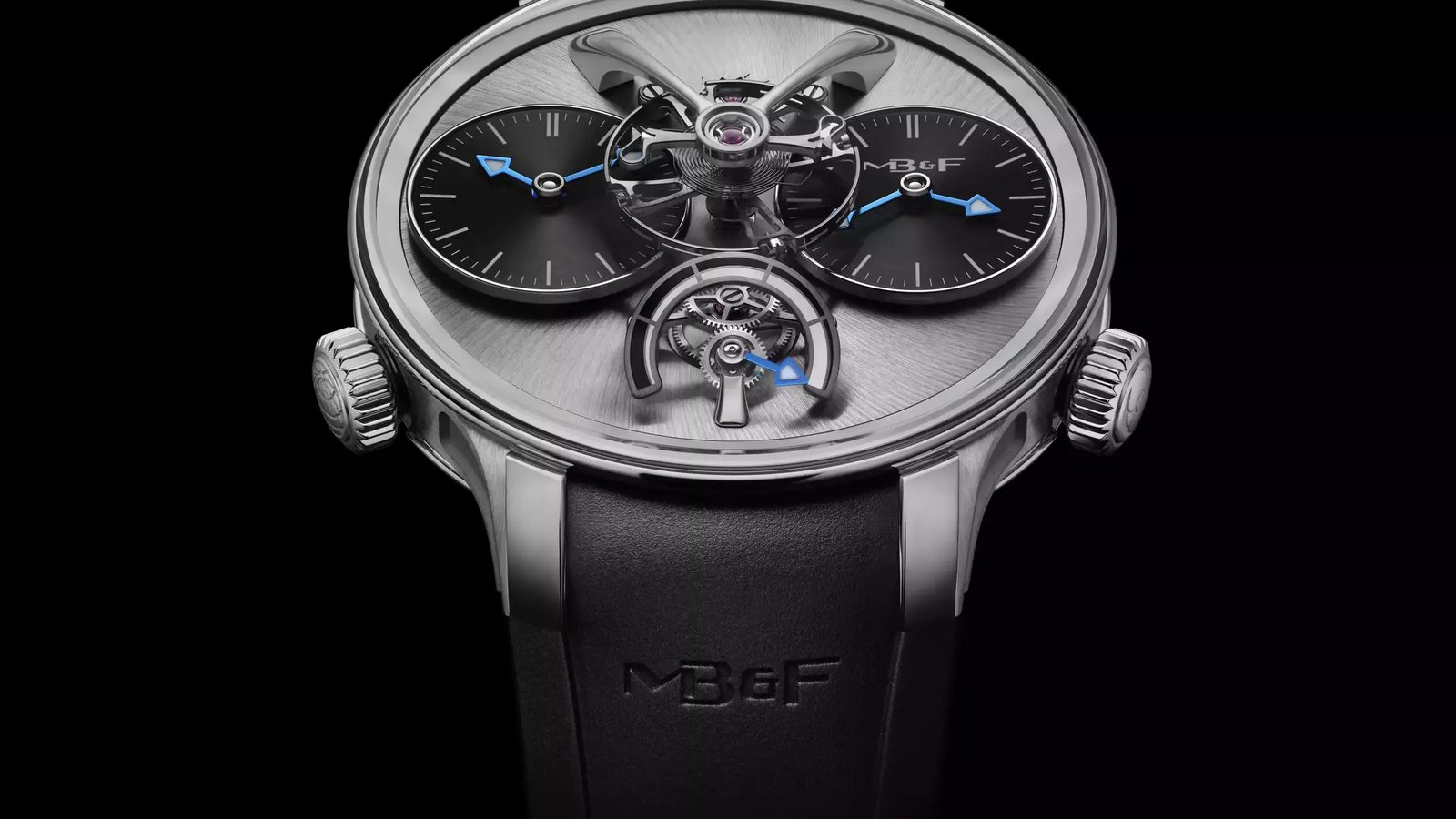

MB&F has brought back the Legacy Machine 1, the watch that began its round-cased dynasty in 2011, re-engineered as the sportier LM1 EVO. The revival lands nine years after the original retired in 2017, in titanium and a limited rose gold edition.
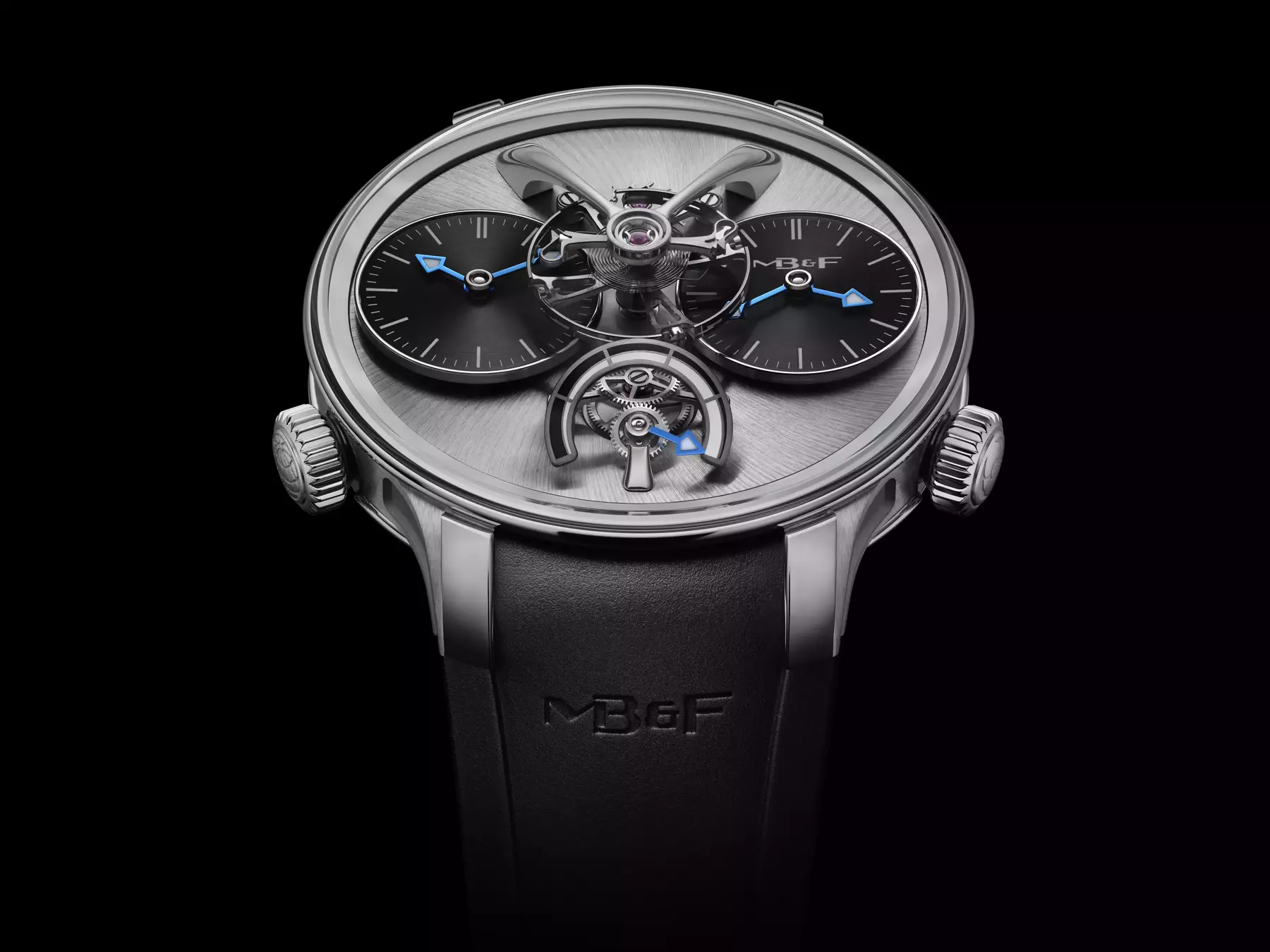
The titanium model wears a rhodium-plated dial plate with black sub-dials and blue arrow-tipped hands carrying luminescence. The rose gold edition pairs a rich green dial plate with the same black registers and gold-toned hands fitted with luminous inlays.
Retail prices, excluding VAT, are CHF 82,000, USD 109,000 and EUR 89,000 for the non-limited titanium watch. The rose gold version is capped at 33 pieces and runs to CHF 102,000, USD 137,000 and EUR 111,000.
The case shrinks from the original 44mm to a more ergonomic 42mm, with a thickness of 16.8mm including the hyper-domed sapphire crystal up front and the box crystal at the back. Lug-to-lug measures 52mm and the lug width is 18mm.
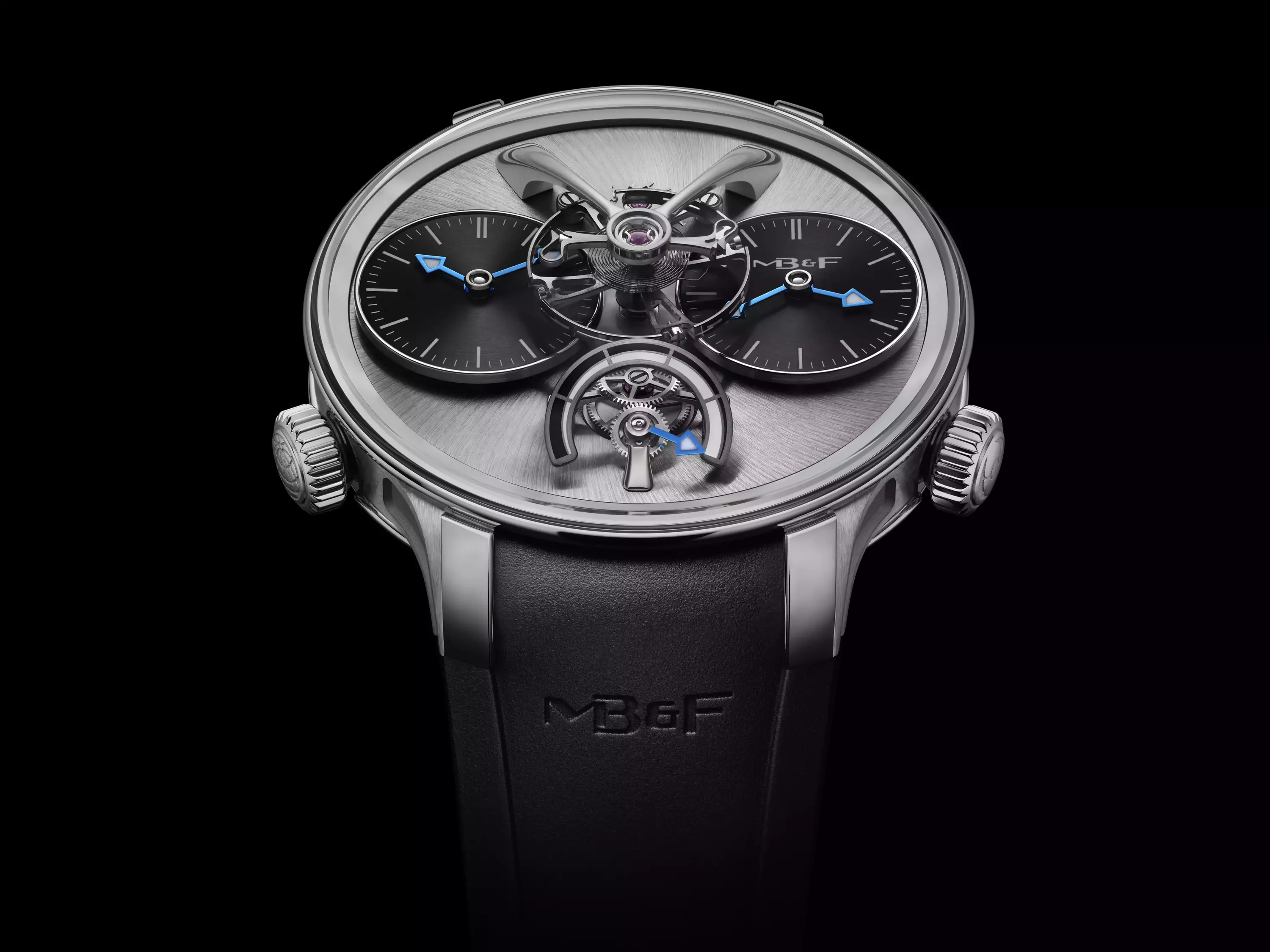
The bezel-less design lets the steep curve of the sapphire dome melt into the case, using a thermal bonding process that fuses the glass directly into the metal for greater structural strength. The result is more light reaching the movement plate beneath.
Every Legacy Machine carries Max Büsser's kinetic reinterpretation of the 19th century: the enormous 14mm flying balance wheel suspended under its arched bridge, and two independent time displays set by separate crowns to the minute, including offset zones.
The EVO treatment arrived on the LM Perpetual, the complex perpetual calendar designed by Northern Irish watchmaker Stephen McDonnell. It adds a screw-down crown for an 80m depth rating, a patented FlexRing shock-absorption system and an integrated rubber strap built for daily wear.
Büsser introduced it because these mechanically ambitious watches were hard to wear in real life, with owners fearing shocks, knocks and water. McDonnell's double-chronograph then debuted directly in EVO form as the LM Sequential EVO, in a case often made of zirconium or titanium.
Since then the Perpetual, Sequential, Sequential Flyback, Split Escapement and LM101 EVO have all carried the armor. The LM1 now joins them, gaining the same beefed-up case and the two screw-down crowns the concept demands.
What has changed inside the LM1 EVO
The power reserve indicator is no longer vertical. It now swings side to side as an inclined arc, tracking an increased reserve of 60 hours rather than the original's 45. The manually wound caliber, developed in-house with Jean-François Mojon, delivers that longer span.
The slow-beating 2.5 Hz balance, running at 18,000 vph, has been upgraded with a Straumann double hairspring for better accuracy and isochronism. The regulating system is now under a redesigned, slimmer titanium bridge. The watch is not chronometer certified and carries 25 jewels.
Finishing stays firmly in the old world, supervised by Kari Voutilainen. The bridges are black NAC, and the movement keeps polished gold chatons, Geneva waves, bevels with internal angles and hand engraving, the sort of work associated with 19th-century watchmaking.
A first for the range: the integrated rubber straps are quick-release at both the case and the clasp. That comes from a case redesign, so the system works only on the new LM1 EVO and cannot be swapped onto earlier EVO models.
The two sub-dials are now sunburst-polished black and flat, while the rose gold case is 5N and the titanium grade 5, with Super-LumiNova on the printed indexes. Grey or black straps come with a matching folding buckle in titanium or rose gold.
Where the LM1 began the Legacy line
When the LM1 appeared in 2011 it was the brand's first round case, and its Roman numerals, lacquered registers and 19th-century air looked alien beside MB&F's galactic Horological Machines. The floating balance and three-dimensional architecture proved the identity was intact.
The original ran from 2011 to 2017 and seeded the prolific LM dynasty, from the LM Perpetual to the Sequential and the 101. Büsser framed it as a tribute to the great watchmaking innovations and master watchmakers of the 19th century.
The winding crown is at 4 o'clock, which also sets the right-hand display, and the 8 o'clock crown sets the left time zone. Manual setting allows 15- or 30-minute offsets, so half and quarter time zones can be tracked.
Support the content you love — it’s free 🎉
Add Luxe Digital as a preferred source on Google. Our stories will be more likely to appear in Google’s Top Stories. It’s free and supports our team. Thank you!
Add as preferred sourceYou can remove us any time in Google’s source preferences.
Thank you — you’re all set 🎉
Luxe Digital is now one of your preferred sources, so our stories are more likely to appear in Google’s Top Stories.
This briefing is published daily using an AI-powered system crafted by Luxe Digital’s team and finely tuned to meet our editorial standards. While we continuously test and review the output, mistakes can sometimes happen. Tell us if you spot one.
Images: MB&F Legacy Machine 1 EVO; MB&F