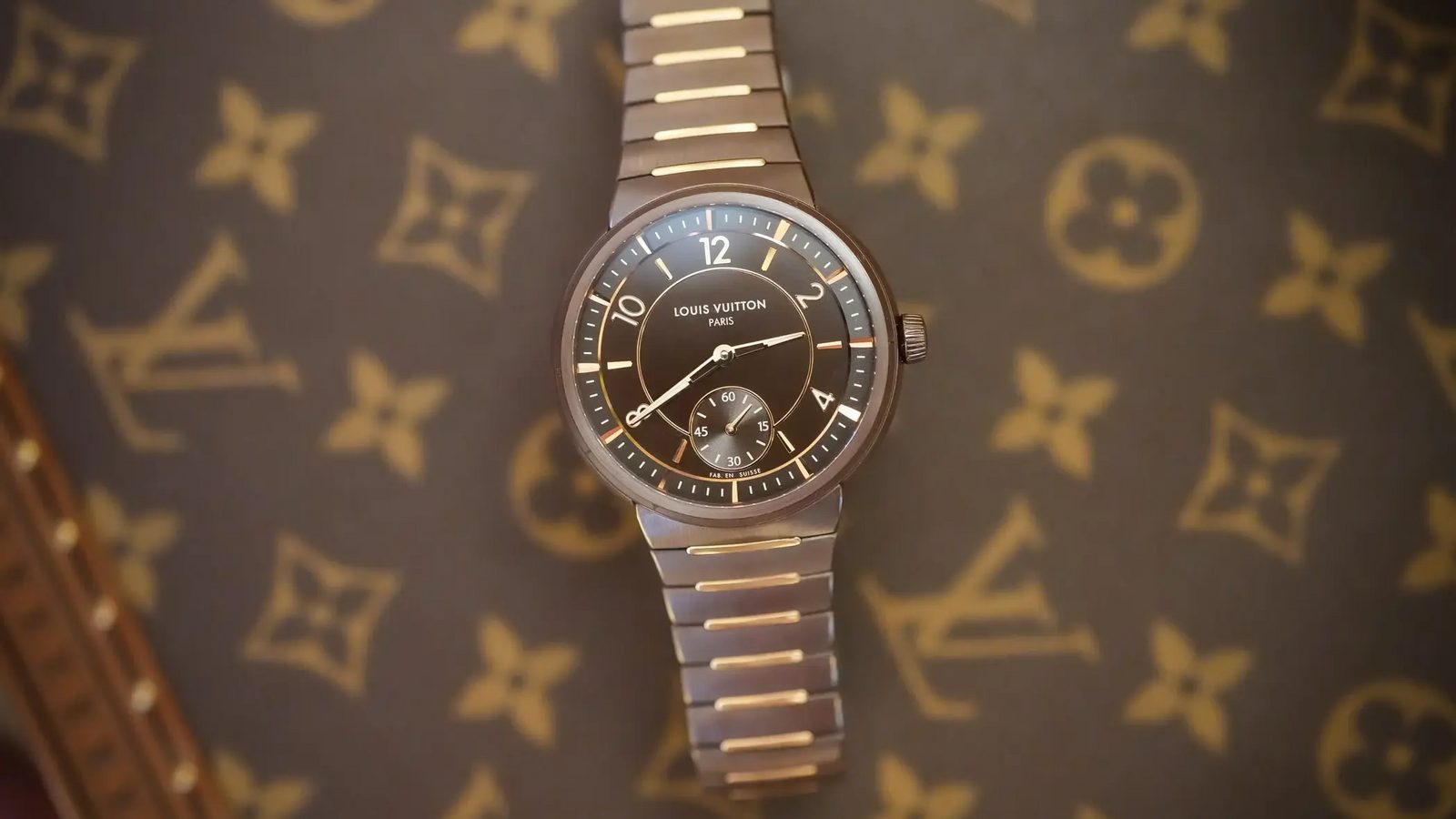

Louis Vuitton has added two permanent references to its watch collection, reviving the pebble-shaped Monterey case in glossy black or green ceramic. The watches are direct tributes to the Montre LV II of 1988, widely mistaken for a later addition despite predating the Tambour, Louis Vuitton's better-known watch line, by 14 years.
What the original Monterey was
The Montre LV I and LV II, launched in 1988, were designed by the Italian architect and industrial designer Gae Aulenti and built in partnership with IWC, which supplied the quartz movements. Their lug-less, pebble-shaped cases and crowns set at 12 o'clock earned them the nickname Monterey, an American mispronunciation of the French word montre.
The 40mm gold LV I was a complex travel watch packed with functions, including an alarm and a date the new pair drops entirely. The smaller 37mm LV II was simpler and came in black or green ceramic, a material so rare in watchmaking in 1988 that Louis Vuitton leaned on ceramic case technology IWC had introduced two years earlier on its Da Vinci QP.
What the new ceramic watches add
The new Monterey Ceramic pair keeps the 37mm diameter of the original LV II, a size the brand compares to the 39mm case it used on a gold, mechanical limited edition released last year in smooth yellow gold.
The case is 11mm thick, 2mm more than the 1988 quartz model, a difference Louis Vuitton attributes to fitting an in-house automatic movement in place of the original battery.
The crown at 12 o'clock, a detail Aulenti borrowed from pocket watches adapted to the wrist, is now wider and steel, cut with a Clous de Paris grip for better purchase. The lug-free case itself is built from ceramic powder, zirconium oxide and pigments compressed into a solid block, then shaped on a three-axis machine rather than cast in a mould.
That block is fired at 1,000 degrees Celsius to set its color, then ground by hand and hand-polished to finish the curved, sculptural profile Aulenti gave the original. Louis Vuitton offers the case in green ceramic with a matching dial, or in black ceramic paired with a white dial for higher contrast.
Both dials keep the double railway-track minute scale of the 1988 originals and their openworked, lacquered syringe-style hands, yellow on the green dial and red on the black. A needle-thin blue seconds hand with an openworked circular counterweight is new, added alongside a movement the originals never carried.
That movement, developed and assembled by La Fabrique du Temps and wound by a central 18k rose gold rotor cut with V-shaped notches, stays hidden behind the caseback. Its bridges are sandblasted with micro-sandblasted edges, the mainplate carries perlage, and its jewels are colourless; it runs at 4Hz with a 45-hour power reserve.
Aulenti's most practical invention survives unchanged: a strap threaded through an attachment on the caseback rather than through conventional lugs, so it disappears from view and keeps the pebble silhouette unbroken. The new Monterey Ceramic pair, priced at EUR 23,000, joins the permanent collection rather than arriving as a limited run.
Where this fits for Louis Vuitton
Louis Vuitton, the trunk maker that became LVMH's flagship, built its name on leather goods rather than watchmaking, and its site remains the most visited among luxury brands in our ranking of the category. The Speedy bag it introduced in 1930, which we have named the Louis Vuitton bag to buy first, still outsells most of what the house makes in hard luxury.
Dior, Gucci and Chanel rank ahead of Louis Vuitton for online search interest in our tracking of the most popular luxury brands, with Hermès placing just above it.
Watches remain a smaller part of that picture, and the Monterey's return as a permanent line, rather than a repeat of last year's gold limited edition, signals Louis Vuitton wants the case to be judged as an ongoing collection rather than a one-off tribute.
IWC, the Schaffhausen watchmaker that supplied the original Monterey's quartz movements and ceramic case technology, still builds its reputation on tool watches and dress pieces rather than fashion house collaborations. A Pilot Watch Automatic 36 starts around $4,350 and the Portofino Automatic runs near $5,000, prices that are well below the EUR 23,000 asked for the new Monterey Ceramic.
Support the content you love — it’s free 🎉
Add Luxe Digital as a preferred source on Google. Our stories will be more likely to appear in Google’s Top Stories. It’s free and supports our team. Thank you!
Add as preferred sourceYou can remove us any time in Google’s source preferences.
Thank you — you’re all set 🎉
Luxe Digital is now one of your preferred sources, so our stories are more likely to appear in Google’s Top Stories.
This briefing is published daily using an AI-powered system crafted by Luxe Digital’s team and finely tuned to meet our editorial standards. While we continuously test and review the output, mistakes can sometimes happen. Tell us if you spot one.
Image: Louis Vuitton