You have seen the photo. Navy blazer, grey flannels, no logo anywhere, a guy who looks like he has had money for three generations and never once tried to prove it. You want the rules he is following, and the photo will not give them to you.
Spotting the look is one thing. Knowing it predates the name by more than a century is another, and the rules underneath are stricter than the outfit lets on.
This guide walks the seven rules the photo is following, then the wardrobe that carries them, then the brands at each price tier and the details that give the costume away. By the end you will know what to buy first and what to leave on the rack.
This is the men’s half of the look. The women’s side runs by its own rules, covered in our companion guide.
Old money style is much older than its name
Old money style predates the phrase by more than a century. In 1899, Thorstein Veblen published The Theory of the Leisure Class and coined the phrase conspicuous consumption, for spending done to display wealth rather than serve a purpose. Old money dressing works the opposite way: it signals status without naming it.
The label arrived later. Lisa Birnbach’s The Official Preppy Handbook came out in 1980 as satire and spent 38 weeks at number one on the New York Times bestseller list. Readers used a parody as a shopping manual.
The phrase old money spread through TikTok from around 2022.
The rules of old money style
The seven rules below are not about the first thing you buy. They are about what you stop doing. Read them as a discipline before you read the wardrobe.
1. Buy natural fabrics and let them age
Natural fabrics are the engine of the whole look. Linen softens and creases. Cotton oxfords fade at the collar. Cashmere pills slightly and then settles. Synthetics do the opposite: they pill badly, they shine at the elbows, and they look worse every year. Choose the material before you choose the brand.

2. Choose soft tailoring over sharp tailoring
Old money tailoring asks for a jacket that moves with you. The unstructured Boglioli K-Jacket, launched in 2000 and garment-dyed, is the reference point: soft shoulders and a light construction instead of heavy padding. An unstructured navy jacket works over a shirt at lunch and over a sweater on a Saturday; a stiff one only works at the office. Boglioli built a whole company on the idea.
3. Keep the palette to five colors
Five colors carry the wardrobe: navy, cream, grey, olive and camel. White shirting and brown leather work as the neutrals underneath.
Every piece works with every other, so you stop assembling outfits and start simply getting dressed. These men look coordinated because the palette does not let them clash. Color itself arrives in small doses, through a tie, a knit, or a pair of socks.
4. Fit beats brand, every time
A well-altered $200 jacket beats an unaltered $2,000 one off the rack. Find a tailor before you find a brand. Sleeve length, trouser break and jacket waist suppression are the three adjustments that change how a garment reads, and all three are inexpensive.
Trousers should break once, lightly, over the shoe; jacket sleeves should show about half an inch of shirt cuff.
5. Repair it rather than replace it
Resole the shoes. Reweave the moth hole. Replace the buttons.
Old money style treats wear as evidence, not damage, and assumes a garment stays in the wardrobe for a decade or longer. Learn your tailor and your cobbler before you learn the sales calendar.
6. Own nothing with a visible logo
The logo defeats the whole exercise. The look signals money without saying where it came from. No monograms, no oversized branding, no house pattern across the chest. A discreet embroidered mark on a polo is the outer limit, and even that is a concession to the modern market.
If your clothes need to name the brand, the clothes are not doing the job.
7. Repeat your outfits
Wearing the same navy blazer three times in a week is the point of owning a good one. The men this aesthetic is modeled on own very few clothes and wear them constantly.

The old money wardrobe, piece by piece
Here is what actually goes in the closet. Buy in this order.
The navy blazer
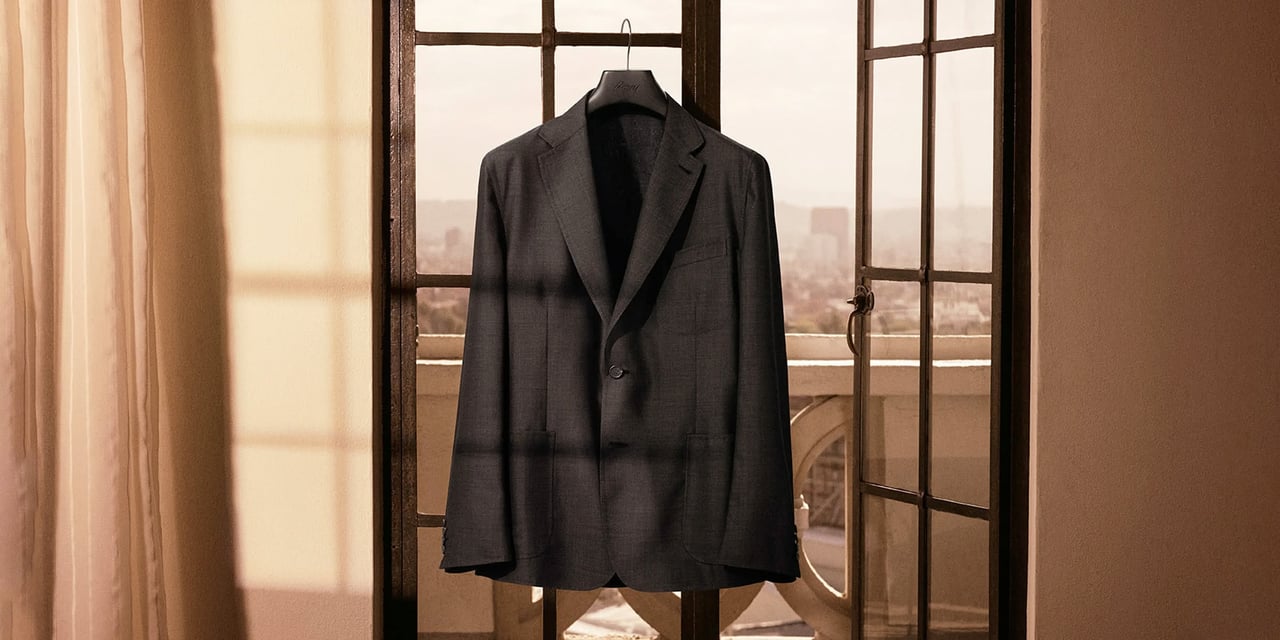
Buy this first. A navy jacket dresses up jeans, dresses down flannels, and travels without complaining about either job.
Canali has cut this shape since 1934, when brothers Giovanni and Giacomo opened a tailoring workshop in Triuggio, north of Milan, and Canali’s tailoring still carries the soft Italian shoulder the look depends on.

CANALI
Italian tailoring and blazers
Check price: CANALI at Mytheresaat Mytheresa · Express delivery
If you want to compare cuts before committing, browse the wider men’s selection and pay attention to the shoulder construction rather than the label.
It is not a dinner jacket, though the same principles apply once the garment changes. Our black tie dress code guide covers that other code, and a dinner jacket is worth buying once and keeping for twenty years.
Grey flannel trousers
Wool flannel drapes better than cotton, holds a crease without looking pressed, and works from October through April. That is the trousers’ whole job under the blazer.
Zegna has milled its own cloth since 1910. Zegna’s trousers and tailoring are cut from it. Stick to a mid-grey; it works with everything else you own.

ZEGNA
Wool trousers and tailoring
Check price: ZEGNA at Mytheresaat Mytheresa · Authentic designer pieces
In warm weather, swap flannel for cream cotton or linen. Our guide to types of suits for men covers how the same rules apply to full suiting.
Cashmere knitwear
Luca Faloni makes its cashmere in Italy and sells direct, well below the designer houses buying from the same mills. Luca Faloni’s cashmere is what we recommend most often in this category.
A crewneck in navy, camel or grey earns its keep two ways: worn over a shirt with the collar out, or alone under a jacket.

LUCA FALONI
Italian cashmere knitwear
Check price: LUCA FALONI at Luca Faloniat Luca Faloni · Great deals every day
The oxford shirt
The button-down oxford is the most useful shirt in this wardrobe, working under a blazer, under a sweater, and alone with the sleeves rolled.
Ralph Lauren has sold the American version of this look since 1967, when he started with a line of wide neckties under the Polo name, and Polo Ralph Lauren’s oxford shirts remain the reference point for the collar roll.

POLO RALPH LAUREN
Oxford shirts and knitwear
Check price: POLO RALPH LAUREN at Ralph Laurenat Ralph Lauren · Competitive prices
The polo and the T-shirt
Summer is where this aesthetic is most often faked, and the fix is a better polo.
Sunspel has made fine cotton knitwear in England since 1860, and has produced in Long Eaton since 1937. Sunspel’s polo shirts use a cotton mesh that stays crisp in heat instead of clinging.

SUNSPEL
Polo shirts and cotton knitwear
Check price: SUNSPEL at Mytheresaat Mytheresa · Free returns available
The plain white T-shirt follows the same logic. Sunspel made some of the earliest luxury versions from Sea Island cotton, and Sunspel’s T-shirts still hold their shape after years of washing.

SUNSPEL
T-shirts and English cotton basics
Check price: SUNSPEL at Sunspelat Sunspel · Fast, reliable delivery
Shoes
Two pairs cover almost everything: a brown leather loafer or derby, and a clean white leather sneaker.
Amberjack started in New York in 2020 and builds its shoes in a family-run factory outside Porto, Portugal. Amberjack’s dress shoes are the pairs you can walk in all day.

AMBERJACK
Leather dress shoes and loafers
Check price: AMBERJACK at Amberjack Shoesat Amberjack Shoes · Secure checkout
For the sneaker, keep it white, keep it leather, keep it clean. Koio launched in 2015 and makes its shoes in Le Marche, the Italian region that produces most of the world’s fine footwear. Koio’s leather sneakers are the ones we keep coming back to.

KOIO
Italian leather sneakers
Check price: KOIO at KOIOat KOIO · Trusted luxury retailer
Our guides to men’s loafers and the best dress shoes for men go deeper on both categories.

Accessories
Accessories stay quiet: a leather belt matched to your shoes, a simple dress watch on a leather strap, and a knitted or grenadine tie. Nothing lights up. Nothing announces.
The watch is the one place where a serious purchase reads correctly. A thin dress watch on a leather strap is understated by design. Our guide to luxury watch brands covers the houses worth the money.
Skip the pocket squares, the lapel pins, the bracelets, and the sunglasses worn indoors.
The brands, by price tier
Four tiers matter. The first three build the look. The fourth sells the costume.
| Tier | The names |
|---|---|
| Heritage houses | Brooks Brothers, Ralph Lauren, Loro Piana, Zegna, Hermès, Sunspel |
| Italian middle | Canali, Boglioli, Luca Faloni, Massimo Alba |
| Accessible end | Uniqlo, Charles Tyrwhitt, Spier & Mackay, J.Crew |
| The costume tier | Labels that name the aesthetic in the product itself |
The heritage houses
At the top sit Brooks Brothers, Ralph Lauren, Loro Piana, Zegna, Hermès and Sunspel, names that have dressed this customer for decades or longer. They are expensive, and their core pieces genuinely last, so buy one at a time.
Above this tier sits a level this wardrobe has no real use for. Our guide to the most expensive suits money can buy traces where tailoring prices actually stop: cloth and hours of handwork are worth paying for, decoration is not.
The Italian middle
The Italian middle is where the tailoring gets soft without the heritage markup: Canali, Boglioli, Luca Faloni and Massimo Alba all sit here. Canali was founded in 1934 by brothers Giovanni and Giacomo Canali in Triuggio, north of Milan, and Boglioli’s garment-dyed K-Jacket has been the unstructured reference since 2000. This tier is where most readers should spend.
The accessible end
The accessible end gives you the shapes without the soft tailoring. Uniqlo, Charles Tyrwhitt, Spier & Mackay and J.Crew cover the basics well, and a Uniqlo oxford and a merino crewneck will carry the look while you save for the jacket.
The brands selling the aesthetic back to you
The fourth tier is the one to skip. A number of labels launched recently with old money in their marketing, and several sell polyester blends at cashmere prices. Read the composition label: if a brand’s entire identity is the aesthetic rather than the manufacturing, you are paying for the positioning, not the cloth.
What gives it away
These are the tells of someone who discovered the look last month rather than lived in it.
- Everything is new. A wardrobe with no wear in it reads as a costume. Nothing looks more borrowed than five perfect garments bought in one order, all creased from the same box.
- The logos are still there. A small horse is fine. A monogram belt buckle, a branded cap, and a logo knit worn together are not.
- The styling is too complete. Pocket square, tie bar, collar pin, cufflinks and a lapel flower on the same body reads as a period costume. Old money dressing is under-accessorized on purpose.
- Everything matches too well. Belt and shoes should relate to each other. Belt, shoes, watch strap, bag and jacket buttons in identical leather is a showroom.
- The fabrics are wrong. Shiny polyester knits, technical blends in tailoring, and faux-suede loafers undo the whole thing, whatever the outfit looks like in a photograph.
- The clothes are too tight. The look descends from clothes built for tennis, sailing and long lunches, and it has ease built into it. Compression tailoring belongs to a different decade.
- The grooming is too deliberate. A tan that is too even and hair that is too styled both read as arranged. A good haircut you do not have to think about beats a styled one.
If you buy the whole look in one weekend, the wear patterns are what give you away.

How to build it slowly
Buying this wardrobe in one weekend produces exactly the result described above. Build it over a year instead. Start with the navy blazer and get it altered, then add the grey flannels and a white oxford. Those three pieces alone already make several outfits. Then the cashmere crewneck, then the shoes, then everything else.
The 3-3-3 rule is the shorthand: three tops, three bottoms and three pairs of shoes, popularized on TikTok by Rachel Spencer. It describes how this wardrobe has always worked.
Buy one good thing every few months rather than five adequate things at once. The cost per wear falls, the wardrobe stays coherent, and the clothes accumulate the wear that makes the whole thing believable.
For quantities and the order to buy, our guide to building a capsule wardrobe for men takes over where this page stops. If the whole look reads a step too formal for your weekdays, our men’s smart casual dress code guide is the next code down.
Let the wear do the talking.
Frequently asked questions about old money style for men
What defines "old money" style for men?
How to dress like an old money guy?
What is the 3 3 3 rule for men?
What is the old money aesthetic for guys?
Why is Gen Z obsessed with old money?
Products featured here are independently selected by our editors. If you buy through our retail links we may earn an affiliate commission — it never changes the price you pay, and it never decides our verdicts. Read our earnings disclaimer.