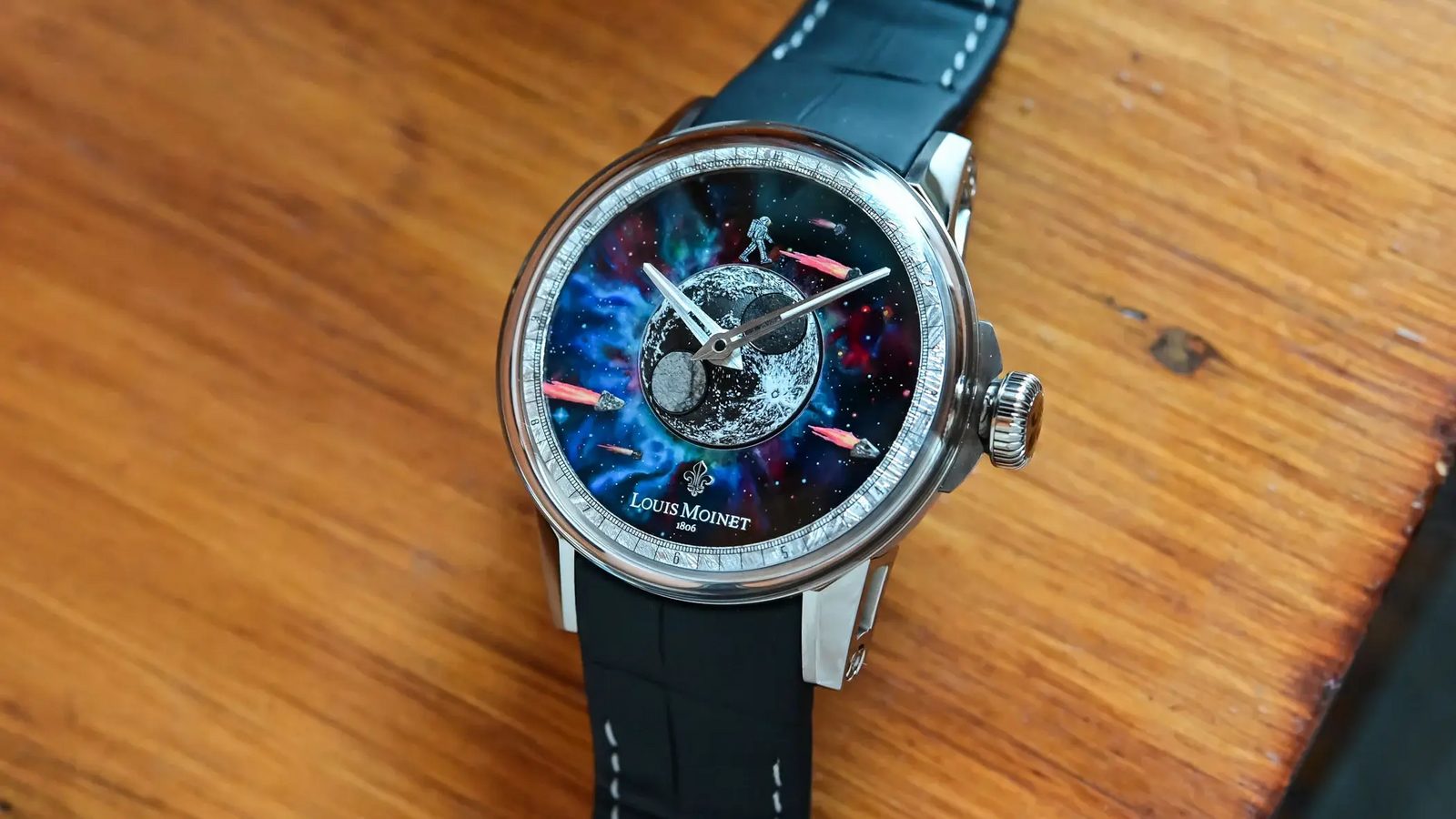
Louis Moinet has unveiled the Moon Meteor, a 12-piece limited edition that sets genuine meteorite fragments into a hand-painted celestial dial. The watch is priced at CHF 48,000, a figure Louis Moinet says reflects the cost of sourcing named meteorite specimens and hand-finishing each dial individually, rather than the cost of the movement alone, which is a modification of an existing Concepto base caliber.
Each piece is engraved "One of Twelve" on the case, and the design shows a different composition once viewed in darkness than it does in daylight.
The case measures 40.7mm across and 17.92mm high, machined from grade 5 titanium with a polished and satin finish. Despite its height, the case weighs just 18 grams. It has openworked lugs, a large fluted crown, and a display caseback with engravings that reveal the movement beneath.
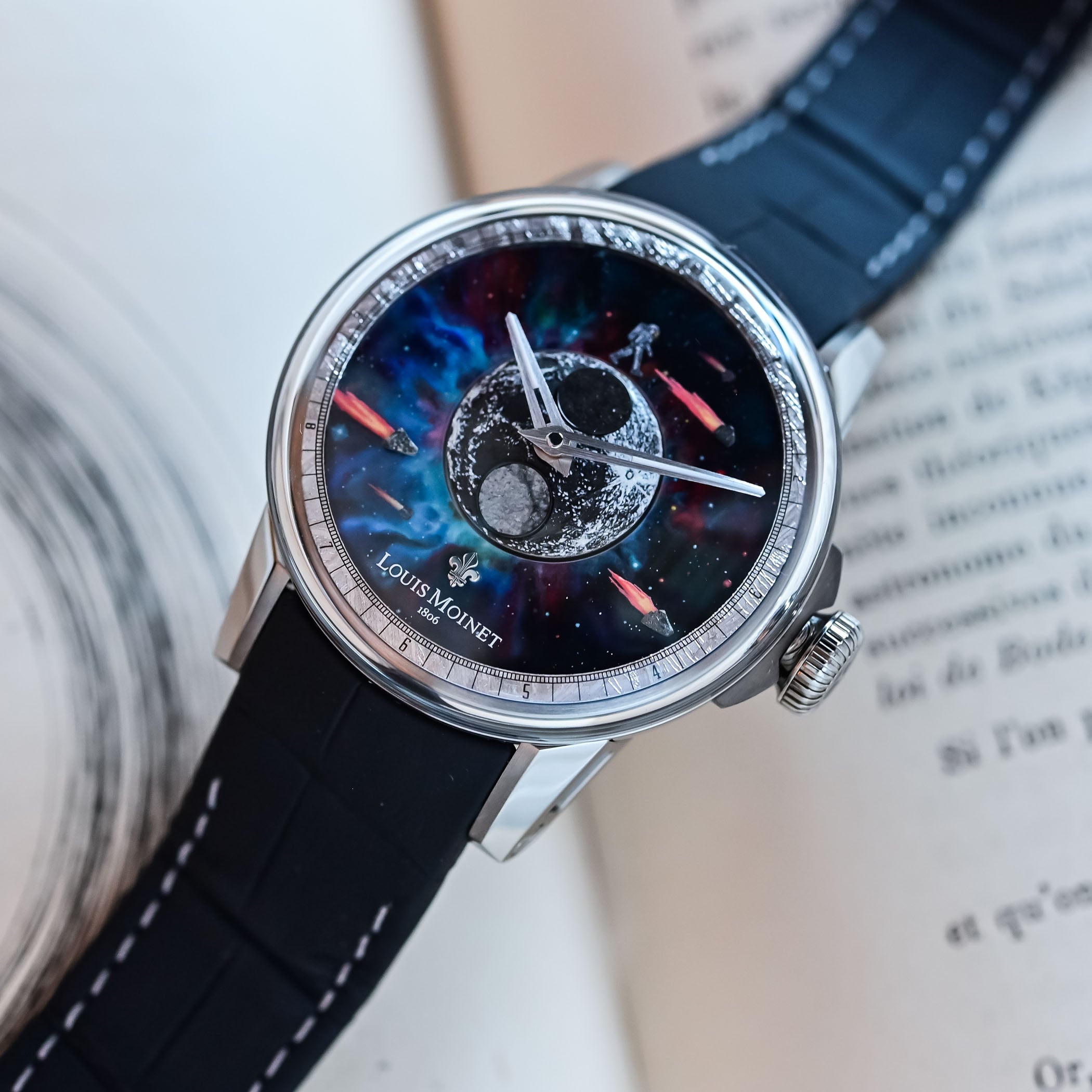
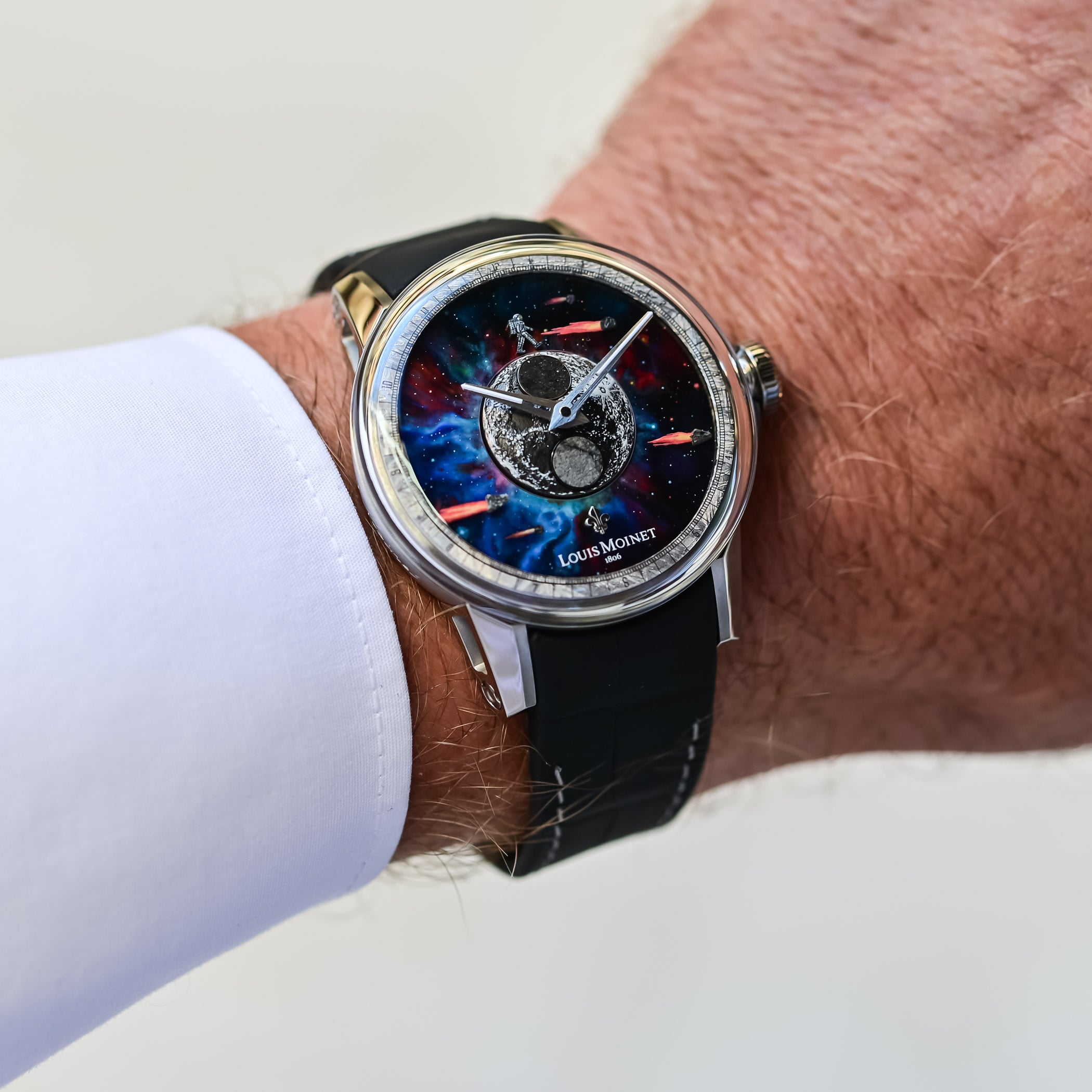
A box-type sapphire crystal with double-sided anti-reflective treatment covers the dial, which carries a hand-painted miniature landscape. Louis Moinet says the scene was created under a binocular microscope with an extremely fine brush, built up through successive layers of lacquer and varnish, and finished with luminescent material worked directly into the paint.
That luminescent treatment is why the dial reads differently after dark: elements of the painted scene emerge under low light that are not visible in daylight. Time is shown by faceted, skeletonised hands that are themselves luminescent, so the display stays legible in both states.
What the meteorite fragments actually are
Three named meteorites cross the dial as a visual band: the Martian meteorite NWA 13925, a fragment called Jbilet Winselwan, and Sahara 97093, an EH3-type enstatite meteorite that Louis Moinet says contains microdiamonds of interstellar origin. The flange itself is cut from Muonionalusta meteorite, chosen to display its Widmanstätten pattern.
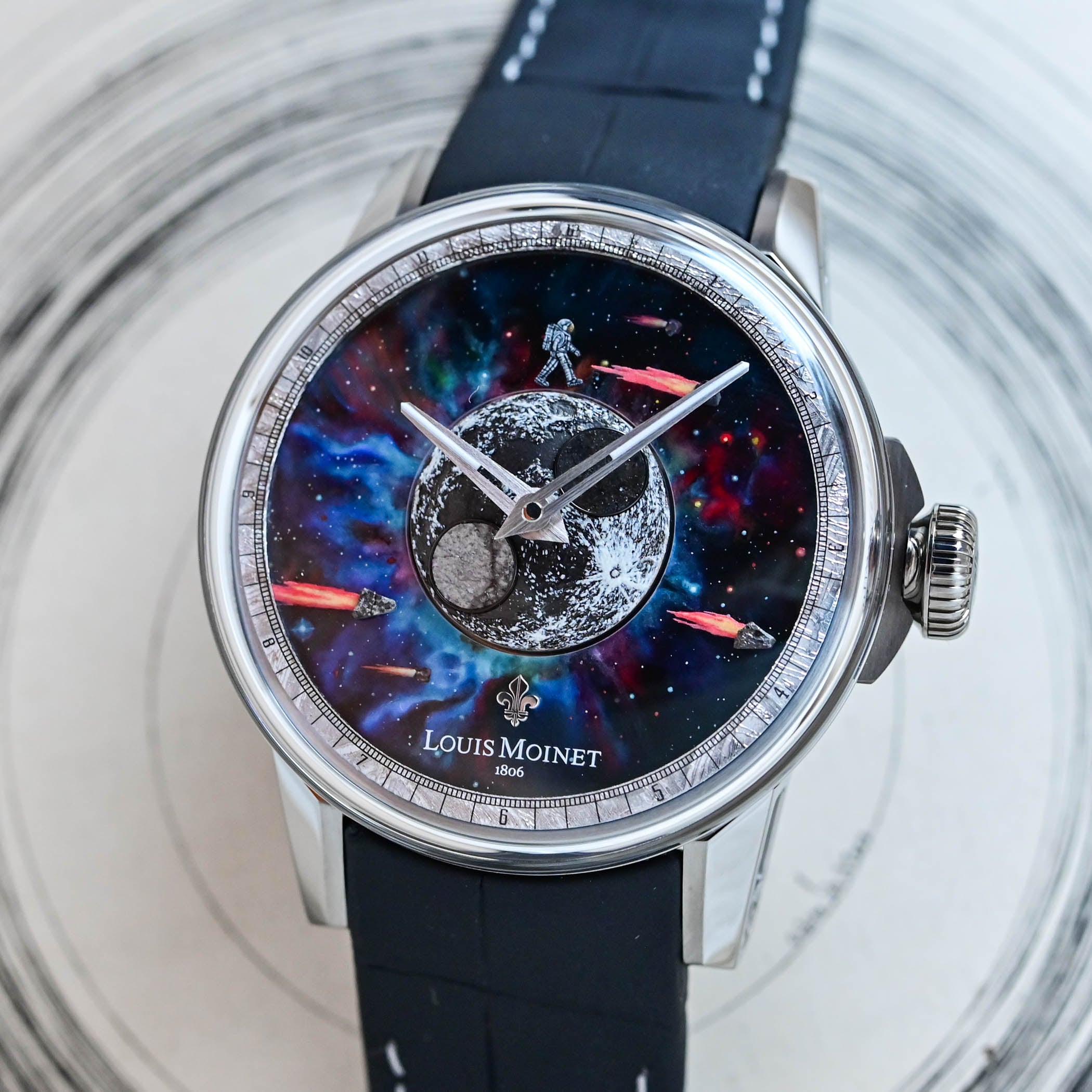
At the center of the dial, a domed lunar disc recreates the Moon with engraved and hand-painted craters, and two further lunar meteorites, Gadamis 005 and Dhofar 457, stand in for the full and new moon phases. A hand-painted astronaut walking above the disc serves as the reference point for reading the lunar phase as it turns.
Louis Moinet claims the moon phase mechanism keeps its precision to within one day every 122 years, a figure well ahead of the roughly two and a half years typical of a standard moon phase complication. The watch runs on the LM113, a self-winding caliber developed with movement specialist Concepto.
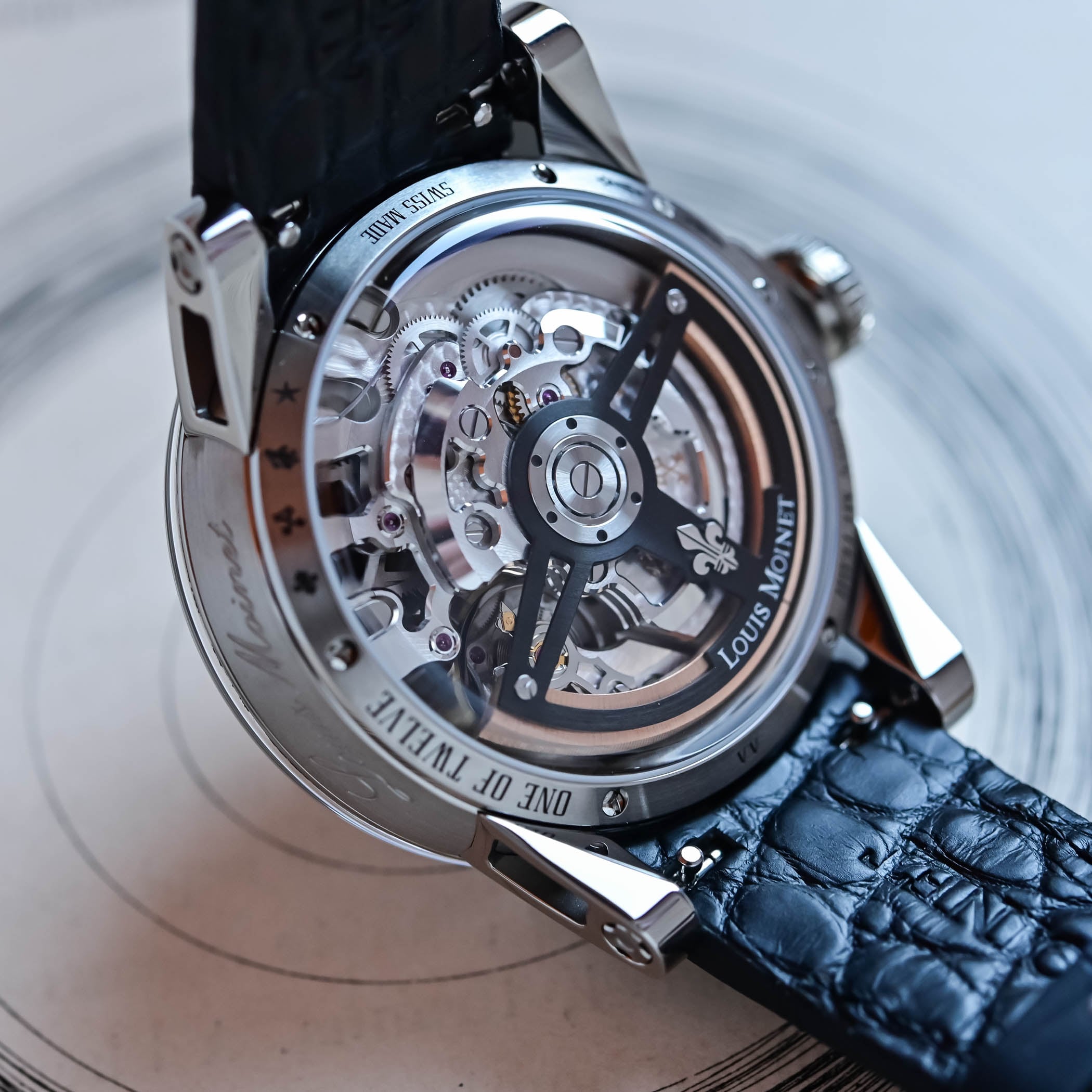
The LM113 displays hours, minutes and the lunar cycle, operates at 28,800 vibrations per hour, and stores 48 hours of power reserve. The movement itself measures 30.4mm across and 12.7mm thick. Water resistance on the finished watch is rated to 30 meters, modest for a piece built primarily as a wearable art object.
The Moon Meteor is fitted to a Louisiana alligator strap closed with a triple-folding clasp that includes fine adjustment and is stamped with the Louis Moinet fleur-de-lys. Louis Moinet has not stated a delivery date for the run, only that the 12 pieces are engraved individually as they are completed.
A brand built on astronomical complications
Louis Moinet takes its name from the nineteenth-century watchmaker credited with inventing the chronograph, whose "compteur de tierces" was built specifically for tracking celestial events. The modern brand has leaned into that history repeatedly, with space-themed watches including the Super Moon, the Mars Mission, the Space One Chronograph and, most recently, the Starman.
The Moon Meteor extends that lineage by combining three disciplines the brand has used separately in earlier pieces: miniature painting, meteoritic materials and moon phase mechanics, now brought together in a single watch rather than spread across a collection. It is a small, independent maison, and pieces at this production scale are toward the top of what it makes.
We have tracked how independent watchmakers use rare materials and limited runs to justify high prices without the marketing weight of the largest groups, in our coverage of watches jewelry and in profiles of emerging names within the category.
The Moon Meteor fits that pattern: a run of 12 pieces, natural materials with documented origins, and a price set by scarcity rather than by brand recognition alone.
Louis Moinet has not broken out how much of the price is attributed to materials versus finishing.
What happens to the watch once all 12 pieces are allocated is not addressed in the brand's release, and Louis Moinet has not said whether the Moon Meteor's design elements, the meteorite flange or the astronaut-referenced moon phase, will reappear in a future model the way the Starman followed the Space One Chronograph.
Sources
This briefing is published daily using Luxe Digital’s AI agents, finely tuned to meet our editorial standards. While we test and review their work, mistakes can sometimes happen; tell us if you spot one.
Images: Louis Moinet