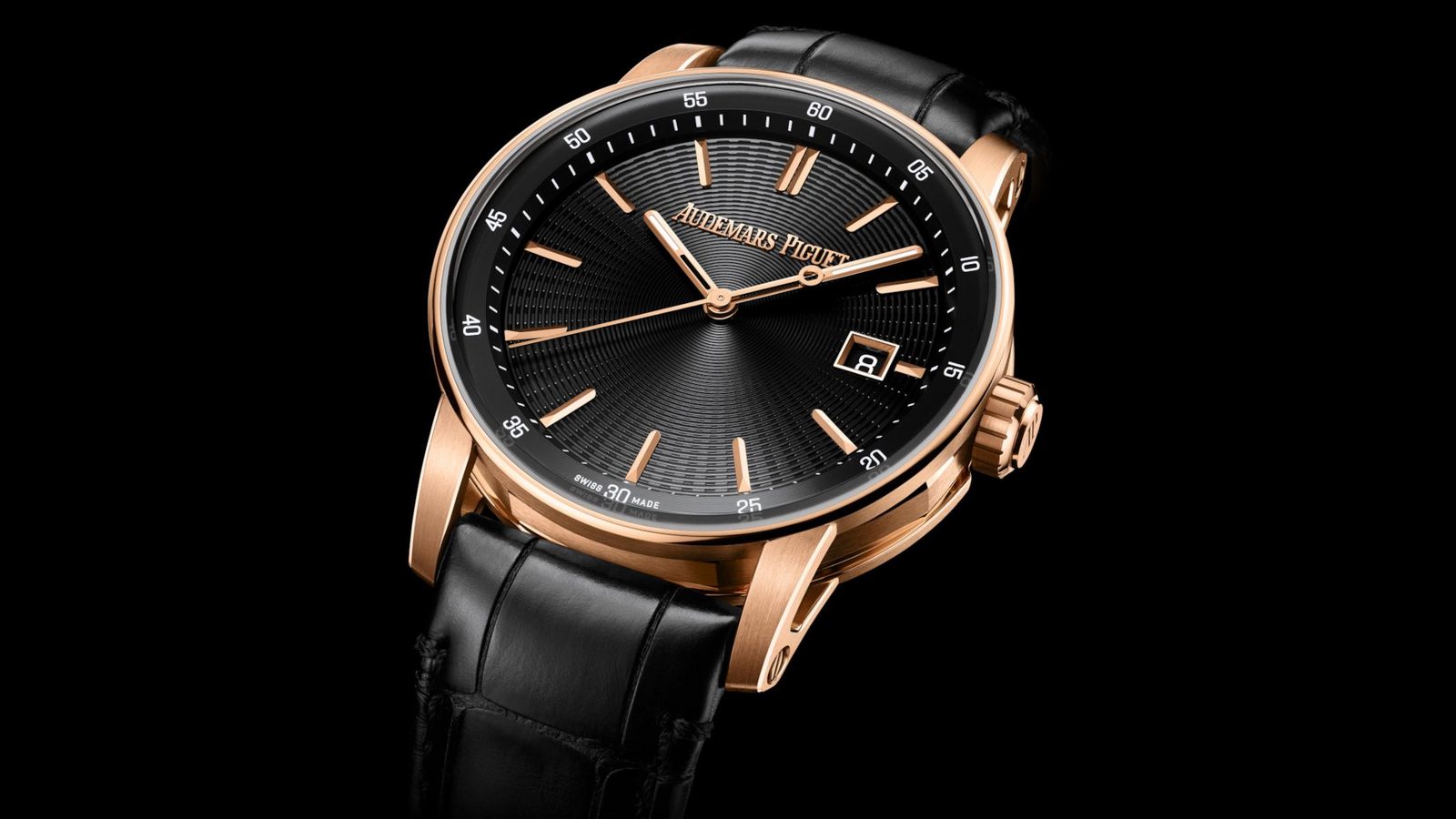

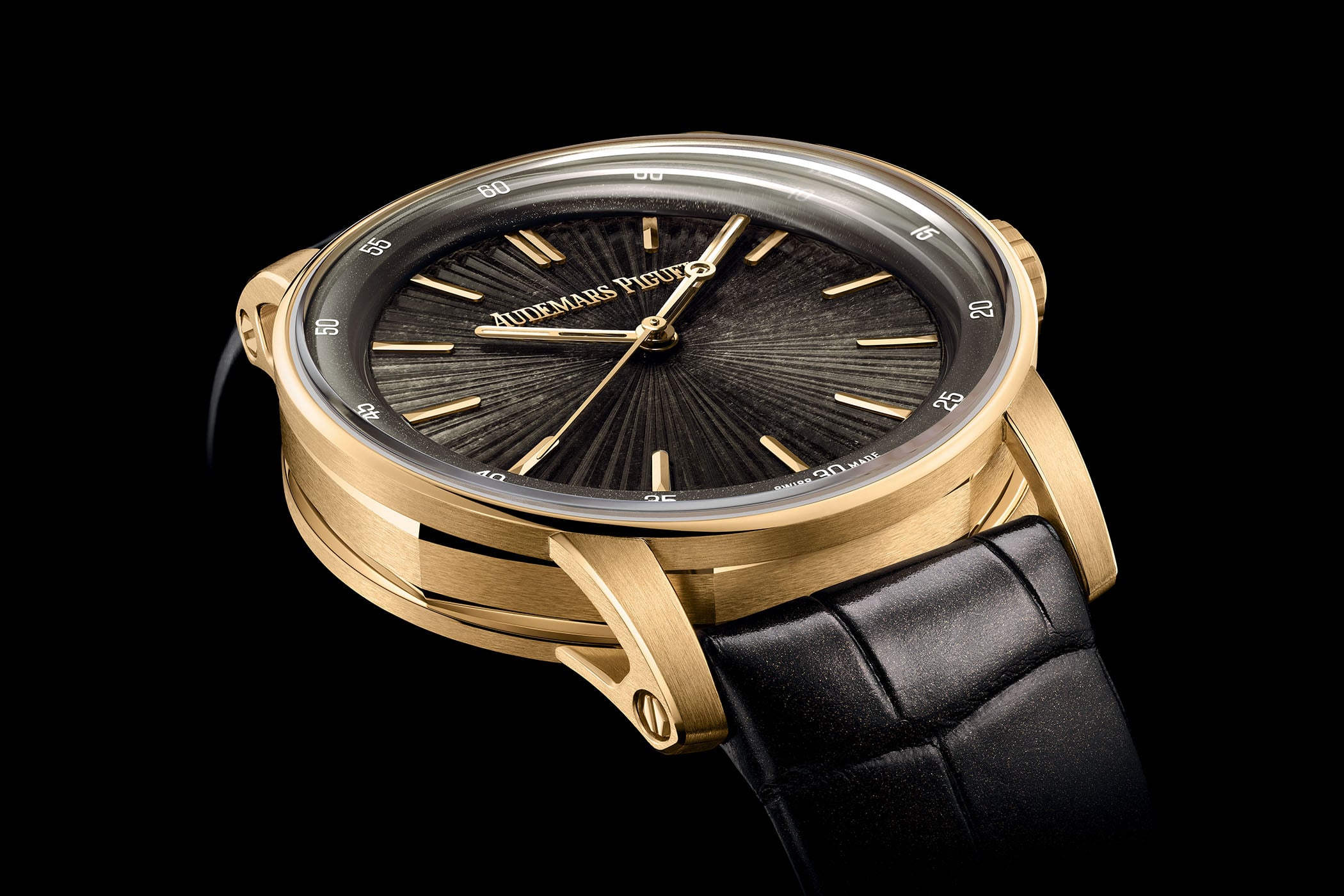
Audemars Piguet has added two stone dials to its 38mm Code 11.59 Selfwinding. One pairs an 18k yellow gold case with a natural gold obsidian dial; the other sets a black onyx dial inside pink gold. Both are time-only, dropping the date found on regular references.
The two watches follow a sequence the maison has built since 2023. The first 38mm models had stamped ripple dials in light blue, green and black, in rose gold cases. Gem-set editions came in 2024, and a natural turquoise dial in white gold followed in 2026.
Obsidian, formed through volcanic activity, gives the yellow gold reference a glass-like reflective surface. In this variety, mineral inclusions create tiny golden glints. Audemars Piguet adds a sunburst motif to the stone to draw out that texture rather than flatten it.
On that gold obsidian model, the hour markers are pink gold, and the yellow gold hands are filled with luminescent material. A shimmering brown inner bezel frames the dial. The watch is worn on a black alligator strap whose subtle sheen contrasts with the warm case.
The onyx reference is the more graphic of the two. Its black inner bezel surrounds a natural black onyx dial, mirror-polished to show the stone's deep, uniform appearance.
Onyx also carries the diamonds. The hour markers are 13 baguette-cut stones, doubled at 12 o'clock, totaling approximately 0.37 carats. The gem-setting is the main difference between the two references, and the price reflects it.
What the two watches share
Both watches share the 38mm Code 11.59 case construction. That version arrived in 2023 as a more compact, slimmer, redesigned take on the series launched in 2019. The double-curved sapphire crystal and the sapphire caseback are each treated with anti-reflective coating.
The cases measure 9.6mm thick and are water-resistant to 30m. Neither new reference carries a date indication, which sets them apart from the regular 38mm references in the family.
Powering both is the automatic calibre 5909, an AP 5900 Vaucher-based movement. It measures 26.2mm in diameter and 3.9mm thick, and it comprises 174 components and 29 jewels.
The calibre beats at 28,800 vibrations per hour and holds a 60-hour power reserve. Audemars Piguet's own description of the new watches centers on the dial materials, and it does not mention any change to the movement.
The yellow gold and gold obsidian reference is priced at CHF 45,500, while the pink gold and onyx version costs CHF 54,100, both including taxes. The onyx watch is the dearer of the pair, and it is the one with diamonds.
The pink gold watch is worn on a glossy black alligator strap. Both straps close with a pin buckle matching the case material, so the yellow gold watch has a yellow gold buckle and the pink gold one a pink gold buckle.
The maison and the price bracket
The starting price for an Audemars Piguet watch is around $17,000, though the most expensive pieces can reach over $100,000. Set against that range, both new Code 11.59 references are priced well inside the brand's upper reaches.
In our ranking of the best luxury watch brands, Rolex is first, and Audemars Piguet is in the classic trinity of haute horlogerie with Patek Philippe and Vacheron Constantin. We rank on heritage, in-house movement-making, value retention and design language.
We covered the maison's Supersonnerie earlier, a chiming complication where the chime can be seen before it is heard. These Code 11.59 references are a quieter story, and they sit within our coverage of style and watches.
Audemars Piguet has not stated production numbers or whether the two stone dials are limited. Details are on audemarspiguet.com.
Support the content you love — it’s free 🎉
Add Luxe Digital as a preferred source on Google. Our stories will be more likely to appear in Google’s Top Stories. It’s free and supports our team. Thank you!
Add as preferred sourceYou can remove us any time in Google’s source preferences.
Thank you — you’re all set 🎉
Luxe Digital is now one of your preferred sources, so our stories are more likely to appear in Google’s Top Stories.
This briefing is published daily using an AI-powered system crafted by Luxe Digital’s team and finely tuned to meet our editorial standards. While we continuously test and review the output, mistakes can sometimes happen. Tell us if you spot one.
Images: Audemars Piguet